303 Stainless Steel CNC Machining
CNC machining of 303 stainless steel: why the sulfur addition buys free machining, where the corrosion and weldability boundaries sit against 304 and 316, and what to send for a quotation.
Last updated: 2026-10-29
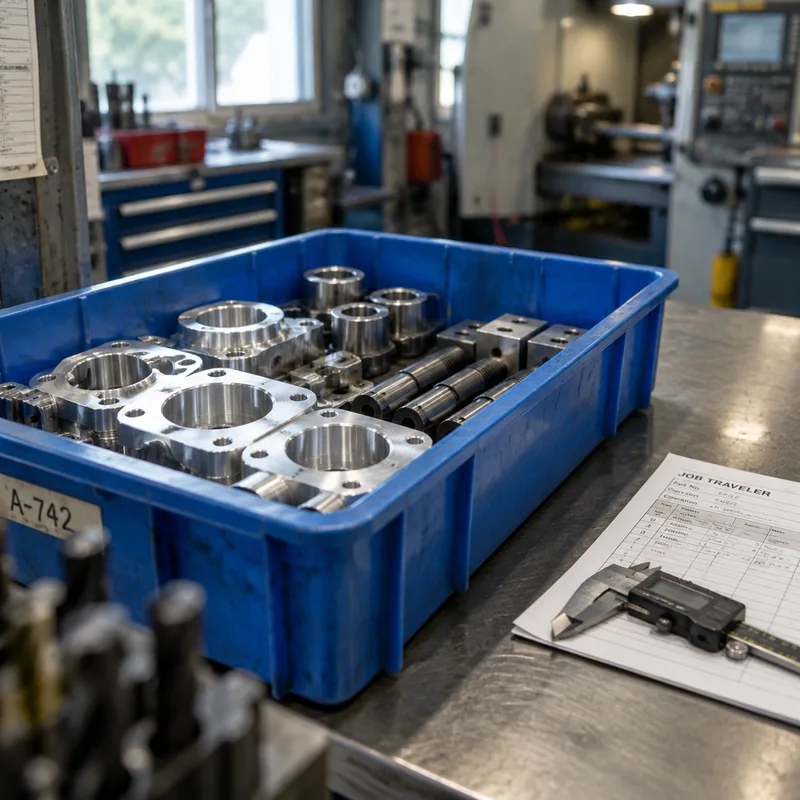
303 is the free-machining member of the austenitic stainless family: a deliberate sulfur addition breaks its chips into short, clean segments and lets production turning and milling run conspicuously faster than the same features in 304. For high-volume turned hardware — fittings, shafts, bushings, fasteners — that machinability is the entire reason the grade exists, and it is why bar-feed turning work so often starts here.
The addition has a price, and it is paid outside the cutting zone. Sulfur inclusions slightly reduce corrosion resistance relative to 304 and make the grade a poor choice for welded assemblies. The selection logic is therefore simple to state: where the part is machined, not welded, and lives in a benign atmospheric or indoor environment, 303 is the economical stainless; where corrosion service or welding enters the picture, the drawing usually belongs to 304 or the molybdenum-bearing grade instead.
Specifications
| Property | Value | Condition |
|---|---|---|
| Tensile strength | 528–639 MPa | 303, annealed bar (typical published range) |
| Yield strength (0.2% offset) | 204–280 MPa | 303, annealed bar (typical published range) |
| Youngs modulus | 192–200 GPa | 303, austenitic |
| Elongation | 35–55 % | 303, annealed |
| Hardness | Brinell 149–216 HB / Vickers 149–222 HV / Rockwell B 91–96 HRB (one source; a second reports 81–96 HRB) | 303, annealed |
| Carbon content | ≈0.15 % max | 303 composition |
| Density | Not established in the collected evidence — confirm at quotation. | |
| Corrosion resistance rating | Not established in the collected evidence — confirm at quotation. | |
Values above are rendered from the collected model-evidence layer, each carrying the heat-treatment condition it was reported under; fields without collected evidence are stated as not established rather than estimated. Requirements outside the table are confirmed for the specific geometry and batch at quotation.
Applications & Selection Points
High-volume turned and milled hardware
Fittings, adapters, shafts, valve internals, instrument components — any stainless part made in quantity on a lathe or a machining center is 303's home turf. The free-machining behavior shows up as faster cycle times, longer tool life and better surface finish on complex turned profiles, which is a direct price advantage at quantity. This is the grade to quote first when a drawing says "stainless" and the environment is benign.
Where corrosion service is the boundary
The sulfur inclusions that free the chips are also initiation sites: in chloride exposure, marine atmospheres or continuous damp service, 303 pits visibly sooner than 304, and both give way to the molybdenum-bearing grade in true marine duty. If the part sees washdown chemicals, salt spray or outdoor coastal air, the grade conversation should move up the family before the RFQ is released.
Welded assemblies are the wrong call
Sulfur also degrades hot cracking resistance, and 303 is generally excluded from welded construction for that reason. A machined-then-welded assembly specified in 303 is a specification error worth catching early — either the assembly moves to 304 with post-weld treatment planned, or the design avoids the weld. Flag it at quotation if the drawing shows both the grade and weld symbols.
Machining-behavior selection points
Expect short chips and forgiving cutting on turning and milling with standard stainless practice; the grade punishes dull tooling less than its work-hardening siblings. The buyer watch-items are surface finish on polished cosmetic features and passivation after machining — the sulfur inclusions and any free iron picked up from tooling both deserve the standard post-machining passivation treatment to restore the corrosion performance the grade does have.
Frequently Asked Questions
Is 303 as corrosion-resistant as 304?
Close but not equal: in benign indoor and atmospheric service the difference is rarely noticeable, but the sulfur addition gives 303 measurably lower pitting resistance in chlorides and damp aggressive environments. A practical rule is to treat the two as interchangeable only where the environment is mild and dry; anywhere moisture, salt or chemicals are part of the service, quote 304 or the marine grade instead.
Can 303 be used for food-contact or sanitary parts?
It appears in food equipment where heavy machining dominates, but 304 is the conventional sanitary-grade choice and many sanitary specifications name it or its lower-carbon variant explicitly. If the part carries a sanitary or regulatory callout, the governing document decides — 303 substitutions in regulated contact service are a concession conversation, not a drop-in. Confirm the requirement before quoting.
What should I send for a 303 machining quote?
The standard package: a STEP model plus a 2D drawing with tolerances, thread callouts and finish, the grade and product form named explicitly (bar diameter matters to a turned-part quote), quantity and batch intent, and any passivation or finish requirement. If the drawing shows weld symbols alongside the grade, mention it — that combination usually means the grade itself needs revisiting.
Ordering & Documentation
Documents
Send a STEP or IGES model with a 2D drawing carrying tolerances, thread callouts and the finish specification. Name the grade and product form rather than writing "stainless" — within the austenitic family the free-machining, general-purpose and marine grades look interchangeable on a drawing and behave differently in service and on the machine.
Quotation
A quote is priced from the model and drawing, the named grade, quantity and batch intent, tolerance class on critical features, and destination country. Starting bar size and stock form drive a turned-part price more than most buyers expect, so state them when fixed — or let the quote propose the stock that minimizes cutting time.
Sample & Supply
Prototype quantities from one piece are normal for machined stainless and validate thread quality, surface finish and dimensional behavior on the actual geometry before production. First-article inspection with material certification is available on request; agree the scope at quotation, especially where passivation or sanitary finish is specified.
Storage & Shipping
Machined stainless ships as-machined or passivated per the drawing; ordinary warehouse conditions suit it, though the surface should be protected from contact with carbon-steel handling gear, which can embed free iron and seed rust spots. Thread protection travels with turned parts by default, and cosmetic surfaces ship individually wrapped.