SUS304 CNC Machining (JIS Designation)
CNC machining of the JIS-designated austenitic stainless: the collected property band across annealed and cold-worked states, cryogenic service behavior, and how the designation maps in procurement.
Last updated: 2026-10-29
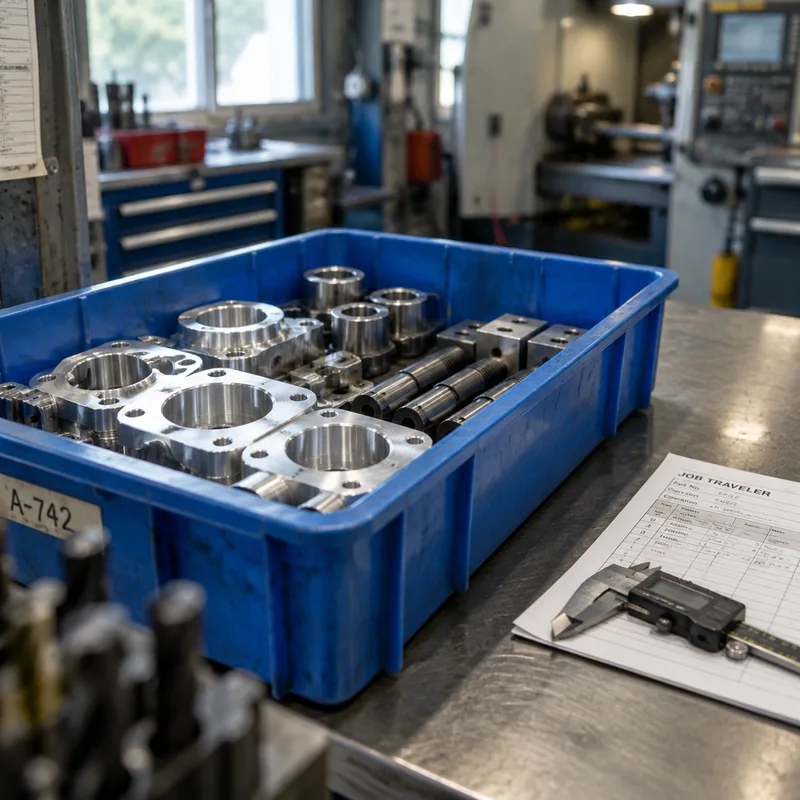
The JIS designation for the most widely used austenitic stainless steel names the same family most buyers know by its AISI counterpart, and drawings sourced from Japanese supply chains carry it as standard. Its defining trait in this collection is the width of the strength band: the annealed state sits at the bottom of the range, and cold working pushes strength — and hardness — substantially upward, which is why one grade serves both deep-drawn kitchenware and work-hardened fasteners.
Two behaviors shape the machining plan. First, the familiar austenitic work hardening: keep the cut ahead of the hardening with sharp tooling and steady feeds. Second, an unusual strength — the grade holds ductility and impact toughness at cryogenic temperature, which makes it a natural fit for liquid-gas and cold-chain hardware that ordinary steels cannot serve.
Specifications
| Property | Value | Condition |
|---|---|---|
| Tensile strength | 520–1035 MPa | annealed band; the upper end reflects cold-worked states |
| Yield strength (0.2% offset) | ≥ 205 MPa | σ0.2, annealed |
| Elongation | ≥ 40% | δ5, annealed |
| Hardness | ≤ 187 HB annealed; up to HRB 92 after cold rolling | state-dependent |
| Min service temperature | ductile at −196 °C | low-temperature impact toughness retains ductility |
| Melting point | 1398–1454 °C | |
| Thermal conductivity | 16.3 W/(m·K) | at 100 °C |
| Density | 8.0 g/cm³ (7,900 kg/m³) | austenitic, annealed |
| Fatigue strength | Not established in the collected evidence — confirm at quotation. | |
Values above are rendered from the collected model-evidence layer, each carrying the heat-treatment condition it was reported under; fields without collected evidence are stated as not established rather than estimated. Requirements outside the table are confirmed for the specific geometry and batch at quotation.
Applications & Selection Points
Food equipment and chemical containers
The classic service set: sanitary-grade food machinery, chemical storage and process containers, and the general corrosion-exposed equipment space where the grade is the default assumption. Corrosion performance in chlorides is the boundary, as with its AISI counterpart — brine and marine spray are the standard reasons to move up the family.
Cryogenic and low-temperature hardware
Hardware for liquefied gas handling and cold-chain equipment uses the grade where toughness must survive deep cold. Most steels lose impact toughness as temperature drops; this family keeps its ductility far below freezing, which is why the cryogenic world keeps specifying it even when warmer alternatives exist.
Medical instruments and building structures
Instrument bodies, surgical hardware blanks and architectural structural elements use the grade for the combination of corrosion resistance, toughness and cleanable surfaces. Medical applications add their own compliance layer — the grade is the material answer, not the regulatory answer, and the two are specified separately.
Machining behavior and the cold-work trap
Cutting behavior matches the family: work hardening, continuous chips, heat that needs flood coolant. The trap for buyers is strength assumptions — quotes priced on the annealed band can be wrong if the part will be cold-worked after machining, because both strength and hardness climb with deformation. Say on the RFQ whether the part gets formed, swaged or shot-peened afterward.
Frequently Asked Questions
Is this grade identical to its AISI counterpart?
Functionally equivalent for most procurement, but not paper-identical: the standards differ in tolerance windows and acceptance mechanics. If your supply chain certifies to one standard, buy to that standard — treating the designations as interchangeable on paper is how certification mismatches happen.
Why does the strength range on datasheets look so wide?
Because the grade strengthens dramatically under cold work: the bottom of the range is the annealed state, and deformation — rolling, drawing, forming — pushes strength and hardness upward from there. Match the datasheet row to the material state your part will actually be in.
What should I send for a quote?
Model and drawing with tolerances, the designation and certification standard, the material state that matters to you (annealed or work-hardened), service temperature if the part sees cold, finish and passivation requirements, quantity and inspection needs.
Ordering & Documentation
Documents
Send the model with a drawing naming the designation, the certification standard, and any cryogenic or post-forming requirement — both change how the material state is sourced.
Quotation
Price follows the model, tolerance class, finish and passivation, quantity, and the certification named. State the service temperature: it is the one requirement most likely to confirm or kill the grade choice.
Sample & Supply
First articles verify fit and finish; cryogenic or impact-critical parts deserve a stated acceptance test rather than an assumed one. Material certification is available on request — agree the scope at quotation.
Storage & Shipping
Ships passivated or finished per the callout; keep stainless separated from carbon-steel handling in packing to avoid free-iron staining. Store dry — warehouse conditions are harmless, damp contact is not.
Request a quote for SUS304 CNC Machining (JIS Designation) →