45# Carbon Steel CNC Machining
CNC machining of grade steel with the collected heat-treatment envelope: delivery hardness, quenched and tempered states, and what to state on the drawing so the right condition is quoted.
Last updated: 2026-10-27
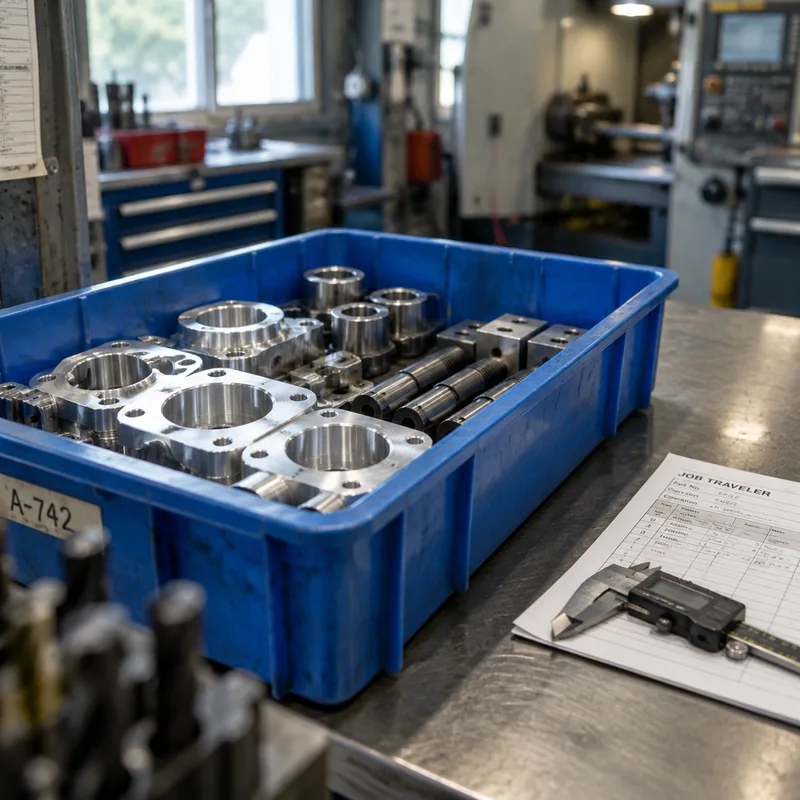
Grade steel in the medium-carbon range — written on drawings as the numbered Chinese standard grade — is the workhorse shaft and gear steel across the machining industry. It carries more strength than low-carbon stock while staying far easier to cut than alloy grades, and it responds cleanly to a standard quench-and-temper cycle, which is why medium-load components keep landing on it.
The machining plan should be chosen around the heat-treatment state. In the delivery state it cuts with predictable, chip-forming behavior; after quenching it hardens dramatically and becomes a grinding-class problem; the tempered state is where most finished parts land, trading some hardness back for toughness. Ordering machining before or after heat treatment is a genuine sequence decision, not a detail — state the intended condition when you request a quote.
Specifications
| Property | Value | Condition |
|---|---|---|
| Tensile strength | ≥ 600 MPa | structural bar, σb |
| Yield strength (0.2% offset) | ≥ 355 MPa | σs |
| Elongation | ≥ 16% | δ5 |
| Section shrinkage | ≥ 40% | ψ, reduction of area |
| Impact toughness | Akv ≥ 39 J; akv ≥ 49 J/cm² | room-temperature Charpy |
| Hardness | ≤ 197 HB delivered; HRC 55–62 quenched; HRC 42–46 tempered | state-dependent: delivery / quench (no temper) / quench+temper |
| Heat treatment | Normalizing 850 °C; Quenching 840 °C; Tempering 600 °C | standard quench-and-temper schedule |
| Density | Not established in the collected evidence — confirm at quotation. | |
| Fatigue strength | Not established in the collected evidence — confirm at quotation. | |
Values above are rendered from the collected model-evidence layer, each carrying the heat-treatment condition it was reported under; fields without collected evidence are stated as not established rather than estimated. Requirements outside the table are confirmed for the specific geometry and batch at quotation.
Applications & Selection Points
Shafts, gears and medium-load rotating parts
This is the classic home ground: transmission shafts, gear blanks, spindles and keyed couplings that see bending and torsion but not extreme duty. Machined in the tempered state, the steel balances strength against toughness well enough that general machine builders default to it. Where surfaces mate and rotate, plan for hardening the wear faces only, so the rest of the part stays machinable.
Automotive chassis and structural elements
Chassis brackets, mounting hardware and construction structural parts use the grade in or near the delivery state, relying on its strength margin over mild steel without needing the expense of alloy stock. Weldments should account for the medium carbon content — preheat and post-weld handling matter more than they do on mild steel, and strength-critical welded joints deserve a note on the drawing.
Where the heat-treatment state decides the process
Parts that need hardened bearing or wear surfaces are best rough-machined in the soft state, then hardened and ground on the critical faces. Trying to finish-cut the quenched state burns tooling and quietly loses tolerance. If your drawing shows a hardness callout, send it with the RFQ — the condition changes the process chain and the price, and assuming the wrong one is the most common requote cause on this grade.
Where it is the wrong call
Corrosion exposure without coating or plating points to stainless; impact-dominated, sub-zero service points to low-alloy toughness grades; and weight-critical parts belong to aluminum. Also treat the numbered grade and Western equivalents as similar, not identical — composition ranges and acceptance limits differ between standards, so procurement documents should name the actual specification rather than assuming a one-to-one mapping.
Frequently Asked Questions
Is the numbered grade the same as AISI/EN medium-carbon steel?
They sit in the same family and are often treated as interchangeable, but the mapping is not exact: composition windows, sulfur limits and acceptance criteria differ between standards. Use the equivalent as a starting point for quoting, then name the actual standard on the purchase documents so material certification matches what the drawing asks for.
Should machining happen before or after heat treatment?
Before, in almost every practical case: cut the part in the delivery or normalized state, then harden and temper, then finish only the surfaces that need it — usually by grinding. Finish-machining the fully quenched state is impractical with normal tooling. Put the sequence on the drawing when tolerance at a hardened face matters.
What should I send for a quote on this grade?
The STEP model and a drawing with tolerances, the heat-treatment condition you want (delivery, normalized, or quenched and tempered, with hardness if it matters), the standard to certify against, quantity, and any coating — the bare steel rusts, so plated, painted or blackened finishes are common quote items.
Ordering & Documentation
Documents
Send the model with a drawing that names the grade, the standard for certification, and the heat-treatment condition. A hardness callout without a condition is ambiguous — state the state you will accept the part in.
Quotation
Price follows the model, the condition and the process chain it implies: soft machining is ordinary work; hardening plus grinding on selected faces adds steps that are worth scoping precisely rather than assuming.
Sample & Supply
First articles are the right place to verify the tempered hardness and the critical dimensions after heat treatment, since movement during hardening is real. First-article inspection with material certification is available on request — agree the scope at quotation.
Storage & Shipping
The bare grade rusts in humid storage — parts ship oiled, phosphated, blackened or coated per the finish callout. On receipt, keep parts dry and separated; rework on rusted surfaces costs more than the coating did.