1215 Steel CNC Machining
CNC machining of 1215 steel: the lead-free free-machining carbon steel for screw-machine work, with collected property envelope and its welding and corrosion limits.
Last updated: 2026-10-31
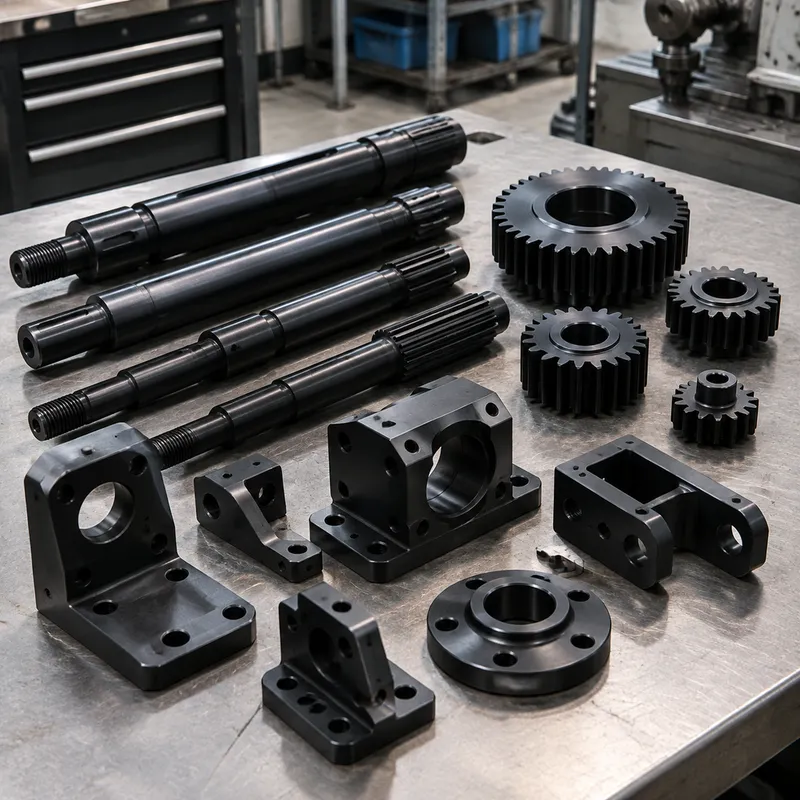
1215 is the resulfurized, rephosphorized free-machining carbon steel that answers the question 12L14 answers with lead: how to run high-volume turned steel parts fast without lead in the composition. Sulfide inclusions act as internal chip breakers, so 1215 produces short, clean chips, takes dimensional size easily on long screw-machine runs, and leaves a surface finish that usually removes secondary polishing from the plan.
The alloy is honest about its limits: it is not a hardening steel, its weldability is poor, and its corrosion behavior is ordinary carbon steel at best. It exists for machined components — fittings, bushings, couplings, threaded hardware — where the machining is most of the value and the environment is benign or coated.
Specifications
| Property | Value | Condition |
|---|---|---|
| Tensile strength | 370–415 MPa | — |
| Yield strength (0.2% offset) | 300 MPa | — |
| Elongation | 10% (in 50 mm) | — |
| Hardness | 120–180 HB (Brinell); 167 HB (second source) | — |
| Machinability rating | 136% | — |
| Weldability | Poor | — |
Values above are rendered from the collected model-evidence layer, each carrying the heat-treatment condition it was reported under; fields without collected evidence are stated as not established rather than estimated. Requirements outside the table are confirmed for the specific geometry and batch at quotation.
Applications & Selection Points
High-volume turned components
Threaded fittings, spacers, bushings, couplings and any rotational steel part with heavy removal are the designed territory of 1215. Machinability ratings place it among the fastest-cutting steels on the standard chart scale, which converts directly into cycle time on volume work — the dominant cost line on screw-machine parts.
Lead-free requirement — 1215 versus 12L14
12L14 historically dominated free-machining steel, but its lead addition is restricted in drinking-water, food-contact and some consumer applications. 1215 delivers most of the same machining behavior with no lead, at a modest speed penalty. Where the application or market forbids lead, 1215 is the standard substitution — and the restriction belongs on the RFQ explicitly so the alloy proposal respects it.
Welding is the wrong join for 1215
The sulfur and phosphorus that make 1215 cut fast also make it hot-short: welded joints crack-prone and weak. Parts that get welded should not be 1215 — the usual structure is a welded assembly in a weldable grade with 1215 confined to the machined screw-in components. If a drawing mixes both, flag it at quotation; it is a common and fixable specification slip.
Strength and hardening positioning
1215 carries moderate strength for a low-carbon steel and cannot be through-hardened — case hardening is its only route to a hard surface, and even that interacts poorly with its machinability additions in some processes. For parts needing heat-treated strength or hard surfaces, medium-carbon or alloy steels take over; for hardware whose loads a bolt would also survive, 1215 buys cycle time with strength to spare.
Corrosion protection belongs in the plan
Bare 1215 rusts like any unalloyed carbon steel, so plated, zinc-coated or black-oxide finishes are part of the specification rather than an option. Fastener-style coatings run routinely on 1215 components. State the service environment at quotation so the coating choice matches it rather than defaulting to the cheapest available.
Frequently Asked Questions
Is 1215 a good substitute for 12L14?
For most turned hardware, yes — it is the standard lead-free alternative, with slightly reduced machining speed and similar strength. Where the application touches potable water, food or a market that restricts lead, 1215 is not just a substitute but the compliant answer. Confirm the substitution with the drawing owner when the drawing names 12L14 explicitly.
Can 1215 parts be case hardened?
Low-carbon steel responds to case-hardening processes in principle, but the free-machining additions complicate some routes, and the strength underneath the case remains that of a low-carbon steel. Parts that genuinely need hardened surfaces plus core strength usually move to a medium-carbon or alloy grade. Ask the application question before the process question.
Why does my 1215 part rust in storage?
Because it is plain carbon steel with no corrosion resistance of its own. Uncoated 1215 needs dry storage and benefits from oil film or wrapped packaging; parts specified with plating or black oxide resist ordinary atmospheres. Recurring rust on finished parts usually traces to a missing or too-thin coating callout, not a material defect.
What should I send for a 1215 machining quote?
A STEP model, a 2D drawing with tolerances, threads and coating, quantity and batch bands, and any composition restrictions (lead-free is assumed for 1215, but state the driver). Batch size drives the economics on screw-machine work — honest bands get materially better pricing.
Ordering & Documentation
Documents
Send a STEP or IGES model with a 2D drawing carrying tolerances, thread callouts and the coating specification. If the drawing names 12L14 and the market requires lead-free, mark the substitution status on the RFQ.
Quotation
Pricing follows the model and drawing, the named grade, quantity bands and finish. Coating is part of the price on 1215 work — specify it rather than leaving bare parts to rust in your own warehouse.
Sample & Supply
First articles on turned hardware validate threads, coatings and size retention across a realistic run length. Certification of the composition against the lead-free requirement is available on request.
Storage & Shipping
Ship and store machined 1215 dry; bare surfaces should carry an oil film or wrap for any extended storage. Coated parts tolerate ordinary warehouse conditions; recurring rust is a coating-spec question, not a material one.