Mild Steel CNC Machining
Machining mild steel: the collected grade envelope for 1018, 1020 and A36, how the grades differ on paper and in the cut, and what to send for a quotation.
Last updated: 2026-10-29
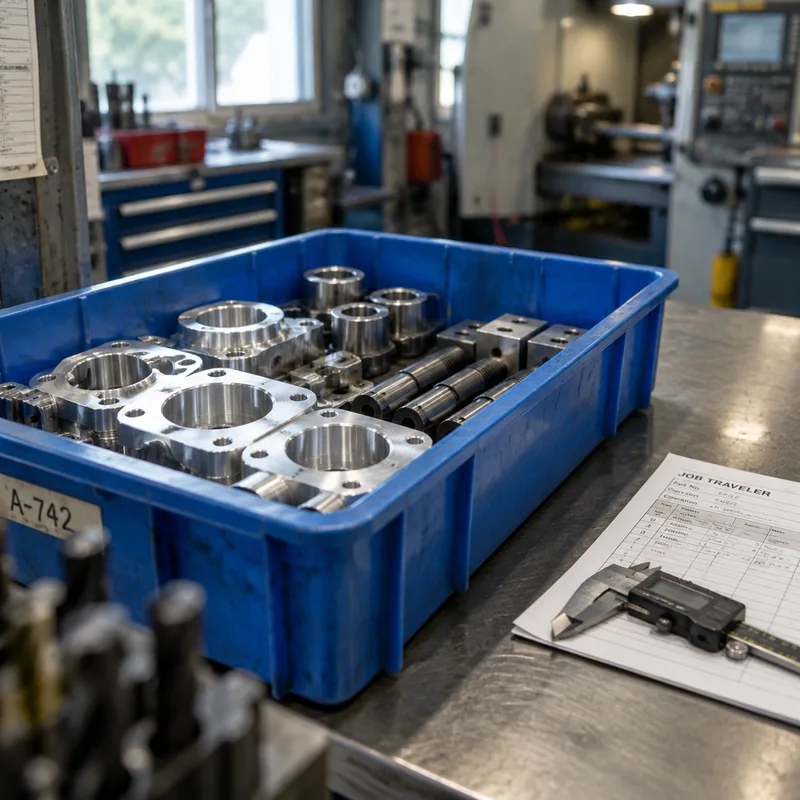
Mild steel is the low-carbon backbone of general machining: cheap everywhere, predictable in the cut, weldable without ceremony, and strong enough for most non-critical hardware. In practice the name covers a small set of grades — 1018, 1020 and A36 are the common ones — whose paper differences look trivial until a drawing cares about formability, machined finish or certified properties.
The grades are not interchangeable at the margin. 1018 is the machined-finish and cold-drawn favorite; 1020 splits the difference; A36 is the structural plate grade whose strength numbers sit lowest and whose mill-to-mill variation is widest. Critical components should carry a material test report regardless of grade — the values vary with mill source and heat, and the certificate is what turns a nominal property into a contractual one.
Specifications
| Property | Value | Condition |
|---|---|---|
| Common grades | 1018, 1020, A36 | verify mill certifications per lot; MTRs requested for critical components per the source |
| Yield strength by grade | A36 ≈250 / 1020 ≈350 / 1018 ≈370 MPa | approximate mill-condition values; source cautions values vary with mill source and heat |
| Tensile strength by grade | A36 ≈400 / 1020 ≈410 / 1018 ≈440 MPa | approximate mill-condition values from the same grade table |
| Hardness by grade | ≈70–80 HRB (1018 ≈70, 1020 ≈72, A36 ≈80) | approximate mill-condition values from the same grade table |
| Machinability rating | ≈78% | 1018 cold-drawn/cold-rolled; AISI 1212 = 100% |
| Max stock dimensions | Not established in the collected evidence — confirm at quotation. | |
| Surface finish capability | Not established in the collected evidence — confirm at quotation. | |
Values above are rendered from the collected model-evidence layer, each carrying the heat-treatment condition it was reported under; fields without collected evidence are stated as not established rather than estimated. Requirements outside the table are confirmed for the specific geometry and batch at quotation.
Applications & Selection Points
General hardware, brackets and fixtures
Brackets, mounting blocks, fixture bodies, spacers and machine hardware are mild steel home ground: the loads are modest, the environment is benign or painted, and the alloy costs less than everything with a spec sheet. Cold-drawn 1018 bar machines to a clean finish for exposed surfaces; A36 plate covers the larger structural pieces.
Choosing between the grades
A36 is the structural workhorse with the lowest strength band of the three; 1020 sits between; 1018 delivers the best combination of machined finish and dimensional consistency in cold-drawn form. If the drawing names a grade, honor it; if the buyer asks for "mild steel", the honest question is which property matters — finish, formability or certified strength — and the grade follows from that.
Welded machine frames
Low carbon content makes every grade in this family weldable with standard practice — the reason welded frames, bases and enclosures start here. The usual sequence is weld, stress-relieve or straighten as needed, then machine the critical surfaces so the machined features reference a stable finished structure.
Corrosion protection is part of the plan
Mild steel rusts; the finish is not optional in most service. Zinc plating, black oxide with oil, powder coat and paint are the standard answers, chosen by environment and cost. Machined tolerances should anticipate coating thickness on mating features — a plated bore is not the same bore it was before plating.
Frequently Asked Questions
Which mild steel grade should my part use?
Default to 1018 for machined parts where finish and dimensional consistency matter, A36 for larger structural pieces cut from plate, and 1020 in between. The nominal strength differences are real but modest; the practical differences show up in cold-drawn versus hot-rolled form, surface quality and price. Critical components should specify mill test reports either way.
Why do published property values differ between sources?
Because the values vary with mill source and heat — the grades are defined by composition ranges, not guaranteed properties. A published table is a planning envelope, not a certificate. When a number on the drawing is contractual, the material test report for the actual heat is the document that carries it.
What should an RFQ for mild steel parts include?
The model and drawing with tolerances, the named grade and form (cold-drawn bar, hot-rolled plate, tube), coating requirements, quantities, and whether material test reports are required. Naming the grade avoids the substitution question entirely; leaving it open should state what property actually matters.
Ordering & Documentation
Documents
Send a STEP model with a dimensioned drawing that names the grade and form, carries tolerance callouts, and marks the surfaces that get coated. If the part welds before machining, say so — the sequencing changes the plan.
Quotation
A quote is priced from stock size and form, machining content, coating and quantity. Coating thickness on mating features and post-weld machining are the two line items most often missed on first mild-steel quotes.
Process plan
Expect roughing, finishing and coating in that order, with welded parts adding stress relief or straightening before final machining. Sharp tooling and steady feeds carry the cut — mild steel punishes rubbing with built-up edge like any ductile material.
Sample & Supply
First articles confirm machined finish and coated dimensions before the batch runs. Material test reports and traceability per lot are available on request — the standard practice for critical components; agree the documentation scope at quotation.