CNC Machining Service
CNC machining for prototypes and production parts: tolerances to sub +/- 0.001", milled parts up to 80" x 48" x 24" and lathe work to 62" x 32", in metals and plastics, finished and inspected to print.
Last updated: 2026-10-26
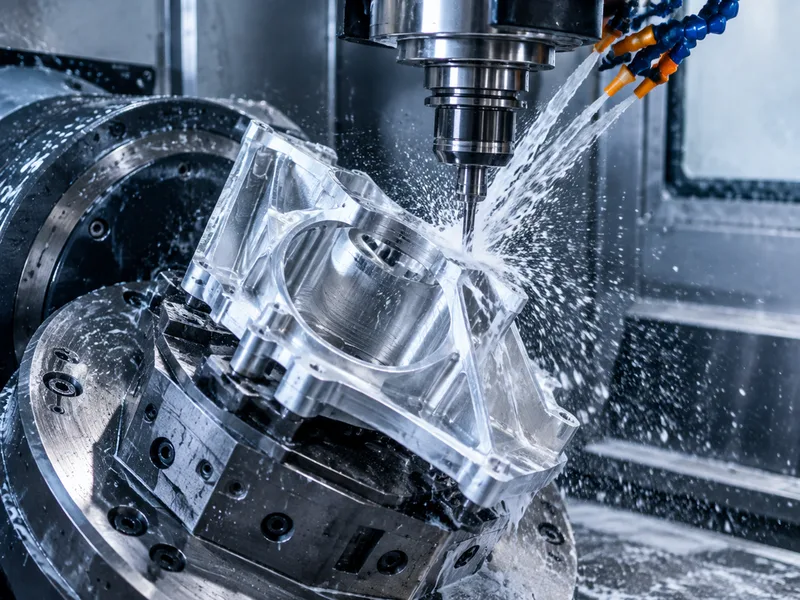
CNC machining is the umbrella process family — milling, turning, drilling and finishing — that converts a digital model into a finished metal or plastic part by programmed material removal. It is the process behind most one-off prototypes and low-to-mid volume production parts across industrial equipment, electronics, automotive, medical and robotics, because it holds geometry to print without the tooling cost that casting and molding carry.
The catalog envelope spans milled parts up to 80" x 48" x 24" (2,032 x 1,219 x 610 mm), lathe parts up to 62" (1,575 mm) length and 32" (813 mm) diameter, tolerances from +/- 0.005" (±0.127 mm) and 0.01 mm down to sub +/- 0.001" on critical features, and 3–7 business day lead times on typical jobs. The finishing catalog is correspondingly broad — anodizing, plating, chem film, black oxide, passivation, electropolishing, powder coat, media blasting and polishing among them.
Specifications
| Specification | CNC Machining Service |
|---|---|
| Max Part Size | Milled parts up to 80” x 48” x 24” (2,032 x 1,219 x 610 mm); Lathe parts up to 62” (1,575 mm) length and 32” (813 mm) diameter |
| Axes | 3, 4, or 5 |
| Lead Time | 3-7 business days |
Materials
Surface Finishes
High-volume CNC machined prototypes and production parts in days, with tolerances down to sub +/- 0.001" and a wide range of metals and plastics.
Values above are the collected catalog specification envelope for this product family. Tolerances and lead times at the demanding end of a range are confirmed for the specific geometry, material and batch at quotation.
Applications & Selection Points
Prototype to production on one process
The defining advantage of machining is continuity: the prototype that validates the design is made by the same process that makes production lot 1, so validation data transfers. Compare injection molding, where the prototype is a different process (3D printing or urethane) and the production tool is a separate purchase decision. Machining carries that flexibility at every batch size.
Tolerance placement strategy
The envelope allows sub +/- 0.001" — but that class belongs on bearing seats, sealing surfaces and alignment features, not on the body of the part. The quoted 0.01 mm and +/- 0.005" bands cover most functional features. Cost tracks the number of simultaneously tight features; a print with three critical callouts prices very differently from one with thirty.
Metals and plastics side by side
The material range covers aluminium alloys (6061/6061-T6, 2024, 5052, 5083, 6063, 6082, 7075/7075-T6, ADC12), steels and stainless steel, copper, bronze, brass, magnesium and titanium, plus a deep polymer list from ABS, PC and PMMA through POM, PA (nylon), PEEK, PPS and PTFE. Enclosures that mix a metal base with a plastic insulator can be machined as a matched pair in one order.
Finishing and inspection in the same order
Specify finish with the part — anodizing for aluminium corrosion and wear, chem film where conductivity matters, plating and black oxide for steel, passivation for stainless, plus painting, powder coat, blasting and polishing for cosmetic surfaces. Inspection evidence (dimensional reports, first articles) is part of the same order package, agreed at quotation.
Frequently Asked Questions
CNC machining vs 3D printing — when does each win?
Machining wins on tolerance, material properties (wrought metal versus sintered or printed polymer), and surface finish; printing wins on geometries a tool cannot reach and on some very small batches. For metal functional parts that carry load or seal, machining is the default; use metal 3D printing when the geometry — lattices, internal channels — is impossible to machine, and compare explicitly when it is merely difficult.
What tolerance should I specify by default?
Use a standard general tolerance and call out criticals. Within the catalog envelope, 0.01 mm to +/- 0.005" covers most functional features; reserve sub +/- 0.001" for named seats and seals. Every tight callout must earn its place in the assembly function — that is the single biggest cost lever a drawing reviewer controls.
What information does a machining quote need?
STEP model plus 2D drawing with tolerances and threads; material and temper; quantity and batch intent (prototype now, production later changes scheduling); finish callout; inspection requirements, if any; and destination country. Quantity is a first-class input, not an afterthought — batch size moves the per-piece price more than most design changes do.
Ordering & Documentation
Documents
Order package: 3D model, dimensioned drawing, material and finish spec, and any inspection requirements. For repeat parts, keep a released drawing revision per order so first-article comparisons stay against the same revision.
Quotation
Quotes are built from model, drawing, material, quantity, tolerance class, finish and destination. Where the drawing is ambiguous — an undefined thread, an unlabeled finish — the quote states its assumption instead of guessing silently.
Sample & Supply
One-piece prototypes through production batches, with the 3–7 business day band typical for standard jobs. First-article approval before production lots is the recommended sequence and is schedulable within the same order.
Storage & Shipping
Parts ship protected per finish: oiled or wrapped bare steel, separated layers for cosmetic surfaces. Store machined parts indoors and dry; for long-term storage of bare steel and cast aluminium, keep the transit wrapping until installation.