Sheet Metal Fabrication
Custom sheet metal fabrication: laser cutting, bending, tapping, countersinking, welding and finishing in aluminum, stainless, brass and steel — lead times from 3 days, plates up to 800 mm.
Last updated: 2026-10-26
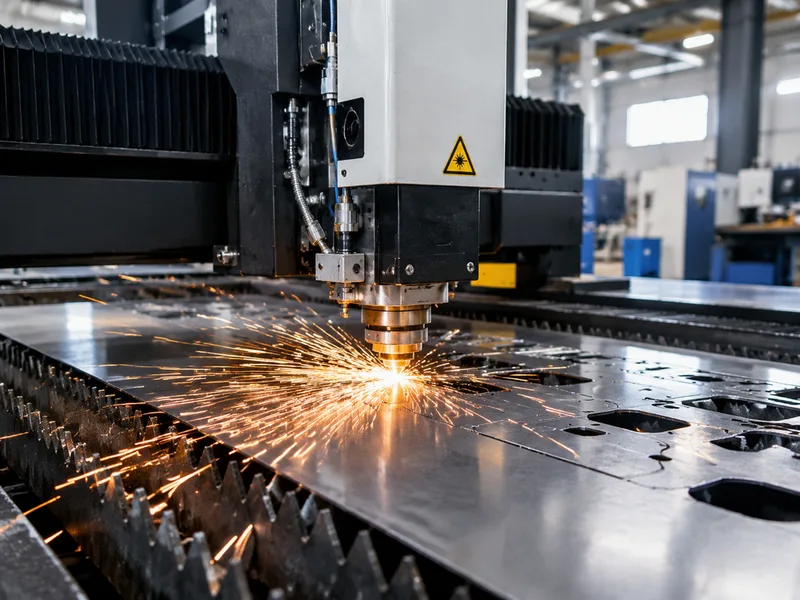
Sheet metal fabrication turns flat stock into finished enclosures, brackets, panels and chassis by cutting (laser), forming (press brake), and joining (welding, tapping, countersinking), then finishing. It is the cost-efficient process for thin-walled parts: a machined-from-solid enclosure and a folded-sheet enclosure can be functionally equivalent, at materially different prices.
The catalog envelope covers ±0.1 mm accuracy on plates up to 800 mm, with lead times from as fast as 3 days (aluminium) through 5 to 7 days (stainless). Materials span aluminium, stainless steel, brass, cold-rolled and galvanized steel. The finishing list is one of the widest in the catalog — anodizing (Type II, III, III+PTF, hardcoat, conductive), zinc plating, alodine/chem film, passivation, powder coat, silkscreen, laser marking, brushing and more.
Specifications
| Specification | Sheet Metal Fabrication |
|---|---|
| Tolerance | ± 0.1 |
| Max Part Size | 800mm |
| Lead Time | As fast as 3 days; As fast as 5 days; As fast as 7 days |
Materials
Surface Finishes
Custom sheet metal fabrication service offering laser cutting, bending, tapping, countersinking, welding, and finishing across materials including aluminum, stainless steel, brass, and cold rolled/galvanized steel. Lead times range from as fast as 3 days for aluminum to 7 days for stainless steel.
Values above are the collected catalog specification envelope for this product family. Tolerances and lead times at the demanding end of a range are confirmed for the specific geometry, material and batch at quotation.
Applications & Selection Points
Enclosures, chassis and panels
Electronics enclosures, machine guards, control panels and equipment chassis are the core sheet-metal product family. The design levers are gauge selection against stiffness, bend radii matched to standard tooling, and feature placement away from bend lines — a hole too close to a bend distorts when the bend forms.
Bend design and tolerance reality
The ±0.1 mm class applies to formed features within a stable process; across multiple bends, accumulated angular variation becomes the governing tolerance. Bend allowance and K-factor determine the flat pattern, and parts whose critical dimensions span several bends should have their tight callouts on the dimensions the brake actually controls.
Material choice by environment
Indoor dry service: cold-rolled steel, finished or painted. Outdoor or corrosive: galvanized steel, powder-coated steel, aluminium (anodized) or stainless. Food and medical contact surfaces: stainless with passivation. The material decision is an environment decision first and a cost decision second — the finishing list exists to close the gap where the base metal needs help.
Fast turnaround brackets and prototypes
Cut-and-form parts without welding carry the fastest cycle in the catalog — the 3-day aluminium lead time is real for straight cut-bend-finish parts. Prototype enclosures built this way validate fit before any commitment to stamping tooling at volume.
Hardware and integration features
Fabricated parts usually integrate hardware: PEM-style self-clinching studs and standoffs, tapped holes, weld nuts, countersinks for flush fasteners, and cutouts sized to standard connectors. Hardware goes in before or after bending depending on its position relative to the bend, and the placement tolerance it needs decides whether it lands in the flat or formed state. Count the hardware on the drawing and quote it explicitly — fasteners are a per-piece cost line, and unlisted hardware is where enclosure quotes quietly diverge.
Frequently Asked Questions
Sheet metal vs CNC machining for my part?
Compare at equal function: a thin-walled part (roughly 0.5–6 mm) with large surface area is almost always cheaper fabricated from sheet, because you pay for the outline, not the block. Solid, thick, or prismatic parts with 3D features route to machining. The crossover shows up on parts between 6 and 12 mm thick with deep formed features — worth quoting both ways.
Which tolerance can formed sheet metal hold?
The catalog states ±0.1 mm accuracy. Within one bend, that holds; across a chain of bends, angular variance accumulates and the practical tolerance widens. Design so that critical interfaces (mounting holes, connector cutouts) sit on the first bend or on the flat, and let cosmetic flanges carry looser callouts.
What does a fabrication quote need?
A 3D model (STEP) or flat pattern with material and gauge, quantity, finish callout, and hardware requirements (PEM inserts, taps, weld nuts) marked on the drawing. Thickness and material together decide tooling; finish decides lead time — the 3/5/7-day band maps to material and finish combinations.
Ordering & Documentation
Documents
STEP model or DXF flat pattern plus a drawing marking gauges, bends, hardware and finish. Weldments need a weld-symbol spec. Inspection or flat-pattern reviews are requestable before release for formed parts with tight feature-to-bend relations.
Quotation
Pricing inputs: material and gauge, part size against the 800 mm envelope, number of bends and welds, hardware count, finish, quantity and destination. The lead-time band (3–7 days) is material/finish dependent and confirmed per quote.
Sample & Supply
Prototypes from single pieces; production runs on the same cut-and-form line with consistent tooling. Bridge quantities between prototype and stamped production are a normal intermediate step — quote them before committing to stamping tooling.
Storage & Shipping
Finished sheet parts ship nested where surfaces allow, separated where cosmetic. Powder-coated and anodized surfaces scratch — ship masked or interleaved. Galvanized and bare steel parts store dry; stainless and aluminium are forgiving but should not be stored in contact with bare carbon steel (cross-contamination marks).