Metal Stamping
CNC punching and stamping for sheet metal parts: ±0.1 mm punching accuracy, plate to 6 mm thick and 800 mm, louver/package/countersunk/rib forming, with finishing from anodizing to silkscreen.
Last updated: 2026-10-26
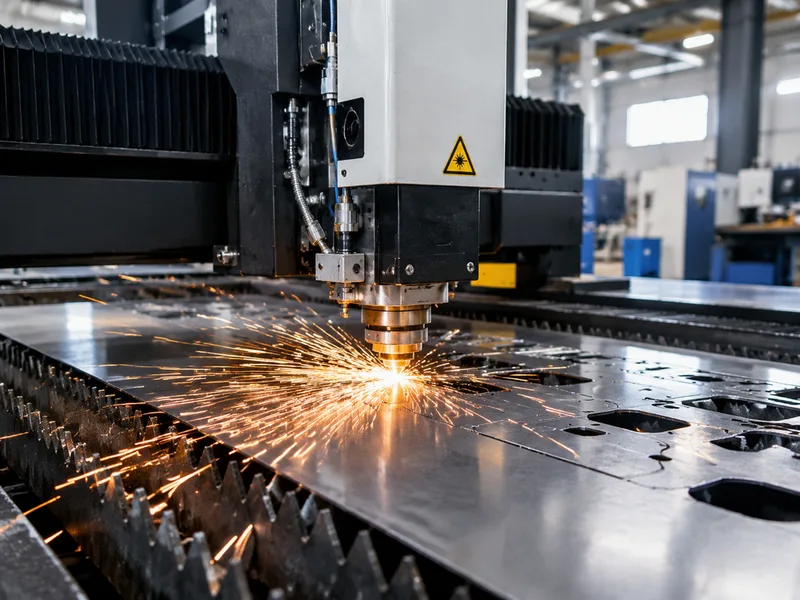
Metal stamping (CNC punching/turret pressing) forms and pierces sheet metal in stroke-cycle operations. Compared with laser cutting, it trades tooling lead time for per-hit speed: once the tooling exists, holes and forms arrive in fractions of a second, which is why stamping is the volume route for brackets, chassis, panels and carriers.
Because every hole and form is a tooling decision, the drawing review at quotation carries more weight here than in cutting processes: hole sizes that match standard punches, feature spacing the die can hold, and formed features that release from the punch all keep the tool simpler and the per-part price lower. The catalog envelope covers ±0.1 mm punching accuracy on plates up to 6 mm thick and 800 mm, with forming capability including louvers, convex packages (embosses), countersunk holes and rolling ribs — features a cutting laser cannot make. The finishing list covers anodizing (including hardcoat and conductive), brushing, powder coating, silkscreen and laser marking.
Specifications
| Specification | Metal Stamping |
|---|---|
| Tolerance | ±0.1 |
| Max Part Size | 800mm |
Materials
Surface Finishes
CNC punching/stamping service for sheet metal parts, offering louver, convex package, countersunk hole and rolling rib forming with ±0.1 punching accuracy on plates up to 6mm thick.
Values above are the collected catalog specification envelope for this product family. Tolerances and lead times at the demanding end of a range are confirmed for the specific geometry, material and batch at quotation.
Applications & Selection Points
Volume production of formed sheet parts
Parts that laser-cut and brake-form fine at 50 pieces price very differently at 50,000 — stamping carries the volume economics. The decision input is the tooling-versus-volume curve, so bring the annual volume to the quote, not just the drawing.
Formed features cutting cannot make
Louvers (vent geometry), embossed packages (stiffness without weight), countersunk holes (flush fasteners) and rolling ribs (panel stiffness) are formed operations. Designs that need these features route to stamping even at moderate volumes, because the alternative is adding hardware.
Thickness and envelope
The process window — plate to 6 mm thick, parts to 800 mm — covers most electronics chassis, appliance brackets and industrial panels. Beyond 6 mm, fine-blanking or machining takes over; above 800 mm, panel tooling and press capacity are confirmed per part.
From prototype to stamping without a dead end
The standard sequence is laser-cut prototypes to validate the design, then stamping tooling for production. Design the prototype with stamping in mind (bend radii, hole-to-bend distances, grain direction) and the transition does not force a redesign.
Tooling type follows volume and feature mix
Not every stamping job needs progressive tooling: single-hit and stage tooling cover lower volumes and simpler feature sets at a fraction of the die cost, while progressive dies carry the strip through all stations at production speed. The feature mix decides too — parts that only pierce and form in one direction can stay in cheaper tooling far longer than parts needing CAM-actuated side actions. Matching tooling class to the honest volume forecast is where most stamping budgets are won or lost.
Frequently Asked Questions
Stamping vs laser cutting — where is the crossover?
Laser cuts any geometry with no tooling; stamping amortizes tooling across volume and adds formed features. Below roughly a few hundred pieces, laser wins on flexibility and lead time; at sustained volume, per-part stamping cost drops below laser and the tooling pays back. The exact crossover is per-part — quote both when annual volume is uncertain.
What accuracy does punched sheet hold?
The catalog states ±0.1 mm punching accuracy. Hole-to-hole positions within one nest hold that band; dimensions spanning multiple stations or formed features accumulate variation like any sheet process. Keep critical hole patterns in one station where possible and put tight callouts where the tooling actually controls them.
What does a stamping quote need?
Part model/drawing with material and thickness, annual and per-lot volume, formed features marked (louvers, embosses, countersinks), hardware requirements, finish, and destination. Volume accuracy is the decisive input — the tooling decision and the per-part price both hang on it.
Ordering & Documentation
Documents
Part drawing with formed features specified, material and gauge, hardware and finish callouts, and volume forecast. Tooling design (strip layout, stations) is a review step before tool cut — plan an approval cycle there for production tools.
Quotation
Quotes separate tooling from per-part price, with per-part price stepped by volume. Inputs: geometry, thickness, formed-feature count, finish, quantities and destination. Ask for the price at two or three volumes — the curve is the decision input, not a single point.
Sample & Supply
First samples come from the production tooling and anchor the run approval: dimensional report against the drawing plus formed-feature check. Blanket orders with call-off deliveries are a normal arrangement once the tool is approved.
Storage & Shipping
Stamped parts ship nested — the same property that makes them cheap makes them scratch-prone, so cosmetic surfaces ship interleaved or bagged. Bare steel parts need dry storage; finished parts (anodized, powder-coated) store like any coated hardware, away from abrasion.