Laser Cutting
Laser cutting service for flat sheet metal: ±0.005" tolerance, material to .750" thick, 1–3 business day turnaround, clean edges on thin stock with aluminium, steel and AR plate capability.
Last updated: 2026-10-26
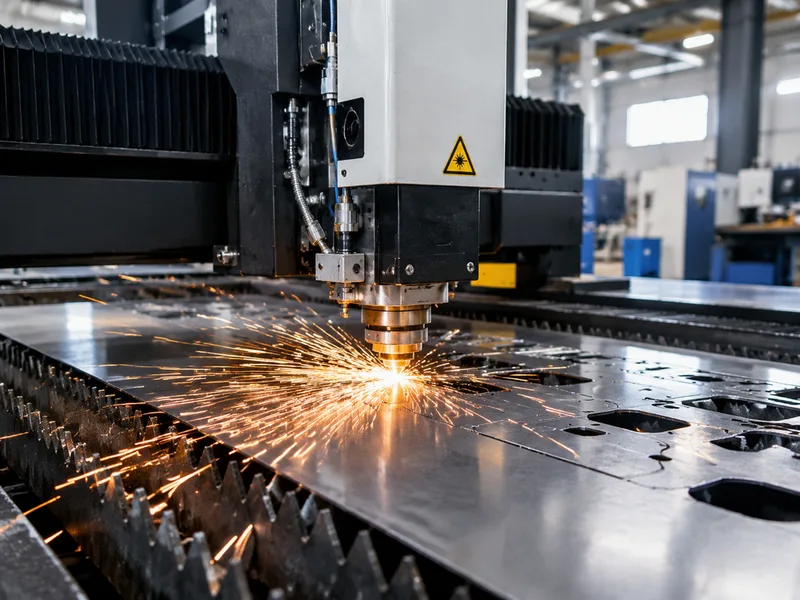
Laser cutting converts flat sheet into finished part geometry with a focused laser beam and assist gas — no tooling, no fixturing, and a file-to-part cycle measured in days. It is the fastest and most precise of the common sheet-cutting options on material up to .750" thick, and the standard first step of any sheet metal fabrication order.
The catalog envelope covers ±0.005" tolerance, 1–3 business day lead times, and a material list running from 2024-T3, 5052-H32, 6061-T6, 7075-T6 and MIC-6 aluminium through AR400/AR500 abrasion-resistant plate. Edge character varies with thickness: clean on thin stock, with striations and an abrasive edge above .187", where deburring is worth adding if the edge is cosmetic or handled.
Specifications
| Specification | Laser Cutting |
|---|---|
| Tolerance | ±0.005″ |
| Lead Time | 1–3 business days |
Materials
Surface Finishes
A precision sheet metal cutting process that uses a laser to turn flat material into finished part geometry, ideal for tight tolerances, small features, and fast production. It is the fastest, most precise option for metal up to .750″.
Values above are the collected catalog specification envelope for this product family. Tolerances and lead times at the demanding end of a range are confirmed for the specific geometry, material and batch at quotation.
Applications & Selection Points
Flat parts with tight small features
Gaskets, shims, mounting plates, brackets and perforated panels are the natural laser job: small holes and fine features cut at ±0.005" without tooling. Feature size scales with material thickness — hole diameters below roughly the material thickness need a feasibility check rather than an assumption.
Fast prototypes and bridge quantities
Because there is no tooling, one piece and one thousand pieces cut from the same file. The 1–3 business day band makes laser cutting the standard route for validating a flat design before committing to forming, stamping tooling, or a production run.
Abrasion-resistant plate work
AR400/AR500 wear plates, wear liners and backup strips are cut in the hardened state — the alternative (flame or plasma) carries a wider kerf and heat-affected zone. Wear-part profiles that must bolt up to existing equipment benefit directly from the ±0.005" class.
Edge quality as a specification
Treat the edge as a spec, not an accident: thin stock cuts clean; above .187" expect striations and an abrasive edge. Where parts are handled or the edge is visible, add deburring to the quote; where the edge welds into an assembly, leave the as-cut condition and note it on the drawing.
Nesting and material utilization
Because the part cost carries the sheet area it consumes, nesting efficiency is a real price lever: parts arranged to share cut lines and fit standard sheet formats waste less material. Designers influence this more than they expect — tab width, part spacing, and whether mating pairs can mirror on the sheet all change yield. If volume makes material the dominant cost, say so in the RFQ; a small geometry adjustment at the unconstrained edges of the outline can pay back on every sheet consumed after it.
Frequently Asked Questions
Laser cutting vs stamping vs waterjet — how do I choose?
Laser wins on precision, small features and tooling-free turnaround in flat stock up to .750". Stamping wins at high volume once tooling amortizes, and it forms at the same stroke. Waterjet cuts thick or non-metallic material without a heat-affected zone. For prototypes and low-to-mid volumes in metal sheet, laser is the default; revisit at volumes where per-part tooling amortization flips the economics to stamping.
How thick can you laser cut, and what happens to the edge?
The catalog covers metal up to .750" thick. Edge condition tracks thickness: thin stock comes off clean; above .187" the edge shows striations and an abrasive condition from the assist-gas process. If the edge is functional (a mating surface) or cosmetic, spec deburring or edge finishing explicitly — it is a quoted operation, not a default.
What does a laser cutting quote need?
A DXF/DWG flat pattern or 3D model to unfold, material and thickness, quantity, any bend/hardware operations if the order extends past flat cutting, and destination. State which edges matter — "all edges deburred" prices differently from "as-cut" and prevents both surprises at receipt and over-specification in the quote.
Ordering & Documentation
Documents
DXF flat pattern is the ideal input; STEP models are unfolded at quotation. Mark material, thickness, grain direction if relevant for formed parts, and any edge-finishing requirements on the drawing.
Quotation
Pricing inputs: sheet material and thickness, part outline and cut length, hole count and minimum feature size, quantity and destination. Lead time quotes at 1–3 business days for standard flat work; forming and finishing operations add their own steps to the schedule.
Sample & Supply
Single-piece prototypes are the standard entry point. For repeat flat parts, holding the same DXF revision per order keeps replacements and re-orders dimensionally identical without re-approval.
Storage & Shipping
Cut parts ship flat, stacked and edge-protected where the material (AR plate edges, thin fin stock) warrants it. Aluminium sheet surfaces mark easily — interleaving is worth specifying for cosmetic panels. Store flat and dry; thin-gauge parts warp if stored on edge under their own weight.