CNC Milling
CNC milling service for prismatic and complex parts: 3/4/5-axis capability, tolerances from ±0.02 mm, a broad metal and polymer range, and finishing options from anodizing to polishing.
Last updated: 2026-10-26
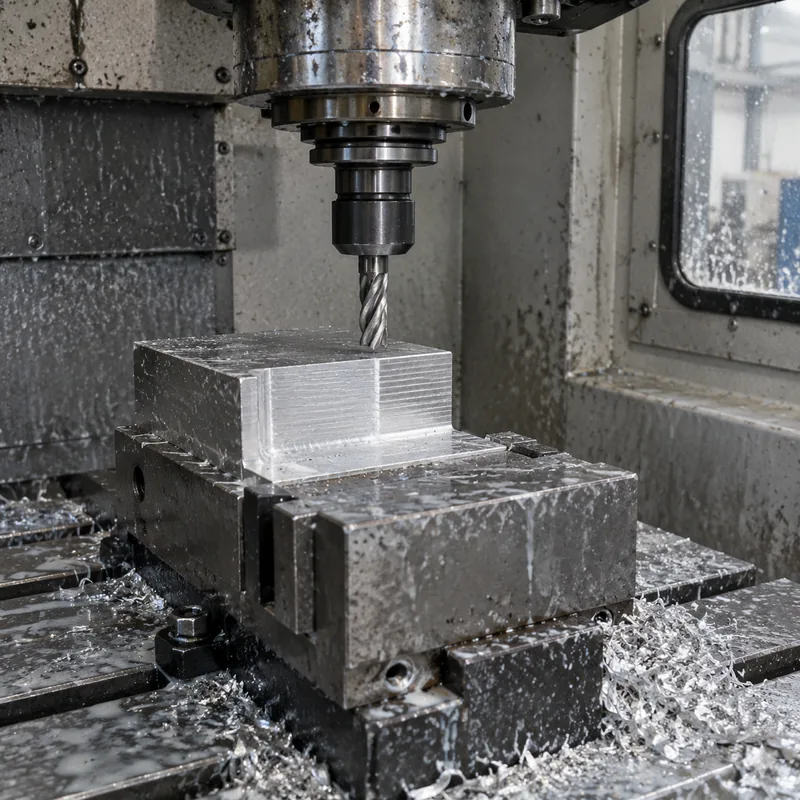
CNC milling removes material with rotating cutting tools that the machine positions along three, four, or five axes. It is the default process for prismatic parts — housings, brackets, plates, manifolds, molds and fixtures — where features sit on several faces of a block and holes, pockets, and contours must hold a defined position relative to each other.
The quoted capability envelope in this catalog covers tolerances from ±0.02 mm and ±0.05 mm up to +/- 0.005" (±0.127 mm), +/- 0.010", and sub +/- 0.001" on critical features, with milled parts up to 80" x 48" x 24" (2,032 x 1,219 x 610 mm). Which end of that envelope a specific part lands on depends on feature geometry, material, and how many setups the part needs — the tolerances that survive a fifth-axis setup are not the same ones that survive four manual flips.
Specifications
| Specification | CNC Milling |
|---|---|
| Axes | 3, 4, or 5 |
| Lead Time | 3-7 business days; About 5 business days; About 6 business days |
| Price From | $$ |
Materials
Surface Finishes
CNC milling is a precision machining technique that uses rotating cutting tools to shape workpieces into finished products, accommodating a wide range of materials such as metals, polymers, wood, and glass. Advanced 5-axis systems allow intricate geometries to be produced without multiple machine setups.
Values above are the collected catalog specification envelope for this product family. Tolerances and lead times at the demanding end of a range are confirmed for the specific geometry, material and batch at quotation.
Applications & Selection Points
Housings, plates and multi-face parts
When a part has features on four to six faces — mounting holes, O-ring grooves, pockets, threaded ports — milling is the routing answer because every face is reachable in one to two setups on a 4- or 5-axis machine, or sequentially on a 3-axis with re-fixturing. The design lever that matters most is internal corner radius: every corner is swept by a finite-diameter tool, so radii that match standard tool sizes keep tool access open and cycle time predictable.
Tight-tolerance functional features
Bore-to-bore positions, seal grooves and dowel holes that carry a positional tolerance are milled, then finished by boring or reaming where the callout demands it. Set general-feature tolerances looser than critical ones deliberately: the cost of a tolerance is driven by how many features must hold it simultaneously, not by the tightest single number on the drawing.
Material spread from aluminium to PEEK
The material list spans aluminium alloys (6061, 6061-T6, 2024, 5052, 5083, 6063, 6082, 7075, 7075-T6), steels and stainless steel, copper alloys, magnesium, titanium, and polymers from ABS, PC and POM through PEEK, PAI and PPS. Free-machining aluminium covers most brackets and enclosures; the engineering polymers matter when the part must survive chemicals, heat, or electrical isolation that metal cannot provide.
Finishing in the same supply chain
Because milled parts usually need corrosion protection or a cosmetic surface, the finishing list matters at selection time: as-machined, anodizing, powder coating, electroplating, painting, sand blasting, polishing, brushed finish and Teflon coating. Specifying finish together with the machining quote avoids a second sourcing round and the dimensional drift a post-coat can introduce on tight features.
Frequently Asked Questions
Is CNC milling the same as CNC machining?
No, and the difference matters when you route a part. CNC machining is the umbrella term that includes milling, turning, drilling and grinding. Milling is specifically the rotating-tool, stationary-or-multi-axis-workpiece process for prismatic geometry. A rotational part — shafts, pins, bushings — usually routes to CNC turning instead, often at lower cost, because a lathe shapes it in one setup.
Which tolerance should I put on the drawing?
Start from the catalog envelope: ±0.05 mm and ±0.02 mm cover most milled features; callouts in the +/- 0.005" to sub +/- 0.001" band are for features whose function genuinely needs them — bearing seats, seal surfaces, alignment dowels. Apply tight numbers only to those features and let general dimensions carry a standard tolerance. The quoted lead times (3–7 business days typical, about 5–6 business days on many jobs) already assume standard-tolerance bodies with a few critical features.
What does a milling quote need from me?
A 3D model (STEP preferred) plus a 2D drawing that marks tolerances, threads, and critical features; material and temper; quantity and target delivery country; and the finish callout. If a feature is questionable for tool access — a deep narrow pocket or an internal sharp corner — flag it in the RFQ so it is resolved before machining rather than discovered after.
Ordering & Documentation
Documents
Standard order package: STEP or IGES model, 2D PDF drawing with GD&T callouts, material and finish specification. First-article and dimensional inspection reports can be requested with the order — agree the inspection scope at quotation so the report matches the drawing.
Quotation
A quote is priced from: model and drawing, material and temper, quantity (price breaks at batch quantities), tolerance class on critical features, finish, and destination country. Ambiguity in any of these is resolved as a cost question, not assumed — a missing finish callout returns as a line item, not a surprise.
Sample & Supply
Prototype quantities from one piece are normal, and the quoted lead times of 3–7 business days apply to typical prototype batches. For production lots, a first-article approval run before the batch is the standard sequence; MOQ and per-batch scheduling are confirmed at quotation rather than assumed from a listing.
Storage & Shipping
Machined aluminium and steel parts ship with corrosion protection appropriate to the finish selected — bare machined steel needs oil or wrapped protection, anodized and plated parts less. Parts are packed with faces separated where cosmetic surfaces exist. On receipt, store indoors; condensation is the main risk to bare finishes in transit-season storage.