4140 Alloy Steel CNC Machining
Machining 4140 chromoly steel: the collected composition and property envelope, how heat treatment moves its properties, and where 4130 is the better fabrication choice.
Last updated: 2026-10-29
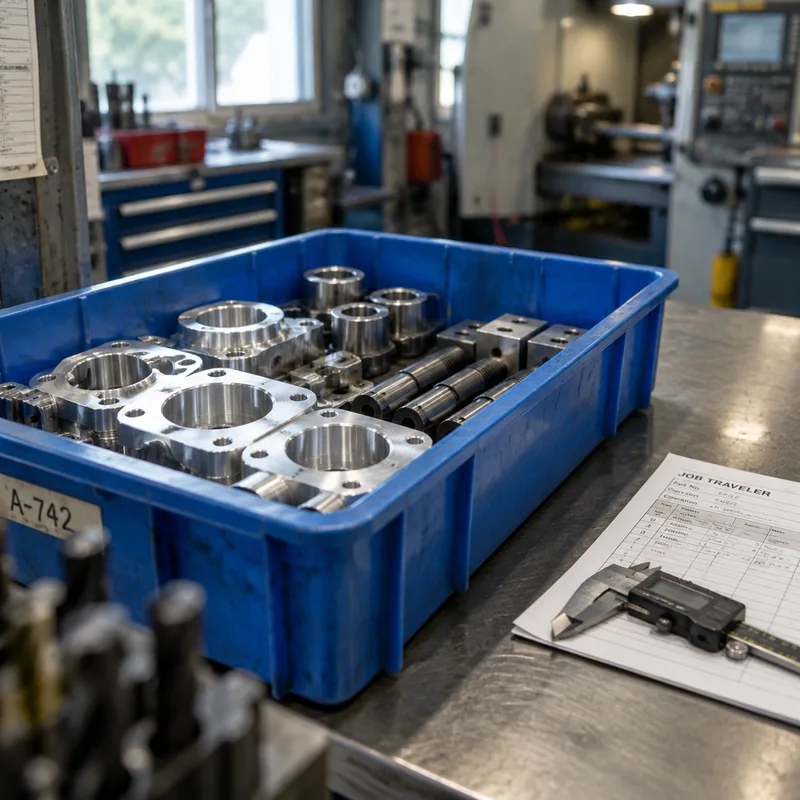
4140 is the workhorse of the chromoly family — a low-alloy steel carrying chromium and molybdenum, with a carbon content in the high threes-by-weight-percent band that puts it above its 41xx sibling 4130. That carbon gap is the whole story of the comparison: more carbon means a harder, stronger part after heat treatment, which is why gears, crankshafts, sprockets and heavily loaded shafts specify 4140.
Machining 4140 in its supplied condition is routine carbide work. What the alloy rewards is planning the heat-treatment sequence: strength and hardness are not fixed properties of the bar but outcomes of normalizing, quenching and tempering, and the machinist needs to know which state each feature is cut in — cutting threads after hardening is a different job than cutting them before.
Specifications
| Property | Value | Condition |
|---|---|---|
| Carbon content | 0.38–0.43% | chromoly (41xx) low-alloy steel with Cr and Mo; source contrast: 4130 at 0.28–0.33% C — the carbon gap drives the property gap |
| Tensile strength | 148,000 PSI | high-tensile condition per the source; comparison point: 4130 at 97,200 PSI and C20 Rockwell |
| Stock forms | bar and plate (more cost-efficient); 4130 more commonly tube and sheet | form availability shapes which grade a drawn part can use |
| Weldability condition | weldable in the annealed state with heat treatment | fabrication welding is difficult otherwise; for weld-heavy fabrication 4130 (lower carbon) is the source-recommended choice |
| Hardness hrc heat treated | 28–32 HRC | pre-hardened |
| Yield strength (0.2% offset) | 860–930 MPa | pre-hardened |
| Machinability rating | ≈66% | AISI 1212 = 100% |
Values above are rendered from the collected model-evidence layer, each carrying the heat-treatment condition it was reported under; fields without collected evidence are stated as not established rather than estimated. Requirements outside the table are confirmed for the specific geometry and batch at quotation.
Applications & Selection Points
Power transmission and wear parts
Gears, shafts, spindles, crankshafts and sprockets are the classic territory: the alloy responds to quench-and-temper with the strength to take heavy, cyclic loading, and its surface hardens well for wear resistance. Drawn-in wires and exceptional ductility in the unhardened state make it cooperative stock before hardening, not after.
Welded fabrications: the boundary
Welding 4140 is a heat-affected-zone management problem, not a routine joint. The standard practice is to weld in the annealed state and follow with heat treatment; weld-heavy fabrication is where the lower-carbon 4130 gets the nod. If the part combines machined features with significant welding, settle the alloy and the sequence at design stage — retrofitting the decision costs rework.
Stock form and sourcing
The alloy is readily available in bar and plate, generally at good cost efficiency, which suits machined-from-solid parts. Its sibling is more commonly stocked as tube and sheet — a structural distinction that often decides the alloy before properties do: welded frames and shells lean 4130, machined solid parts lean 4140.
Corrosion and coating expectations
Like most carbon and low-alloy steels, 4140 rusts without protection. It resists corrosion better than plain carbon steel but not enough to skip a finish in wet or outdoor service: black oxide, phosphate, paint or plating belong on the drawing, and machined surfaces exposed after finishing should be identified so the coating plan covers them.
Machinability is a property of the condition, not the grade name
The same 4140 bar spans cooperative through hostile cutting depending on its heat-treated state: annealed and normalized stock is standard carbide work; quench-and-tempered stock at strength is hard machining demanding rigid setups and managed heat; fully hardened stock is grinding territory. Quoting therefore requires the condition named per stage of the sequence — "4140, hardened" as the whole specification produces either a mispriced job or a conservative one. Where high volumes allow, the free-machining variant with added sulphur cuts meaningfully easier at a small property trade.
Tolerance and surface finish across hardening
The plan that works: rough machine oversize before hardening, then finish the precision features after — by grinding or hard turning — because quenching moves the part. Distortion is directionally repeatable on symmetric parts and not on thin or asymmetric ones, which is why grinding stock allowances are the standard insurance. Surface-finish callouts above what fine grinding delivers route to honing or lapping; specifying them before hardening wastes the callout, because the quench destroys the surface it was meant to define.
Failure and rejection modes on 4140 parts
The characteristic rejects: quench cracks initiating at sharp internal corners or abrupt section changes — a design issue that surfaces as a scrap part at heat treatment; grinding burns and re-hardening damage on finish-ground surfaces, detectable only with the right inspection; threads cut before hardening that no longer gauge after it; decarburized skin left on surfaces machined in an insufficient depth pass; and hydrogen embrittlement where plating follows hardening without a baking step. Each is a sequence or callout question, and each is cheap to prevent on the drawing.
Positioning among the alloy steels
In the machined-parts context 4140 sits between the plain-carbon medium-carbon grades, which it outperforms in hardenability and wear response, and the higher-alloy grades reserved for more demanding sections or fatigue. Its lower-carbon sibling keeps the welding license; the sulphurized free-machining variant trades a slice of transverse toughness for volume production economics. The alloy choice is usually settled by three questions — heat-treated strength target, welding content, and stock form — and the substitution article below is the honest way to run that check.
Frequently Asked Questions
How do 4140 and 4130 actually differ?
Composition first: the same chromium-molybdenum system, but 4140 carries more carbon. That difference is responsible for the property gap — 4140 reaches higher hardness and tensile strength in heat treatment, while 4130 welds more easily and comes preferentially as tube and sheet. Choose by dominant requirement: machined strength favors 4140, welded fabrication favors 4130.
What heat treatments apply, and what do they change?
Annealing increases ductility and machinability at the cost of strength; normalizing refines the structure; quench-and-temper is the strength-and-hardness move; cold finishing raises strength while costing ductility. The practical point for a machined part: the same bar can be delivered in very different states, so the drawing should state the condition the final properties are wanted in.
What should an RFQ for 4140 parts include?
The drawing with tolerances and the heat-treatment condition called out per feature or per part, the stock form, quantity, any NDT or hardness verification requirement, and the coating. Threads and close-tolerance features should state whether they are cut before or after hardening — it changes both the process plan and the price.
Why do my hardened 4140 parts come back with cracked corners?
Quench cooling is not uniform, and sharp internal corners or abrupt section transitions concentrate the resulting stress — the crack shows up at heat treatment even though the drawing measured fine before it. The countermeasures are design-side: generous internal radii at stress-raising corners, gradual section transitions, and where the design cannot yield, interrupted quench or martempering practice agreed with the heat treater. If a crack-prone geometry is fixed, say so in the RFQ — it is far cheaper to plan the quench around the part than to discover the interaction on a scrapped batch.
Can I just machine 4140 after it is fully hardened?
Only with hard-machining process choices: rigid setups, CBN-class tooling, low removal rates — or grinding, which is the conventional route. It is done routinely on bearing seats and precision faces, but as a finishing operation, not as the main material-removal plan. The economical sequence almost always roughs in the soft condition and finishes after hardening; a drawing that leaves bulk machining until after hardening is pricing the wrong end of the process first.
Ordering & Documentation
Documents
Send a STEP model with a drawing that names the delivery condition, the heat treatment and where it applies, plus thread and tolerance callouts relative to hardening. Coating requirements belong on the same document so finishing prices into the plan.
Quotation
A quote is priced from stock size, machining content, heat treatment, coating and quantity. Heat-treatment steps are priced per batch — consolidating parts that share a treatment cycle is usually visible in the per-part number.
Process plan
Expect rough machining before hardening and finish grinding or hard machining after, on parts that need both. Welded assemblies on this alloy should carry an explicit welding-in-annealed note and a post-weld treatment step.
Sample & Supply
First articles verify the heat-treated dimensions — the step where distortion and growth surface. Hardness verification and material certification are available on request; agree the inspection scope at quotation.