6061 Aluminum CNC Machining
CNC machining of aluminum: collected property envelope with temper condition, structural and enclosure selection points, and what to send for a quotation.
Last updated: 2026-10-29
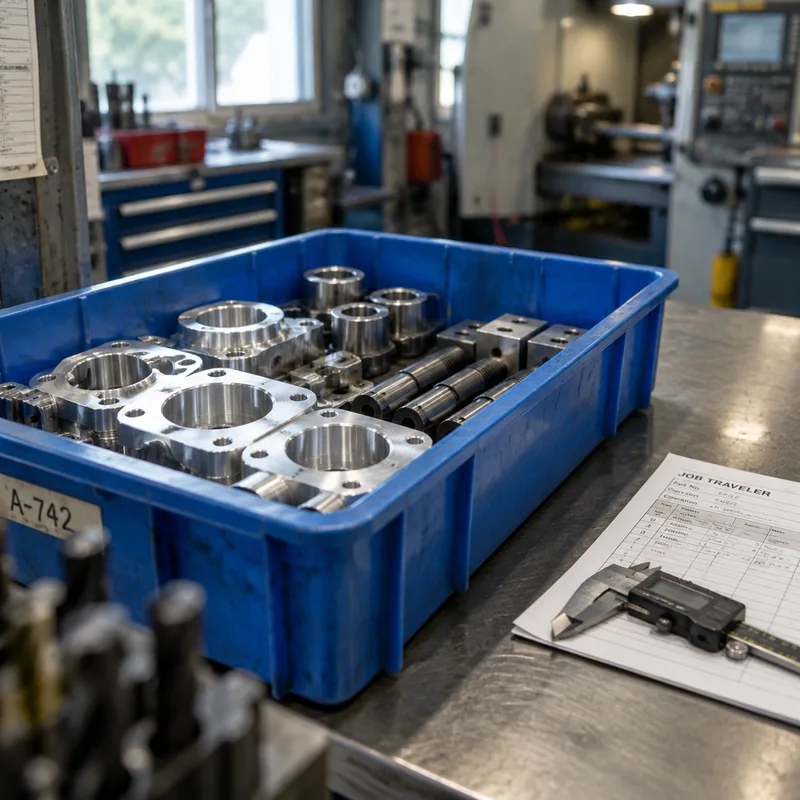
This is the general-purpose structural aluminum most machine shops cut every day: a heat-treatable magnesium-silicon alloy that balances strength, corrosion resistance, weldability and cost well enough to be the default answer whenever a drawing says "aluminum" without a grade. It takes anodizing cleanly, machines predictably, and is stocked in every common product form.
Its selection boundaries are forming and peak strength: in the fully hardened temper it resists sharp forming operations, and where a design needs the highest strength-to-weight the high-zinc aerospace alloy is usually the better call. Neither boundary is a defect — they are the reasons the two grades coexist instead of one replacing the other.
Specifications
| Property | Value | Condition |
|---|---|---|
| Tensile strength | ≥ 290 MPa | T6, seamless rod (specimen Ø ≥ 70 mm) |
| Yield strength (0.2% offset) | ≥ 240 MPa | T6, seamless rod (σp0.2) |
| Elongation | ≥ 10% | T6, seamless rod |
| Density | 2800 kg/m³ | T6 |
| Fatigue strength | ≈95 MPa | 500M cycles, unnotched |
| Hardness | 95 HB | T6 (Brinell) |
Values above are rendered from the collected model-evidence layer, each carrying the heat-treatment condition it was reported under; fields without collected evidence are stated as not established rather than estimated. Requirements outside the table are confirmed for the specific geometry and batch at quotation.
Applications & Selection Points
Structural and enclosure parts
Frames, brackets, plates, housings and fixtures are the home ground. The alloy welds readily, anodizes to a consistent finish, and holds dimension well after machining. For welded machined assemblies, plan the post-weld temper question early — heat input locally softens the heat-affected zone, and stress-critical welded designs should say so on the drawing.
Where the high-strength alloy wins instead
When the part is strength-limited — thin load-carrying sections, aerospace-style fittings, high-cycle fatigue — the zinc-bearing alloy carries more load at the same weight. Moving between the two grades is a drawing decision, not a shop preference: state the load case and the quote can propose the right one.
Forming after machining
In the fully heat-treated temper this alloy cracks when formed to sharp angles; parts that need bending or flanging after machining should either be machined from a softer temper and heat treated after, or designed with generous radii. Confirm the temper on the purchase order — the same grade name covers very different forming behaviors.
Finishing and corrosion planning
Anodizing is the standard finishing route and doubles as corrosion protection; the alloy responds well to both clear and colored anodize. In most atmospheric service the bare machined surface also performs acceptably. Coastal or chemical exposure moves the selection conversation — say so on the RFQ rather than after the first service failure.
Cutting behavior and parameter discipline
This is one of the most cooperative alloys a machine shop cuts: high surface speeds, sharp uncoated or diamond-polished tooling, and generous feeds produce the clean sheared finish the grade is known for. The failure modes are correspondingly specific — rubbed surfaces from dull tools or excessive dwell smear rather than cut, and welded-on aluminium in pockets where chip evacuation stalls. Thin walls and long unsupported spans bring the second family of problems: chatter marks and spring-pass distortion, both answered by fixturing and toolpath strategy rather than by tolerance generosity.
Tolerances, surface finish and the anodize interaction
The alloy holds tight tolerances willingly on a rigid setup, which is exactly why the finishing step is the usual surprise: anodize builds a grown layer on the surface, so a dimension measured before finishing lands differently after it. Precision bores, press-fit seats and threaded features either carry a pre-finish size offset agreed with the shop, or are masked. Fine roughness callouts interact the same way — anodizing roughens the surface slightly at the micro scale, so cosmetic-critical faces may specify polishing after the treatment rather than before.
Failure and rejection modes on machined 6061 parts
The recurring rejects: chatter and rub-mark surfaces traced to tooling or fixturing rather than material; burrs at pocket edges that survive deburring on thin features; distortion after machining on plates with asymmetric stock removal, from residual stress in the raw plate; post-anodize dimension disputes on unmasked precision features; and black smut from carbon-steel contact or contaminated finishing baths. Every one is preventable at the specification stage — mask callouts, stress-relief choices, and handling requirements all belong on the drawing or in the RFQ.
Positioning inside the aluminum family
Within the machinable aluminum set, this alloy is the cost-and-availability default; the forming alloy takes bent and welded enclosures; the high-zinc aerospace alloy takes the fatigue and strength ceiling; the free-machining legacy alloy persists on high-volume screw-machine work. Substitution between them is a legitimate quotation outcome when the load case is stated — the selection split article below walks the most common pairing decision.
Frequently Asked Questions
Is "6061 aluminum" the same as 6061-T6?
No — the number names the alloy chemistry; the temper suffix names its mechanical condition. The fully heat-treated temper and the annealed condition carry very different strength and forming behavior, and supplier stock may be either. Always write the full designation including temper on the drawing and the purchase order.
Should my part be this alloy or the high-strength aerospace one?
Decide from the load case and the environment. General structures, enclosures and machined fittings usually stay with this alloy on cost, weldability and finishing grounds. Primary load paths, fatigue-critical parts and minimum-weight designs justify the high-strength alloy — at the price of lower corrosion resistance and harder welding. State the load case and let the quote confirm the choice.
What should I send for a quote on this material?
A STEP model plus a drawing with tolerances, the full designation including temper, the finish callout (anodize type where relevant), quantity and batch intent, and any inspection needs. If the part welds or forms after machining, include that too — both constrain which temper the raw stock should carry.
Will anodizing change my part's dimensions?
Yes, slightly and predictably: the anodic layer grows both outward and into the material, so finished dimensions move by roughly the order of the coating build. On general enclosures this is invisible; on press fits, bores, threads and mating surfaces it is a real tolerance consumer. The standard answers are a pre-finish machining offset agreed with the shop, or masking the precision features. State which features are tolerance-critical and whether they are masked — an RFQ that says so quotes cleanly, and one that does not usually comes back with the question anyway.
My thin-walled housing came out with wavy walls. What happened?
Almost certainly a conversation between residual stress and fixturing, not a material fault: plate stock carries rolling stresses, and machining away material asymmetrically lets the plate relax — often visibly on thin floors and long spans. The countermeasures are process choices: roughing both sides before finishing, stress-relieved or pre-flattened stock, revised clamping, or a design review of the wall itself. Flag thin-wall geometry in the RFQ so the fixturing plan is made before machining, when it is still cheap.
Ordering & Documentation
Documents
Send a STEP or IGES model with a 2D drawing carrying tolerances, threads and the finish specification. Name the complete designation with temper — ordering bare-chemistry stock is the most common avoidable mistake on this alloy.
Quotation
Quotes are priced from the model and drawing, the named temper and product form, quantity, tolerance class on critical features, finish (anodize thickness and color where called), and destination. Anodizing is quoted as a separate finishing line — carry it in the RFQ, not as an afterthought.
Sample & Supply
Prototype quantities from one piece are normal, and first articles confirm both the machined fit and the anodized appearance before a batch releases. Material certification is available on request — agree the scope at quotation.
Storage & Shipping
Machined surfaces arrive with the finish the callout defines. The alloy tolerates ordinary warehouse conditions; anodized parts should still be packed to avoid abrasion against harder media. Keep separated from carbon-steel handling contact to avoid smutter contamination on bare surfaces.