Aluminum CNC Machining
Aluminum CNC machining for 6061, 7075, 2024 and 5083 parts: 3/4/5-axis milling and turning, tolerances down to ±0.05 mm, parts to 1100 x 600 x 500 mm, anodizing and hard coat finishing, lead times from 3 days.
Last updated: 2026-10-26
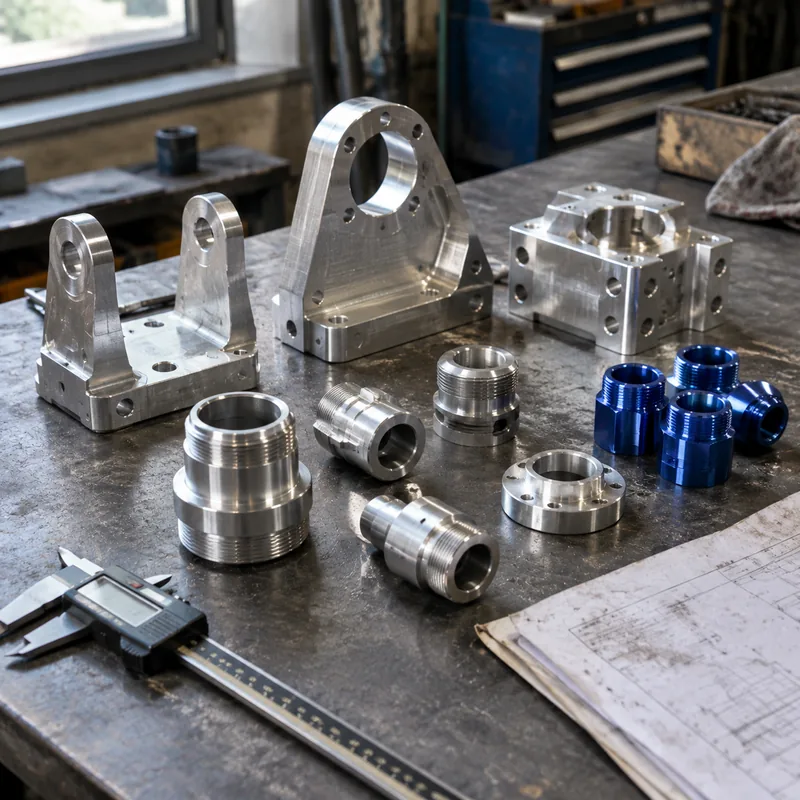
Aluminum CNC machining removes metal from aluminum alloy stock with rotating cutting tools on 3-, 4-, or 5-axis milling machines and CNC lathes. It is the highest-throughput corner of the machining world because aluminum shears cleanly at high cutting speeds, which shortens cycle time, extends tool life, and makes iterative prototype rounds affordable — the practical reasons the alloy family dominates brackets, enclosures, heat sinks, fixtures and structural aerospace-style parts.
The catalog envelope for machined aluminum covers tolerances down to ±0.05 mm, part sizes from 22" x 14" x 3.75" (559 x 356 x 95.25 mm) on 6061/7075 plate and block stock up to 24" x 16" x 4" (609 x 406.4 x 101.6 mm), and a service envelope of 1100 x 600 x 500 mm for parts routed across the machining floor. Alloy coverage spans the wrought workhorses 6061, 7075, 2024, 5052, 5083, 6063 and 6082 plus free-machining 6262, and finishes run from as-machined through anodizing, hard coat, conversion coating, bead blasting, polishing, painting and powder coating — so parts arrive finished, not bare.
Lead times in the sourced data start at as fast as 3 days on aluminum 6061/7075 and cluster in the 2-5 day band — among the shortest of any metal process, because no tooling exists to build and the material is in stock everywhere. Exact timing is confirmed at quotation against part complexity and finishing choice.
Specifications
| Specification | Aluminum CNC Machining |
|---|---|
| Tolerance | Down to ±0.05 mm |
| Max Part Size | 22" x 14" x 3.75" (559 x 356 x 95.25 mm) aluminum 6061/7075; 24" x 16" x 4" (609 x 406.4 x 101.6 mm) block; 1100 x 600 x 500 mm service envelope |
| Axes | 3-, 4-, or 5-axis |
| Lead Time | As fast as 3 days (aluminum 6061/7075); 2-5 days |
Materials
Surface Finishes
CNC machining service for aluminum alloys, offering milling and turning with tight tolerances and a range of surface finishes. Aluminum machines three to five times faster than steel, making it cost-effective for prototypes through production.
Values above are the collected catalog specification envelope for this product family. Tolerances and lead times at the demanding end of a range are confirmed for the specific geometry, material and batch at quotation.
Applications & Selection Points
Structural brackets and housings in 6061-T6
6061 is the default answer when a machined aluminum part needs good strength, weldability, corrosion resistance and cost all at once. It is the right selection for mounting brackets, enclosure bodies, manifolds and test fixtures — parts where the load case is moderate and the drawing needs broad general-purpose properties rather than a single extreme. Its uniform machinability also keeps tolerance behavior predictable across batch sizes.
High-strength parts where 7075 earns its penalties
7075 carries roughly aerospace-grade strength in a machinable wrought alloy, which is why it owns the high-stress bracket and link territory. The upgrade is not free: poor arc weldability, reduced corrosion margins and limited cosmetic anodize colour are real selection constraints, and the cost per kilogram of stock runs well above 6061. The engineering question to settle before the RFQ is whether the load case genuinely needs the strength — if it does not, 6061 is the cheaper part with fewer finishing restrictions.
Sheet-gauge and marine-grade alloys in the mix
The alloy list is not only the two workhorses: 2024 serves fatigue-driven structures, 5052 and 5083 bring the forming and marine corrosion behavior of the 5xxx family into machined-and-adapted parts, 6063 covers extrusion-profile-adjacent geometry, 6082 is the European structural grade, and 6262 exists specifically for high-speed automatic screw work where its free-machining dispersoids matter. Choosing among them is a properties decision first and a price decision second.
Finishing as part of the machining decision
Aluminum parts almost always leave the shop finished, so the finishing list belongs in the selection conversation: anodizing for durable corrosion protection, hard coat where surfaces see abrasion, conversion coating where electrical conductivity or a paint base matters, and bead blasting, polishing, painting or powder coating for cosmetic surfaces. Anodize builds thickness — on tolerance-critical features, call out whether the dimension applies before or after coating, and confirm the sequence at quotation.
Prototype-to-production continuity
Because the same 3/4/5-axis machines cut one part and one thousand, machining is the rare aluminum process with no volume cliff: a validated prototype routes straight into production lots without tooling amortization distorting the economics. That continuity is why machined aluminum dominates development hardware for enclosures, robotics, drones, medical devices and automotive brackets — programs where the design will still change after the first batch.
Frequently Asked Questions
6061 or 7075 for a machined aluminum part — which should I pick?
Start from the load case: if the stresses fit inside what 6061-T6 carries, it is the cheaper part with better weldability and fewer finishing restrictions. Specify 7075-T6 when the strength-to-weight requirement is real — high-stress brackets, links, aerospace-style fittings — and accept its constraints: no arc welding, tighter corrosion management, limited cosmetic anodize colour, and higher material cost. Send the load case with the RFQ and the alloy choice is usually settled in one line.
What size and tolerance can machined aluminum parts hold?
The catalog envelope covers tolerances down to ±0.05 mm on machined features, with parts up to 22" x 14" x 3.75" (559 x 356 x 95.25 mm) in 6061/7075 stock, blocks to 24" x 16" x 4" (609 x 406.4 x 101.6 mm), and a service envelope of 1100 x 600 x 500 mm. Where a specific feature lands inside that envelope depends on geometry, fixturing and how many setups the part needs — the values confirmed at quotation are the ones that bind.
What does an aluminum machining quote need?
A 3D model plus drawing (or a clearly toleranced 2D), alloy and temper callout, quantity and delivery destination, surface finish specification — anodizing, hard coat, conversion coating, bead blasting, paint or powder coat — and any critical dimensions or inspection requirements marked. Finishing choice and alloy are the two inputs that move an aluminum quote most, so state both rather than leaving them open.
Ordering & Documentation
Documents
Order package: 3D model, dimensioned drawing with tolerances (general and critical features distinguished), alloy and temper specification, finish specification, and quantity. For parts with anodize on critical dimensions, mark whether each dimension applies before or after coating — it is the single most common finishing ambiguity on aluminum drawings.
Quotation
Quotes are built from geometry, alloy, tolerances, finish and quantity, with lead time confirmed against current floor load — the sourced data puts aluminum 6061/7075 at as fast as 3 days and the common band at 2-5 days, but the binding figure is the one on your quotation. Anodizing colour and hardness class are quote line items, not afterthoughts.
Sample & Supply
First articles anchor the production run: dimensions against the drawing, finish appearance, and any marked inspection features. Production lots then repeat against that approval. Repeat orders benefit from aluminum machining’s lack of tooling — there is no die to maintain, so a re-order routes straight to the machines. Blanket schedules and lot sizing are confirmed at quotation.
Storage & Shipping
Machined aluminum is dimensionally stable and ships well; bare surfaces may develop the familiar white-gray oxide film, which is cosmetic but avoidable by finishing. Anodized and conversion-coated surfaces should ship clean and dry, separated from abrasive contact; painted and powder-coated surfaces need the same transit care as any coating. Long-stored parts keep best dry and unstressed.