7075 Aluminum CNC Machining
CNC machining of the high-strength aerospace aluminum: collected property envelope with temper condition, load-path selection points, and quotation inputs.
Last updated: 2026-10-29
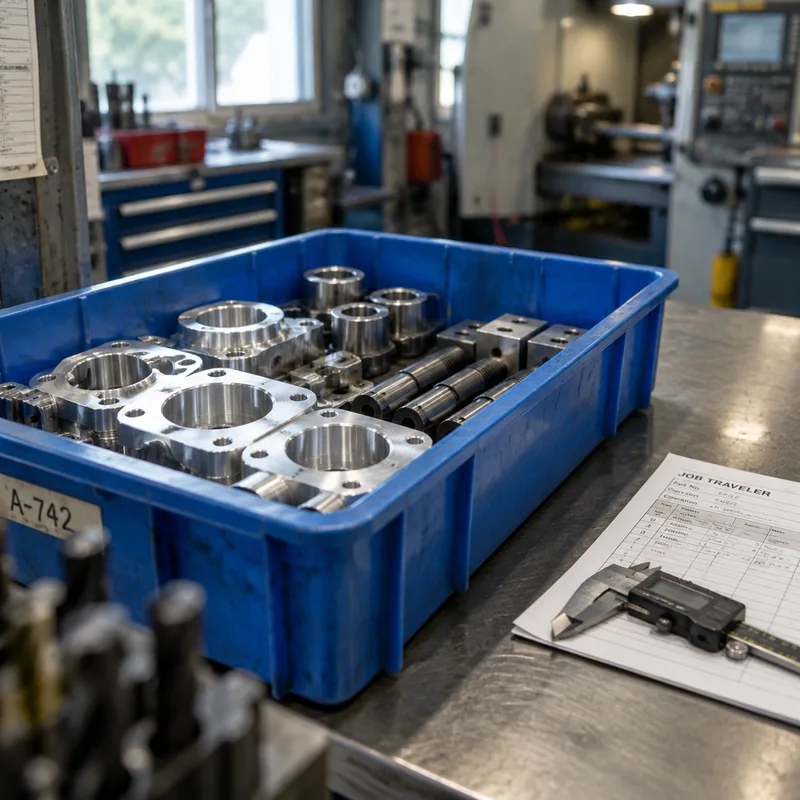
This is the high-strength aerospace aluminum: a zinc-magnesium-copper alloy whose heat-treated temper rivals mild structural steel at a third of the weight. Airframe skins, fuselage frames, load-carrying brackets and high-end sporting equipment are its classic territory — anywhere a design is strength-limited rather than cost-limited.
The strength premium buys two compromises: corrosion resistance is ordinary rather than excellent, and welding is genuinely difficult, with cracking risk that demands special procedures. Parts that need welded assemblies or bare-service corrosion margin usually belong to the general-purpose alloy instead. Fine grain structure also gives it strong drilling behavior — deep holes hold geometry well.
Specifications
| Property | Value | Condition |
|---|---|---|
| Tensile strength | 560–572 MPa | T6 |
| Yield strength (0.2% offset) | 450–503 MPa | T6 (0.2% offset) |
| Elongation | 10–11% | T6 |
| Hardness | 150 HB (~87 HRB) | T6 |
| Density | 2.81 g/cm³ | T6 |
| Fatigue strength | ≈120–159 MPa | 10⁷–5×10⁸ cycles, unnotched |
Values above are rendered from the collected model-evidence layer, each carrying the heat-treatment condition it was reported under; fields without collected evidence are stated as not established rather than estimated. Requirements outside the table are confirmed for the specific geometry and batch at quotation.
Applications & Selection Points
Primary load paths and aerospace structures
Wing skins, bulkheads, landing-gear-adjacent fittings and structural lugs are the core use. Where the drawing carries fatigue or ultimate-load requirements, this alloy is usually what the designer had in mind. Pair it with the inspection requirements such parts imply — state the scope in the RFQ, not after first articles.
High-stress machined fittings
Beyond aerospace: climb-tooling fixtures, jigs, tooling plates, firearm and bicycle frames — anywhere stiffness and strength justify the premium over general-purpose aluminum. It machines well and takes hardcoat anodize for wear surfaces.
Where it is the wrong call
Welded assemblies are the hard boundary — crack sensitivity makes routine welding off the table without special processes, and riveted or bolted joins are the normal answer instead. Chronically wet or salty bare service also argues for the general-purpose or marine alloy, or for cladding.
Corrosion protection planning
The alloy anodizes well — sulfuric hardcoat for wear, standard clear or colored anodize for protection and appearance — and aerospace practice often clads it with pure aluminum. Say which scheme the part expects; anodize on this alloy protects, but the baseline resistance is lower than the general-purpose grades.
Frequently Asked Questions
Why is this alloy so much stronger than 6061?
The zinc addition is the reason: in the heat-treated temper its tensile and yield strength roughly double the general-purpose alloy, at a small density penalty. That is why primary aircraft structures default to it. The same chemistry is what makes welding difficult and corrosion resistance ordinary — the trade is real and should be made on the drawing, not at the shop.
Can parts in this alloy be welded?
Only with special procedures and acceptance of crack risk; standard practice joins it mechanically — rivets and bolts — which is exactly what airframe construction does. If your part needs welded assembly, say so in the RFQ: it usually flips the recommendation to the general-purpose alloy, or redesigns the joint.
What does a quote need for a part in this material?
The model and drawing with tolerances, the full designation with temper, finish callout (hardcoat or standard anodize), quantity, and inspection scope — load-path parts usually carry first-article or certificate requirements. Note any fatigue or ultimate-strength callouts; they drive both material certification and inspection.
Ordering & Documentation
Documents
Send the model plus a drawing with tolerances, the complete designation including temper, and the finish scheme. For airframe-style parts, attach the inspection and certification requirements — they belong in the RFQ from the start.
Quotation
Priced from the model, the named temper and form, quantity, tolerance class, finish, and inspection scope. Expect certification (mill certs, first-article reports) as separate line items on load-path work; agree the scope before quoting rather than after.
Sample & Supply
First articles on this alloy should include the inspection the part class implies — dimensional report at minimum, material certificate on request. Production batches run to forecast; confirm traceability expectations at quotation.
Storage & Shipping
Finished parts ship with the anodize or cladding the drawing defines. Store dry; bare surfaces are adequate but not exceptional in humid storage. Protect anodized and machined faces from abrasion against harder media in transit.