Nylon (PA6) CNC Machining
CNC machining of nylon: the collected shrinkage and moisture-management facts, why PA6 behaves differently from its sibling grade, and what to state on the RFQ so tolerance survives humidity.
Last updated: 2026-10-29
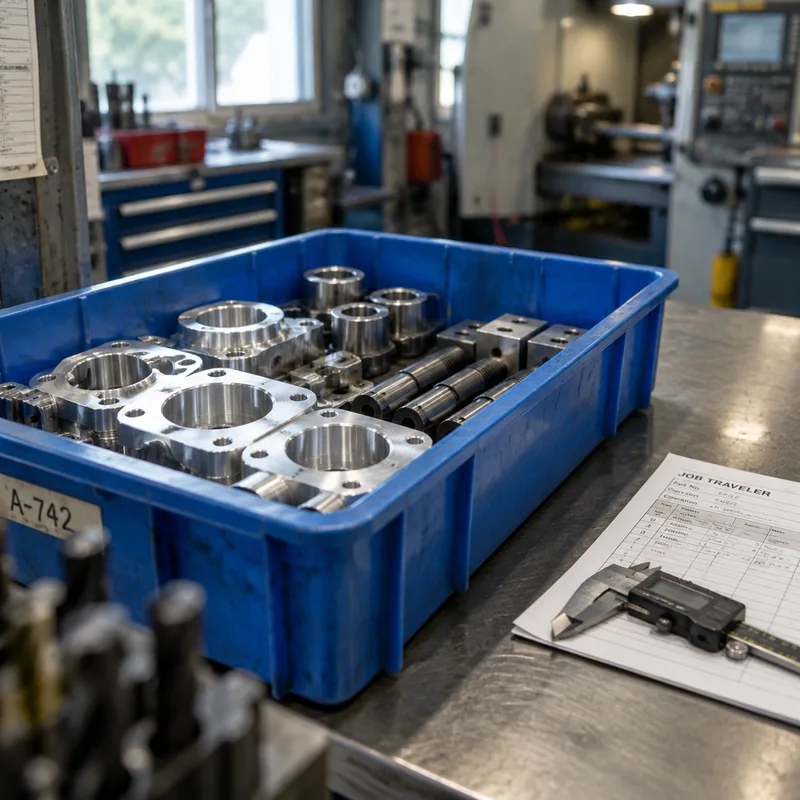
Nylon in the PA6 formulation is the tough, wear-tolerant member of the polyamide family — gears, rollers, sliding guides and insulating wear parts are its natural territory. It resists impact and chemical attack well and machines cleanly at the cutting stage; its real engineering personality shows afterward, because the material absorbs moisture from the air and moves with it.
That hygroscopic behavior is the whole game on dimensionally meaningful parts. Quality characteristics of finished nylon parts track the moisture they absorb, so the questions that matter on an RFQ are the service humidity, the tolerance at specified features, and whether the part is certified dry or moisture-conditioned. Glass-fiber filling trades some of that movement away and stiffens the part — at the cost of abrasiveness at the cutter.
Specifications
| Property | Value | Condition |
|---|---|---|
| Molding shrinkage | 1–1.5% | unfilled resin; actual shrinkage also varies with part design, wall thickness and crystallinity/moisture |
| Molding shrinkage filled | ≈ 0.3% | glass-fiber filled; slightly higher perpendicular to the process direction |
| Predrying | hot air ≥ 80 °C for 16 h (humidity > 0.2%); or vacuum ≥ 105 °C for ≥ 8 h after > 8 h air exposure | moisture-management before processing; PA6 is hygroscopic |
| Melting point | ≈220°C | PA6, unfilled |
| Tensile strength | Not established in the collected evidence — confirm at quotation. | |
| Density | Not established in the collected evidence — confirm at quotation. | |
| Hardness | Not established in the collected evidence — confirm at quotation. | |
Values above are rendered from the collected model-evidence layer, each carrying the heat-treatment condition it was reported under; fields without collected evidence are stated as not established rather than estimated. Requirements outside the table are confirmed for the specific geometry and batch at quotation.
Applications & Selection Points
Gears, rollers and sliding wear parts
Unfilled nylon runs against metal with low noise and good wear behavior, which is why it is the quiet default for gears, rollers, bushings and guide strips inside machinery. It tolerates imperfect lubrication better than most plastics — but verify the load and temperature, because the family softens well below the temperatures metals shrug off.
Where the sibling grade comparison matters
The two common polyamide grades are close in chemistry and behavior, but not twins: the higher-melting sibling processes across a narrower window, while this grade resists impact and dissolution somewhat better — and absorbs more moisture. For a machined part, the moisture difference is the one to weigh: the thirstier grade moves more in humid service and needs the tolerance conversation sooner.
Filled versus unfilled
Glass-fiber filling is the standard stiffening route, with impact modifiers sometimes added alongside. Filling cuts molding shrinkage substantially and stabilizes the part, but the improvement is directional — movement drops far more with the process direction than across it — and the glass makes machining harder on cutters. Specify filled grades explicitly; unfilled and filled stock are not interchangeable on a drawing.
Moisture management as a process step
Drying before processing is part of working with the material, not an optional refinement: above a modest humidity threshold, hot-air drying is the collected recommendation, and material that has sat exposed gets the longer vacuum treatment. For machined parts, the parallel question is conditioning — decide whether the part is dimensionally certified dry or after moisture equilibration, and put the answer on the drawing.
Frequently Asked Questions
Why did my machined nylon part change size after a week in service?
Moisture uptake. The polyamide family absorbs atmospheric water, and the dimensional movement that follows is a property, not a defect. Control it by specifying the conditioning state the tolerance applies to, choosing the less hygroscopic sibling grade where the drawing allows, or moving to a filled grade.
PA6 or the alternative polyamide grade for my part?
They are close enough in properties that the decision usually hangs on one axis: the sibling melts higher and absorbs less moisture, while this grade takes impact and wider processing better. Humid service plus tight tolerance pushes toward the drier sibling; impact and wear duty favor this one.
What should I send for a quote?
Model and drawing with tolerances, the grade (unfilled, glass-filled, impact-modified — they machine and move differently), the service environment including humidity, any food-contact or electrical requirement, quantity, and the conditioning state your tolerance assumes.
Ordering & Documentation
Documents
Send the model with a drawing naming the grade and the tolerance-conditioning assumption. A tight tolerance on hygroscopic stock without a stated condition is a dispute waiting to happen.
Quotation
Price follows grade, stock form, tolerance class and quantity. State humidity service — it can change the grade proposal, not just the number.
Sample & Supply
First articles are worth checking after equilibration to the service environment, not only off the machine. Batch material certification is available on request — agree it at quotation.
Storage & Shipping
Store sealed and dry until use; the material starts absorbing moisture the day the bag opens. Parts ship bagged — if the drawing states a conditioning state, keep the packaging until inspection.