FR4 CNC Machining
CNC machining of FR4 epoxy glass laminate: the collected electrical, mechanical and flammability envelope, where it beats engineering plastics, and how to fixture the abrasive glass weave.
Last updated: 2026-10-29
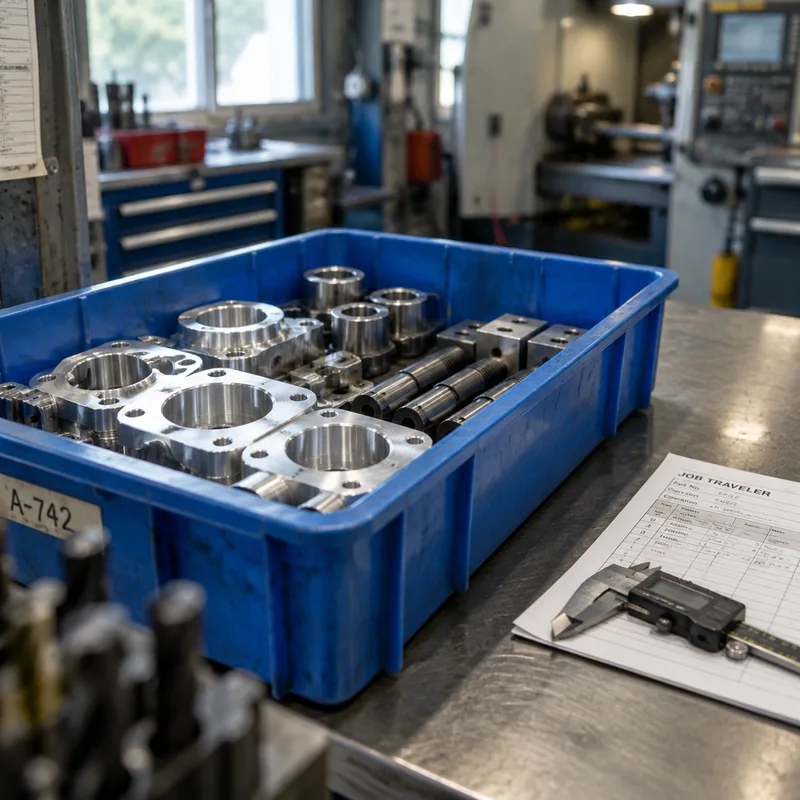
FR4 is the epoxy-glass laminate the electronics industry built its substrate standard on — woven glass cloth in an epoxy resin matrix, flame-retardant by formulation. As a machining stock it occupies a niche engineering plastics cannot: it holds its shape across temperature and moisture, insulates electrically at real voltages, and carries an inherent flame rating without additives.
Machining it is a tooling story more than a parameter story. The glass weave is abrasive and cuts tool life like a grinding operation; carbide tooling, dust extraction and carbide-grade feeds are the working answers. The reward is a dimensionally stable insulating part — terminal boards, test fixtures, insulating spacers — that neither creeps under load nor burns under fault conditions.
Specifications
| Property | Value | Condition |
|---|---|---|
| Flexural strength | ≥ 340 MPa | vertical bending, at 150 ± 5 °C (E-1/150) |
| Impact strength | ≥ 230 kJ/m² | parallel laminar, simply-supported beam (Charpy) |
| Insulation resistance | ≥ 5.0×10⁸ Ω | after water immersion (D-24/23) |
| Electric strength | ≥ 14.2 MV/m | vertical, in 90 ± 2 °C transformer oil, 1 mm plate |
| Breakdown voltage | ≥ 40 kV | parallel layers, in 90 ± 2 °C transformer oil |
| Dielectric constant | ≤ 5.5 (50 Hz and 1 MHz); 2.35 reported (Dk) | laminate spec ceiling; article figure for the low-loss grade |
| Dielectric loss | ≤ 0.04 (50 Hz and 1 MHz); Df 0.0025 reported | laminate spec ceiling; article figure for the low-loss grade |
| Water absorption | ≤ 19 mg | D-24/23, 1.6 mm plate |
| Density | 1.70–1.90 g/cm³ | glass-content dependent |
| Flammability | FV0 | laminate flammability rating |
| Press temperature | 203 °C | FR-4 process press board |
| Hardness | 110 Rockwell M | Rockwell M scale |
| Tensile strength | > 40,000 psi | FR4/G10 laminate |
Values above are rendered from the collected model-evidence layer, each carrying the heat-treatment condition it was reported under; fields without collected evidence are stated as not established rather than estimated. Requirements outside the table are confirmed for the specific geometry and batch at quotation.
Applications & Selection Points
Electrical insulation and terminal hardware
Terminal boards, insulating barriers, busbar supports and switchgear spacers are the core duty: high insulation resistance, strong dielectric performance and an inherent flame rating make it the conservative answer wherever a fault must not propagate. Electrical parts should carry the voltage and clearance requirements on the drawing so the right laminate grade is sourced.
Test fixtures and jigs
Electronics test fixtures, nests and assembly jigs use the laminate for flatness, stability and the ability to host metal inserts. It machines to tight edges without the moisture swelling that makes hygroscopic plastics drift between seasons — a quiet but real advantage in dimensional fixtures.
Where it beats engineering plastics
Choose it over plastics when flame behavior is specified, when the part must stay stiff in warm, wet conditions, or when dielectric loss must stay low at frequency — the low-loss behavior reported for the laminate is why RF-grade variants of the same family exist. Choose plastics over it when the part needs to seal, flex, or take impact: the laminate is stiff, brittle by plastic standards, and unforgiving of sharp internal corners.
Machining and handling notes
Expect abrasive wear, not chatter: glass fibers dull edges quickly, so tool life is planned, not hoped for. Machining generates fine dust — extraction and sealing are part of the shop plan, not an afterthought. Water uptake is low but specified, so parts destined for immersion or tropical service should have the environment stated at quotation.
Frequently Asked Questions
Is FR4 machinable like a plastic?
It machines on the same equipment, but the glass reinforcement makes it behave partway toward a composite: abrasive on tooling, dust-generating, and best cut with sharp carbide and extraction. Plan fixture machining time around tool changes rather than spindle speed.
FR4 or an engineering plastic for an insulating part?
Flame rating, dimensional stability in warm-wet service and stiffness favor the laminate; impact resistance, sealing and lower tooling wear favor plastics. If the part sits near a fault-current path or in a hot enclosure, the laminate is the conservative choice.
What should I send for a quote?
The model with tolerances, laminate thickness and grade (standard electrical grade versus low-loss RF variants are different stock), any voltage-withstand or flammability requirement, hole and edge finish expectations, quantity, and the service environment if moisture or heat is involved.
Ordering & Documentation
Documents
Send the model with a drawing naming laminate thickness, grade and any electrical or flammability requirement. Voltage withstand belongs on the drawing as a test, not a hope.
Quotation
Price follows thickness, grade, feature density (small holes and slots drive tool wear) and quantity. State the environment — immersion or tropical service changes the grade, not just the price.
Sample & Supply
First articles on insulating parts should be approved with the electrical test result attached, not just the fit. Batch traceability of laminate grade is available on request — agree it at quotation.
Storage & Shipping
Store flat and dry; the laminate is stable but thin sections warp if leaned. Machining dust is the handling hazard — parts ship clean, and the extraction discipline belongs to the shop floor.