Swiss Machining Services
Swiss-type turning for small, slender precision parts: diameters inside the guide-bushing envelope, production tolerances in the two-ten-thousandths band, guide-bushing support for parts conventional lathes deflect.
Last updated: 2026-10-28
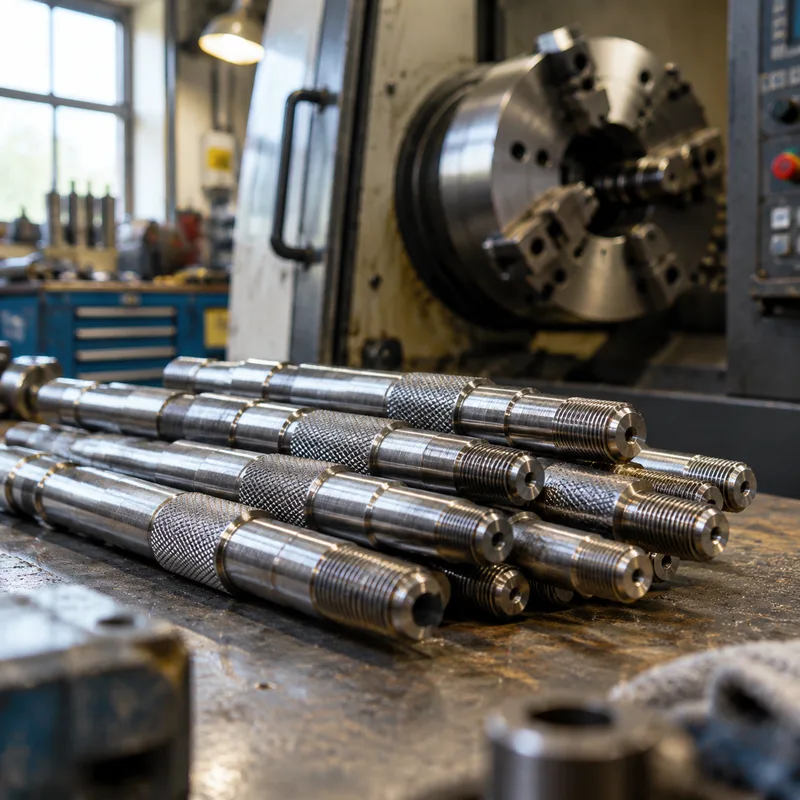
Swiss machining is bar-fed turning through a sliding headstock and a hardened guide bushing: the material is supported directly at the cutting plane, so unsupported stock is limited to one to two bar diameters instead of cantilevering out of a chuck. That single mechanical difference is what lets long, thin, intricate parts — pins, fittings, fasteners, miniature shafts — cut without the deflection that ruins them on a conventional lathe.
The process window is narrow by design. Component diameters stay inside the guide-bushing ceiling — a bit over an inch, with many applications well under that — and standard production tolerances hold in the two-ten-thousandths to one-thousandth-of-an-inch band. In exchange, one machining cycle covers turning, cross-drilling, threading and milling, and bar-fed production sustains five-figure unit runs with consistent dimensional repeatability.
Specifications
| Property | Value | Condition |
|---|---|---|
| Tolerance | ±0.0002–0.001 in (standard production band) | the tight end holds only with spindle-runout, tool-wear, thermal-growth and material-behavior control — the guide bushing is what makes it reachable on slender parts |
| Max diameter | below 1.25 in (many applications under 0.75 in) | the guide-bushing support envelope, not the machine size, sets the diameter ceiling |
| Unsupported length | 1–2× bar diameter at the cutting interface | the constraint that cuts bending forces and vibration versus conventional chuck-and-extend turning |
| Surface finish | 16–32 µin Ra (typical band) | reached under optimized cutting parameters; biocompatible-part practice uses the same band |
| Batch range | bar-fed production beyond 10,000 units | stability for parts over 3:1 length-to-diameter is what carries the long bar-fed runs |
| Materials | brass, copper, aluminum, titanium alloys, stainless steel, nickel alloys, nylon, PEEK | the material span the sliding-headstock process is documented for |
| Typical parts | medical screws, orthopedic pins, aerospace fasteners, electrical connector pins, hydraulic fittings, miniature shafts | the application set the source documents for sub-1.25 in diameters |
| Max stock dimensions | Not established in the collected evidence — confirm at quotation. | |
| Lead time | Not established in the collected evidence — confirm at quotation. | |
| Setup changeover time | Not established in the collected evidence — confirm at quotation. | |
Values above are rendered from the collected model-evidence layer, each carrying the heat-treatment condition it was reported under; fields without collected evidence are stated as not established rather than estimated. Requirements outside the table are confirmed for the specific geometry and batch at quotation.
Applications & Selection Points
Medical screws, pins and implant hardware
Surgical screws and orthopedic pins need precise thread geometry, tight dimensional control and fine surface finish for biocompatibility — exactly the guide-bushing regime. Small diameters under half an inch hold stable support, and thread forms cut in the same cycle as the profile.
Aerospace and hydraulic fittings
Fasteners and hydraulic fittings demand concentricity and repeatable head dimensions across thousands of parts. The sliding-headstock geometry keeps slender threads concentric, and high-strength alloys from stainless to titanium are within the documented material set.
Electronics connector pins and miniature shafts
Connector pins and shafts combine small diameters with length-to-diameter ratios a conventional lathe cannot hold straight. The bushing-supported cut maintains stability past ratio, which is what keeps contact resistance and assembly fits consistent.
When Swiss is the wrong call
Parts over the diameter window, blocky prismatic geometry, or one-off prototypes belong on conventional CNC turning or milling — the bar-feed and setup economics only pay at production volume, and the diameter ceiling is real. State the diameter, length and annual quantity early; the process choice usually falls out immediately.
Frequently Asked Questions
How small and how precise can a Swiss-turned part be?
Diameters typically stay below the guide-bushing size range — many applications run under a smaller fraction of an inch — with standard production tolerances in the two-ten-thousandths to one-thousandth-of-an-inch band depending on runout, thermal and tooling control. Surface finish reaches the low microinch Ra range under optimized parameters. Call out the tight bands only on functional features.
Which materials suit Swiss machining?
The documented set spans brass, copper, aluminum, titanium alloys, stainless steel, nickel alloys, nylon and PEEK. Free-machining alloys carry the highest production rates; titanium and stainless machine within the same support geometry with adjusted speeds. State the alloy and temper with the drawing.
What should I send for a Swiss machining quote?
The drawing with tolerances on functional features, the alloy, bar-stock availability, and the annual plus per-lot quantity. Swiss economics are bar-fed and volume-driven — the quantity band decides whether the process wins at all, so give real numbers rather than a wide range.
Ordering & Documentation
Documents
A drawing with GD&T on the functional features, thread callouts, alloy and temper, and finish requirements. Where a feature mates across an assembly, mark it — the tolerance band on those features drives the process plan.
Quotation
Quotes price bar stock, cycle time and setup against the quantity band. Bar-fed production amortizes setup differently from chuck work, so give annual volume and lot sizes — the same part can quote in a different process class at a different quantity.
Process plan
Expect one machining cycle covering turning, cross-drilling, threading and milling, guided by the bushing at the cut. Inspection concentrates on concentricity and the tight-band features; ask what the inspection report covers before award.
Sample & Supply
First articles prove thread quality and concentricity on the real alloy lot. Production runs bar-fed with consistent dimensional behavior; agree changeover and safety-stock handling for ongoing call-offs at quotation.