C360 Brass CNC Machining
Machining C360 free-cutting brass: the collected property envelope, the cutting-parameter bands that make it the machinability benchmark, and what to send for a quotation.
Last updated: 2026-10-27
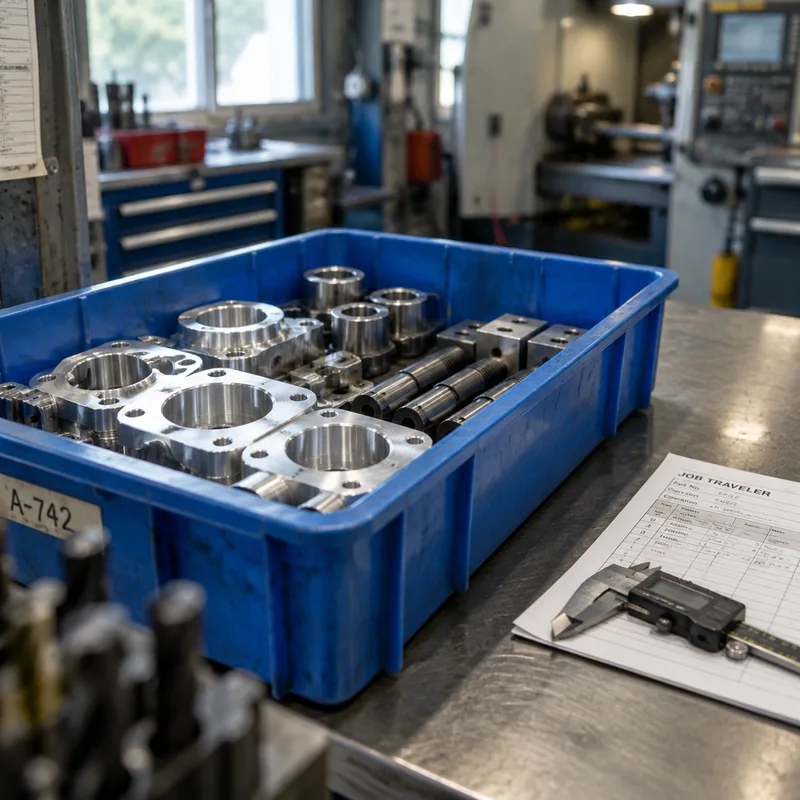
C360 is free-cutting brass: a copper-zinc alloy with a few percent of lead added for one purpose — to shatter chips as they form. That single compositional change makes it the reference point of the machinability scale, the alloy every other copper-based material is measured against. Valve bodies, fittings, gears, precision pins and connectors machine from it at high speed with long tool life and a finish that often needs no secondary operation.
The trade-offs are as specific as the benefit. The lead content rules it out for drinking-water and food-contact service unless compliance is verified, and its forming behavior is ordinary next to the lead-free cartridge grade. For a part defined by machined features rather than formed ones, though, C360 is usually the shortest path from stock to finished component.
Specifications
| Property | Value | Condition |
|---|---|---|
| Composition | ~60% Cu, 35–37% Zn, 2.5–3.7% Pb (α-β brass) | source comparison point: C110 copper ≥99.9% Cu; lead content means RoHS / potable-water compliance must be verified per use |
| Machinability rating | 100% (industry benchmark) | the free-machining benchmark all copper alloys are measured against; low cutting resistance, suitable for high-volume production |
| Tensile strength | 300–600 MPa (depends on grade/temper) | per the same source block: yield ~100–400 MPa, Brinell hardness 80–150 HB |
| Yield strength (0.2% offset) | ~100–400 MPa | holds shape during machining per the source |
| Hardness | 80–150 HB | balances strength and machinability per the source |
| Density | ~8.50 g/cm³ | source comparison point: C110 copper ~8.89 g/cm³ |
| Achievable tolerance | ±0.01 mm | achievable on C360 per the source; low cutting resistance is what carries it |
| Turning parameters | 600–900 SFM cutting speed, 0.005–0.015 in/rev feed | turning band from the source cutting-parameter table; coolant optional, depth of cut 0.010–0.150 in |
| Corrosion dezincification limits | Not established in the collected evidence — confirm at quotation. | |
| Fatigue strength | Not established in the collected evidence — confirm at quotation. | |
| Max stock dimensions | Not established in the collected evidence — confirm at quotation. | |
Values above are rendered from the collected model-evidence layer, each carrying the heat-treatment condition it was reported under; fields without collected evidence are stated as not established rather than estimated. Requirements outside the table are confirmed for the specific geometry and batch at quotation.
Applications & Selection Points
High-volume turned parts
Fittings, valve components, threaded inserts and precision pins are where the machinability benchmark pays: high cutting speeds, low cutting forces and short brittle chips suit Swiss turning and high-volume lathe work. Tight-tolerance small parts hold dimension predictably because the cutting process itself is stable.
Threads, gears and intricate features
The alloy cuts threads cleanly and machines small modules of gear teeth and knurled details without the built-up edge that gummy materials produce. Engraving-grade detail work — badges, instrument components — benefits from the same chip-breaking behavior.
Where compliance or forming moves the choice
Potable-water contact, food service and some RoHS-sensitive assemblies push the choice to the lead-free cartridge grade. Parts that must be bent, deep-drawn or stamped give up little in C360 terms but gain a lot of formability margin by moving to the lead-free alloy — decide the dominant requirement before the material, not after.
Corrosion service boundaries
General atmospheric and indoor service suits C360 well. Hot, stagnant or aggressive aqueous environments raise dezincification risk — the selective loss of zinc that leaves a weak copper sponge — and the lead distribution adds stress-corrosion considerations the lead-free grade handles better. Marine and aggressive-process parts should name the environment explicitly on the RFQ.
Frequently Asked Questions
Why does C360 machine so much faster than other copper alloys?
The lead is insoluble in the alloy and precipitates as tiny globules that act as internal chip-breakers. As the tool shears the workpiece, those inclusions concentrate stress at the shear plane and the chip fractures short instead of flowing long across the face. Less rubbing, lower cutting force, less heat in the cut — that is the whole mechanism behind the benchmark rating.
Can C360 parts be used in drinking-water assemblies?
Not by default. The lead content that makes the alloy machine so well is exactly what potable-water and food-contact regulations restrict, and the alloy appears as exempt-only rather than categorically compliant on compliance tables. If the service demands lead-free, the cartridge grade is the standard substitute — plan the different machining economics into the price expectation.
What should I send for a C360 quotation?
The model and drawing with tolerances and thread callouts, the stock form, quantity, and any finish such as plating, polishing or brushing. Name the service environment — it is the fastest way to surface a dezincification or compliance question before production rather than after first article.
Ordering & Documentation
Documents
Send a STEP model with a dimensioned drawing, tolerances and thread callouts. State the stock form — hex, round rod or bar — because brass stock shapes price and nest differently.
Quotation
A quote is priced from the model, tolerance class, thread content, finish and quantity. High-volume turned work is where the alloy earns its keep; say so on the RFQ so the process plan can use the cutting-parameter headroom rather than treating it like a generic alloy.
Process plan
Coolant is optional on many C360 operations — the chip-breaking behavior carries dry and mist cutting in a way gummy alloys cannot. Deep drillings still want chip-evacuation planning; surface finish targets below the as-machined band may add a polishing or brushing step.
Sample & Supply
First articles on turned features validate thread quality and surface finish before the batch. Production holds dimension consistently once proven; material certification and compliance paperwork are available on request — ask at quotation when the assembly carries regulatory requirements.