Copper (T2) CNC Machining
CNC machining of high-conductivity copper: collected property envelope, electrical and thermal application selection points, and quotation inputs.
Last updated: 2026-10-29
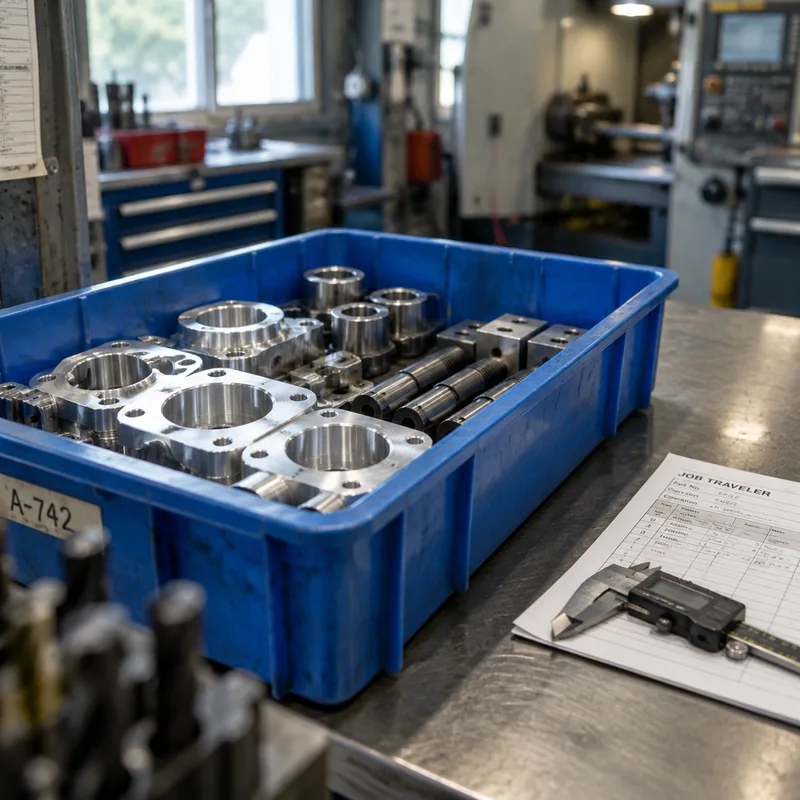
This grade is commercial-purity copper: at minimum a hair under entirely copper by mass, chosen not for strength but for conductivity. Electrical conductivity sits at the top of the metallic range and thermal conductivity just behind it, which is why electrodes, busbars, heat-rejection surfaces and RF components are machined from it.
It is soft and gummy under the tool, and its strength is modest — structural load is not its job. Machining plans revolve around sharp tooling, high clearance and chip control; where strength or wear enters the picture, the copper alloys (brasses, bronzes) are the usual redirection, keeping much of the conductivity while adding hardness.
Specifications
| Property | Value | Condition |
|---|---|---|
| Tensile strength | ≥ 195 MPa | strip, room-temperature tensile |
| Hardness | ≤ 70 HV | strip (Vickers) |
| Density | 8.96 | pure copper (≈99.9% Cu) |
| Elongation | 35% | annealed; C11000 ETP (T2 ≈ C11000 equivalent) |
Values above are rendered from the collected model-evidence layer, each carrying the heat-treatment condition it was reported under; fields without collected evidence are stated as not established rather than estimated. Requirements outside the table are confirmed for the specific geometry and batch at quotation.
Applications & Selection Points
Electrical and thermal conduction parts
Busbars, contact pads, electrode holders for the EDM process, heat sinks and spreader plates — applications where conduction per unit cost is the specification. Soldering and brazing are straightforward, which simplifies assembly of conductive paths.
Where the copper alloys fit instead
Bearings, gears, valves and threaded fittings need hardness and wear behavior pure copper cannot give. The brasses add machinability; the bronzes add strength and wear life. Both keep useful conductivity — the selection is a sliding scale between conduction and mechanical duty.
Machining-behavior planning
Expect gummy chips and tool sticking in the annealed state; sharp positive-rake tooling and flood coolant are the countermeasures. Work-hardened or as-drawn stock machines more cleanly. Surface finish comes up well when the chips are controlled — plan the sequence to keep it that way.
Corrosion and finish
Bare copper develops a patina outdoors; conductive and thermal parts usually stay bare or tin/silver plated where contact resistance matters. State the finish expectation — plating changes contact behavior and is a real specification, not a cosmetic one.
Frequently Asked Questions
What does the T2 designation mean?
It is the commercial-purity wrought-copper grade of the Chinese standard system: copper plus silver at a hair under the full balance, with no phosphorus requirement — the equivalent slot that generic engineering drawings mean by "pure copper". State the standard designation your drawing carries; equivalent grades exist across standards and suppliers can map them.
Should my part be pure copper or a copper alloy?
Follow the dominant requirement. Conduction-limited parts — electrodes, busbars, thermal spreaders — stay pure. Strength-, wear- or thread-loaded parts move to brass or bronze, accepting lower conductivity. If both matter, say which one the part fails without; that decides the family.
What should I send for a copper machining quote?
The model and drawing with tolerances, the material designation, any plating or contact-resistance requirement, quantity, and the inspection needs — conductive parts sometimes carry conductivity or hardness verification. Note the working temperature; it can affect temper selection.
Ordering & Documentation
Documents
Send the model plus a drawing with tolerances and the material designation. Call out contact surfaces and any plating — they drive both process sequence and inspection.
Quotation
Priced from the model, material form and size, tolerances, plating or finish, and quantity. Copper stock prices track the metal market; large cross-sections carry noticeable material share — worth knowing when comparing quotes.
Sample & Supply
First articles confirm surface finish and, where specified, conductivity or hardness verification. Repeat batches run to forecast; agree certificate scope at quotation.
Storage & Shipping
Bare copper tarnishes in humid air — bag parts or specify plated/lacquered surfaces for long shelf life. Soft surfaces dent and scratch in bulk; pack padded and separated.