Brass CNC Machining
Brass CNC machining in C360 free-cutting and C260 cartridge brass: tolerances to ±0.005 in (0.127 mm), fast chip-breaking cuts, plating and polishing finishes.
Last updated: 2026-10-29
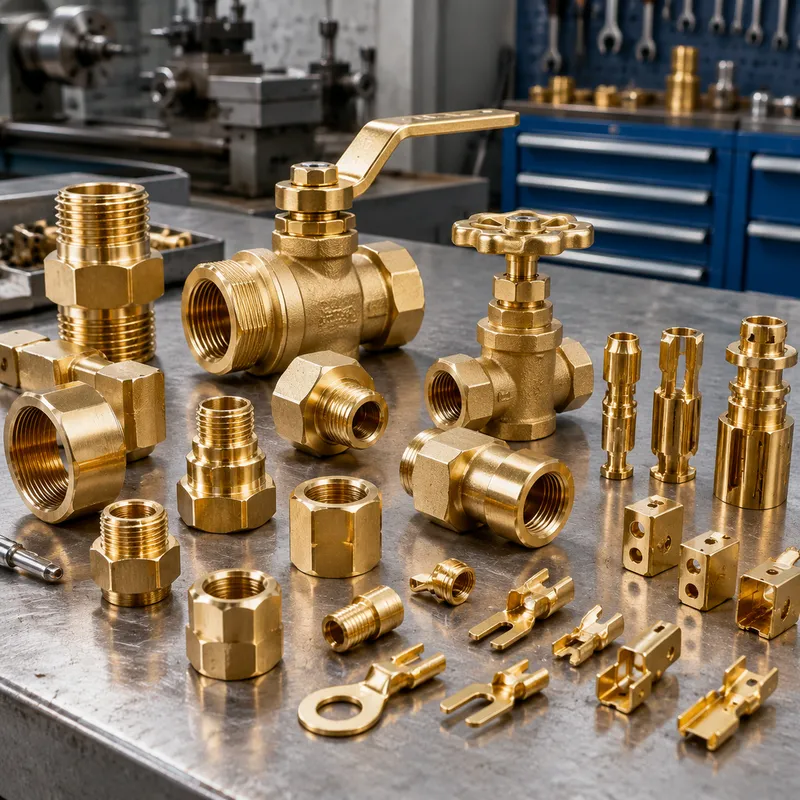
Brass is the speed metal of CNC machining: free-cutting C360 — about 60% copper, over 30% zinc and under 3% lead — breaks chips cleanly and cuts with low tool force, so cycle times and tool wear stay low even on long-running batches. Where cold forming matters, higher-ductility C260 cartridge brass bends, flares and draws without cracking.
Collected tolerance capability runs down to ±0.005 in (0.127 mm). Parts leave the machine functional as-machined; when appearance or corrosion resistance matters, the standard finishing routes are polishing/buffing, nickel or chrome electroplating, and honing for bearing seats and fluid passages.
C360 free-machining brass — approximately 60% copper, over 30% zinc, less than 3% lead — is the default for threaded and fastener-type parts because the lead aids chip breakage and reduces cutting force. Leave parts as-machined where function allows (it eliminates finishing time and maintains tolerances), and spec electroplating knowing a few-micron layer can alter tight fits.
Specifications
| Specification | Brass CNC Machining |
|---|---|
| Tolerance | Down to ±0.005 in (0.127 mm) |
| Axes | brass machines well on 5-axis equipment |
| Lead Time | Typical ranges: simple prototype parts 3–7 business days; complex prototype parts 5–15 business days; low-volume production 1–4 weeks |
Materials
Surface Finishes
Brass machines faster than almost any metal alloy: free-cutting C360 (about 60% copper, over 30% zinc, under 3% lead) breaks chips cleanly and cuts with low tool force, while the higher-ductility C260 cartridge brass suits cold-formed features. Machined tolerance capability runs down to ±0.005 in (0.127 mm). Parts leave the machine functional as-machined; where appearance or corrosion resistance matters, polishing/buffing, nickel or chrome electroplating and honing for bearing seats are the standard finishing routes — plating a few microns thick must be budgeted into fit tolerances.
Values above are the collected catalog specification envelope for this product family. Tolerances and lead times at the demanding end of a range are confirmed for the specific geometry, material and batch at quotation.
Applications & Selection Points
Free-machining components at volume
Fittings, valve bodies, inserts, terminals and decorative hardware: C360 machines so fast that brass often beats steel and aluminum on total part cost at volume. The lead content that aids chip breaking keeps surface finish consistent across long runs.
Cold-formed and combined features
C260 cartridge brass carries bending, flaring and drawing operations — parts that machine partially and form partially stay in one material. State the forming operations when quoting, because temper and grain direction change with them.
Conductive and corrosion-exposed parts
Electrical connectivity plus atmospheric corrosion resistance make brass the default for terminals, RF hardware and plumbing trim. Nickel or chrome plating adds wear and tarnish protection — a few microns of plate must be budgeted into tight fits.
Finish selection on brass
As-machined brass is functional and often final; polishing/buffing produces the decorative surface; honing finishes bearing seats and bores with a cross-hatch pattern. Over-polishing thin walls and fine edges reduces dimensions — flag delicate features so they are finished with care.
Frequently Asked Questions
C360 vs C260 brass — which alloy for my part?
C360 free-cutting brass is the machining default: lowest cutting force, cleanest chips, best finish at speed. C260 cartridge brass sacrifices some machinability for ductility — choose it when the part bends, flares, spins or draws, or when higher cold-worked strength matters. Most machined fittings and inserts are C360.
What tolerance can brass machining hold?
Collected capability runs down to ±0.005 in (0.127 mm) on machined features. Brass machines stably, so holding tight tolerance across a batch is normal; the watch item is plating — a few microns of nickel or chrome shifts a tight fit, so either plate after final machining with allowances or keep plating off critical surfaces.
What does a brass machining quote need?
A 3D model or drawing with tolerances, alloy preference (C360/C260) or the service conditions to choose one, finish requirement (as-machined, polished, plated), and quantity. Note any forming operations — they constrain temper and change the material recommendation.
Ordering & Documentation
Documents
A drawing or model with tolerance callouts and finish maps (which surfaces are polished, plated or left as-machined). State alloy, or state the environment and function and let the alloy be recommended.
Quotation
Pricing inputs: alloy, tolerance and finish spec, quantity and delivery cadence. Brass stocks well — repeat batches often price lower because stock sizes and programs are already qualified.
Sample & Supply
First articles confirm finish and fit, especially where plating follows machining — approve the plated sample, not just the bare part, before the batch.
Storage & Shipping
Bare brass tarnishes in humid storage; bag parts or specify lacquered/plated surfaces for long shelf life. Polished surfaces scratch in bulk — pack padded.