C260 Brass CNC Machining
Machining C260 cartridge brass: the collected property envelope and temper dependence, where it beats free-cutting brass, and what to state on the RFQ.
Last updated: 2026-10-29
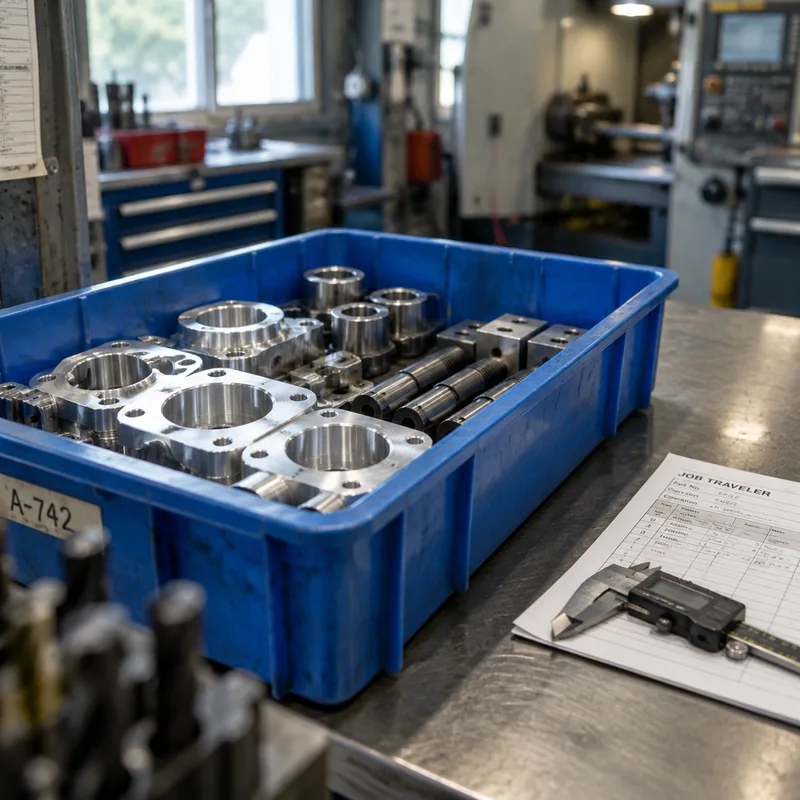
C260 is cartridge brass — roughly seventy percent copper, the balance zinc, with no lead — and it is the forming alloy of the brass family. Where free-cutting brass exists to be turned into chips at maximum speed, C260 exists to be bent, drawn, stamped and spun without cracking, which is why terminals, connector shells, eyelets and deep-drawn housings specify it. It still machines cleanly by general-engineering standards; it simply gives up some cutting speed in exchange for ductility and compliance.
The property that decides a C260 part is the temper. The same alloy in an annealed condition forms deeply and measures soft; in a hard temper it carries spring and strength but loses the elongation a forming die needs. State the temper on the drawing, not just the alloy — two C260 parts can behave like different materials.
Specifications
| Property | Value | Condition |
|---|---|---|
| Composition | 68.5–71.5% Cu, balance Zn, lead max 0.07% | the 70/30 Cu/Zn ratio sits in the alpha-phase field — FCC structure is what carries the cold formability; no lead |
| Machinability rating | 30% | source comparison point: C360 brass at the 100% benchmark — C260 is the forming alloy, not the free-cutting one |
| Tensile strength | 375 MPa (H02 temper) | source comparison point: C360 at 385 MPa in the same temper |
| Elongation | 23% | source comparison point: C360 at 18% — the ductility margin that makes C260 the forming and stamping alloy |
| Lead content | None (RoHS compliant) | source comparison point: C360 at ~3% Pb, exempt-only for RoHS — the compliance reason drawings move to C260 |
| Corrosion behavior | moderate dezincification resistance; resistant to stress-corrosion cracking at typical residual stresses | better than C360 on both counts (70% Cu limits zinc mobility; no lead at grain boundaries) — the two properties that favor C260 for plated or aggressive-environment parts |
| Fatigue strength | 110–160 MPa (≈18 ksi, H02) | temper-dependent; CDA flat products H02, 100×10⁶ cycles |
| Hardness | 60–85 HBW (≈70 HRB, H02) | temper-dependent |
| Max stock dimensions | Not established in the collected evidence — confirm at quotation. | |
Values above are rendered from the collected model-evidence layer, each carrying the heat-treatment condition it was reported under; fields without collected evidence are stated as not established rather than estimated. Requirements outside the table are confirmed for the specific geometry and batch at quotation.
Applications & Selection Points
Stamped and formed current-carrying parts
Terminals, contact springs and connector bodies are the classic C260 territory: the copper content carries current affordably, the ductility survives the die, and the lead-free composition keeps RoHS paperwork simple. Where a terminal needs spring behavior at elevated temperature rather than bulk conductivity, that is the boundary where a phosphor-bronze grade enters the conversation — worth settling before the die is cut.
Plated and cosmetic hardware
C260 takes plating uniformly and polishes to a warm finish, so it is common in decorative hardware, engraved parts and architectural fittings. Its better resistance to dezincification and stress-corrosion cracking — relative to the free-cutting grade — is the second reason plated or outdoor-exposed parts often specify it.
When free-cutting brass is the better call
A part that is mostly turned, drilled and threaded, carries no forming operation, and lives in a benign environment will usually price better in the leaded free-machining grade: the machinability gap is large, and it shows up directly in cycle time. Drinking-water and food-contact requirements point away from leaded brass entirely.
Machining behavior worth planning for
Without lead inclusions to break chips, C260 produces longer, gummier chips than the free-cutting grade. Sharp positive-rake tooling, higher surface speeds than steel and good chip evacuation in deep bores carry most of the difference. Thread cutting and knurling are routine; the alloys real constraint is keep-it-cutting, the same discipline pure copper demands, just milder.
Frequently Asked Questions
Is C260 a drop-in replacement for leaded free-cutting brass?
Not on machining economics. The leaded grade sets the machinability benchmark and C260 sits far below it, so heavy turning work prices noticeably higher in C260. The substitution makes sense when forming operations, plating behavior, dezincification resistance or lead-free compliance dominate the requirement — and poorly when raw cutting speed dominates.
Why does temper matter so much on a C260 drawing?
Temper decides both the forming outcome and the final properties. An annealed temper forms deeply but measures soft; a hard temper delivers strength and spring at the cost of the elongation a tight bend needs. Sources disagree on exact minimum bend radii by temper, so the safe practice is to name the temper, state the tightest bend, and let the shop confirm formability before the die is cut.
What should an RFQ for C260 parts include?
The alloy and temper, the form (sheet, strip, rod or tube), the tightest bend radius and draw depth if any forming is involved, plating or finishing requirements, and any compliance documentation — the lead-free composition is exactly why compliance questions usually end quickly on this grade.
Ordering & Documentation
Documents
Send a STEP model with a 2D drawing that names the alloy and temper explicitly, carries the bend radii and draw depths, and calls out plating or finish. If the part is stamped as well as machined, include the die-readiness tolerances on the critical features.
Quotation
A quote is priced from the alloy and form, forming operations, machining content, finish and quantity. Stock selection matters on C260: parts that nest efficiently from standard strip or rod widths avoid paying for scrap.
Process plan
Expect the plan to sequence forming before finish machining where both exist, and to confirm formability at the stated temper before committing tooling. Chip evacuation on deep features is a planning question, not an afterthought, on this alloy.
Sample & Supply
First articles validate forming behavior at the real temper — the step where temper-dependent surprises surface. Material certification and compliance documentation are available on request; agree the scope at quotation.