12L14 Free-Machining Steel CNC Machining
CNC machining of 12L14 leaded free-machining steel: the machinability benchmark, where its strength ceiling sits, the lead-content boundary conditions, and what to send for a quotation.
Last updated: 2026-10-31
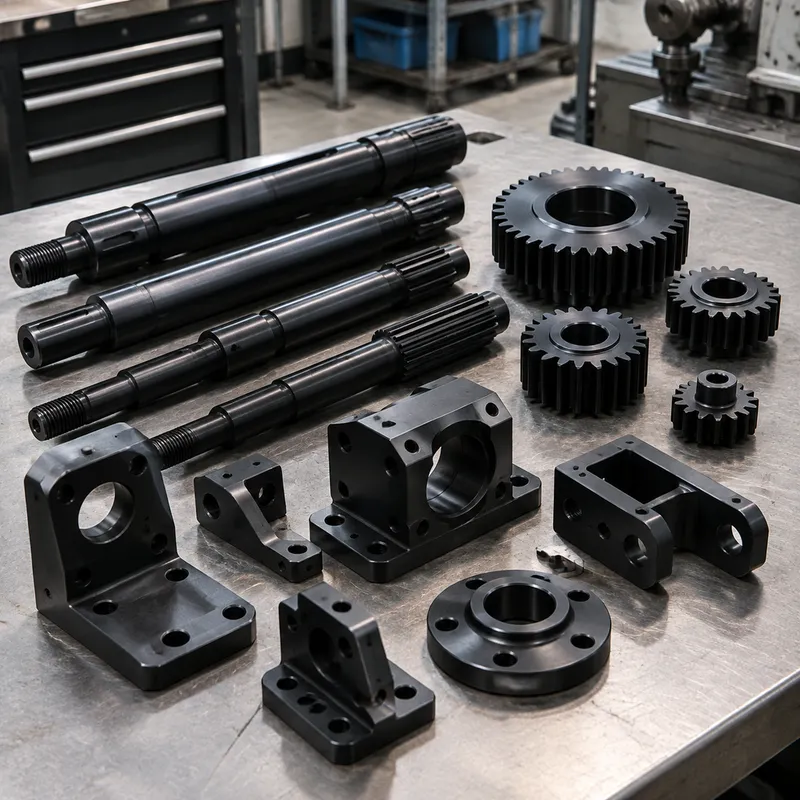
12L14 is the reference point the whole machinability scale hangs on: a low-carbon steel with sulphur for clean chip breaking and a lead addition that lubricates the cutting edge, rated by convention at the top of the machinability index. On automatic lathes and high-volume turning it produces short, clean chips, fine finishes and long tool life at feed rates other steels cannot match — which is why fittings, inserts, fasteners and small hardware have run on it for decades.
The lead addition that makes it cut so well is also its boundary: 12L14 is specified less freely than it used to be, with drinking-water, food-contact and certain environmental applications moved onto lead-free alternatives. Choosing it is a decision about whether the part touches people or regulated systems — and that question belongs on the drawing, not discovered after first article.
Specifications
| Property | Value | Condition |
|---|---|---|
| Tensile strength | 540 MPa | |
| Yield strength (0.2% offset) | 415 MPa | |
| Hardness | 163 HB | |
| Machinability rating | 100% |
Values above are rendered from the collected model-evidence layer, each carrying the heat-treatment condition it was reported under; fields without collected evidence are stated as not established rather than estimated. Requirements outside the table are confirmed for the specific geometry and batch at quotation.
Applications & Selection Points
High-volume turned small parts
Threaded fittings, bushings, spacers, hose inserts, ratchet and knob details, and the whole world of screw-machine hardware run on 12L14 because cycle time is the product. The grade holds small-diameter work without chatter, threads cleanly, and keeps tool changes rare — the cost difference against a plain low-carbon steel is visible on every production batch, not just in the material price.
Precision small hardware at low force
Parts with fine features — small cross-holes, knurls, shallow threads, thin walls — benefit from the low cutting force the grade allows: the workholding can be lighter and delicate features survive machining without distortion. For prototype and short-run CNC work the same behavior holds, though the case for a free-machining grade weakens when the part count is small enough that cutting time is not the dominant cost.
Where 12L14 is the wrong call
Anything that joins by welding: the sulphur and lead cause hot-short weld metal and porosity, so welded assemblies belong on plain low-carbon steel. Load-critical parts hit the strength ceiling of the grade. And any application with drinking-water contact, food surfaces or regulatory lead limits should move to a lead-free free-machining grade — the machinability penalty is real but smaller than a compliance failure.
Machining behavior that defines the grade
The lead films the shear zone and the sulphur forms soft inclusions that break the chip, so 12L14 cuts with minimal built-up edge and takes fine finishes at high feed. For CNC shops used to alloy steels, 12L14 feels almost like brass to cut. The flip side is that its properties are what they are: no meaningful heat-treatment route beyond case treatments, and dimensional behavior set by the low-carbon core.
Surface treatment and corrosion
Zinc plating, black oxide and phosphate coatings are the standard finishes on 12L14 hardware — the grade neither develops stainless behavior nor carries load at temperature, so the surface system chosen at quotation is mostly about corrosion and appearance. Plated free-machining hardware is ubiquitous precisely because the base material takes coatings cleanly.
Frequently Asked Questions
Why does 12L14 machine so much better than ordinary steel?
Two deliberate additions work together: sulphur forms soft manganese-sulphide inclusions that embrittle the chip locally so it breaks short, and lead films the interface between chip and tool so friction and heat drop. The result is higher feeds, less built-up edge, better finishes and longer tool life. The trade is mechanical: those same inclusions are what cap strength and kill weldability.
Is the lead in 12L14 a problem for my application?
Depends entirely on contact. As bare machined metal inside machinery, 12L14 is unremarkable. Drinking-water systems, food-contact surfaces, and some consumer and environmental regulations have moved off lead-bearing grades, and jurisdictions differ on the details. If your part enters one of those worlds, name a lead-free free-machining alternative on the drawing and let the quote follow the compliance boundary.
Can 12L14 parts be heat treated?
Not through-hardened in any useful sense — the carbon content is too low. Case hardening is the standard route where a hard surface is needed, and it works because the core stays soft while the carburized skin hardens. Parts needing bulk strength belong on medium-carbon or alloy grades; forcing 12L14 into that role fails at the load case.
My drawing says mild steel — can I save cost with 12L14?
Sometimes, on three conditions: the part is welded to nothing, the load case fits the free-machining strength band, and the lead-content boundary of the application is clear. Where all three hold, the machinability saving on production volume is real. Where welding or higher strength is involved, the substitution fails — confirm with whoever owns the requirement before changing the callout.
What should I send for a 12L14 machining quote?
A STEP model plus a 2D drawing with tolerances and threads, the named grade and product form, quantity and batch intent, finish or plating callout, and any application context that touches drinking water or food contact — that last item decides the grade before it decides the price.
Ordering & Documentation
Documents
Send a STEP or IGES model with a 2D drawing carrying tolerances and thread callouts. Name the grade and flag any lead-content restriction explicitly — the compliance question changes material selection, not just price.
Quotation
Pricing follows the model, drawing, stock form and finish system, with quantity doing most of the work on a free-machining grade — the grade shows its value at volume. Tolerance class on critical diameters and plating scope complete the quote inputs.
Sample & Supply
First articles verify dimensions and finish; on plated hardware, coating adhesion and thickness join the check list. Production batches hold the free-machining behavior that made the grade worth specifying — cycle-time savings repeat across the run.
Storage & Shipping
Machined 12L14 ships with the surface system the finish callout defines; bare surfaces are oil-protected for transit like any carbon steel. Store dry. Plated parts are stable in ordinary storage and shipping conditions.
Request a quote for 12L14 Free-Machining Steel CNC Machining →