1045 Carbon Steel CNC Machining
CNC machining of 1045 medium-carbon steel: collected property envelope with heat-treatment condition, where it sits between 1018 and 4140, and what to send for a quotation.
Last updated: 2026-10-31
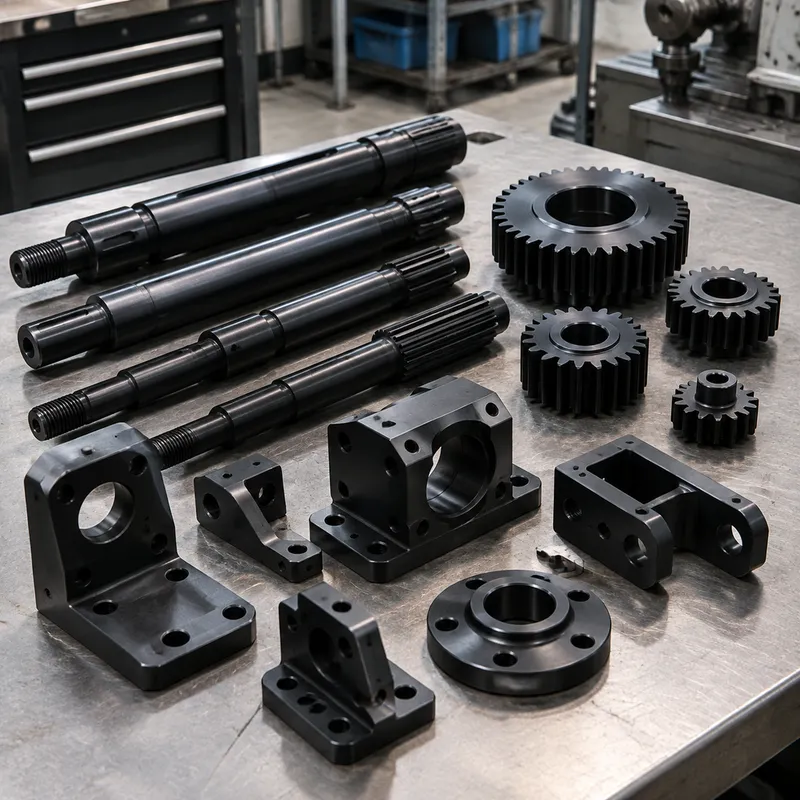
1045 is the workhorse medium-carbon steel of general machining: enough carbon to respond to heat treatment, enough machinability to cut economically, and a price position that keeps it the default answer when a part needs more strength than low-carbon mild steel but does not justify an alloy grade. Shafts, axles, gears, pins, bushings and general machinery components are its classic territory.
The grade rewards a process plan that names the heat-treatment condition up front, because the same bar stock can arrive normalized, quenched and tempered, or as-rolled, and the machining behavior and final properties move with the condition. Shops quote 1045 most cleanly when the drawing separates as-machined features from post-heat-treat tolerances and states which surfaces, if any, get induction hardening.
Specifications
| Property | Value | Condition |
|---|---|---|
| Tensile strength | 585–700 MPa | |
| Yield strength (0.2% offset) | 310 MPa | |
| Hardness | 170 HB | annealed |
| Elongation | 12–16% | |
| Machinability rating | 60–65% |
Values above are rendered from the collected model-evidence layer, each carrying the heat-treatment condition it was reported under; fields without collected evidence are stated as not established rather than estimated. Requirements outside the table are confirmed for the specific geometry and batch at quotation.
Applications & Selection Points
Shafts, axles and rotating machinery parts
Turned 1045 shafts, spindles, sprocket hubs and keyed axles are the bread-and-butter use of the grade. Its medium-carbon balance gives the strength a rotating part needs at modest cost, and bearing seats can be locally induction hardened without treating the whole shaft. Where rotating duty carries shock loads or elevated fatigue demands, the alloy grades are the usual step up.
General machinery components and fixtures
Clamp blocks, fixture plates, tooling details, clevis pins, tie rods and hydraulic fittings routinely come out of 1045 stock. It machines predictably with standard carbide practice, holds general tolerance work without special measures, and its response to welding and flame hardening makes it convenient for one-off tooling where the material may need rework in the field.
Where 1045 is the wrong call
Large or complex welded fabrications belong on low-carbon steel, where the weld zone needs no preheat gymnastics. Through-hardened precision dies and high-wear tooling belong on tool steel. And when the duty combines high strength with toughness across a temperature range, the nickel-bearing alloy grades outperform plain-carbon 1045 — specifying it there saves material cost and buys rework.
Heat-treatment condition shapes the quote
As-rolled 1045 machines acceptably but carries the lowest strength; normalized stock gives a more uniform structure; quenched-and-tempered stock delivers the strength buyers usually chose the grade for, at the price of harder cutting and possible distortion on thin sections. The efficient sequence for precision parts is usually rough machine, heat treat, finish machine — and the drawing should say so, because finishing to tight tolerance before hardening risks losing the tolerance.
Machining behavior and tooling
1045 cuts with continuous to short chips depending on condition, and hardened or heat-treated lots raise cutting forces noticeably. Sharp carbide, flood coolant and stable workholding cover the general case; interrupted cuts on hardened stock are where inserts chip, so the sequence should avoid impacting a hardened surface with a finishing pass. Parts that need very fine finishes route to grinding after machining, standard for shaft bearing seats.
Welding, rework and secondary operations
1045 welds, but its carbon content means preheat and slow cooling matter — skip them and the heat-affected zone can crack or harden unpredictably. For welded-and-machined assemblies, stress relief before final machining keeps the geometry true. Keyseating, broaching, thread cutting and cross-drilling are all routine; the grade punishes no particular operation the way free-machining grades punish none.
Frequently Asked Questions
Should my part be 1045 or an alloy grade like 4140?
Decide from the duty, not from habit. 1045 carries general shaft and machinery loads at minimum cost; 4140 buys higher strength and better hardenability for the same machined geometry when the part sees shock, elevated section sizes or demanding fatigue. If the drawing was written for 4140 but the load case is modest, moving to 1045 is a legitimate cost reduction — confirm it with whoever owns the requirement.
Is 1045 the same as mild steel?
No. Mild steel carries roughly half the carbon of 1045 and cannot through-harden the same way, which is why mild parts stay ductile and weldable while 1045 parts can be heat treated to much higher strength. Confusing the two on a drawing is expensive in both directions: mild steel where heat treatment was planned fails at the load case, and 1045 where welding was planned cracks at the weld.
What condition should I buy 1045 in for machining?
Match the condition to the sequence. For parts machined entirely before heat treatment, normalized stock gives predictable cutting. For parts that need the strength built in before final machining, buy quenched-and-tempered stock and plan harder cutting parameters. For general fixtures and pins, as-rolled or normalized is the economical default. State the condition on the RFQ — quotes differ with it.
How do I keep tolerance through heat treatment?
Rough machine, heat treat, then finish machine the tolerance-critical features. Distortion on thin or asymmetric sections is the enemy, so symmetric stock removal and stress relief before the final passes are the standard countermeasures. Features that must survive hardening without grinding — such as tapped holes — should be cut before heat treat and sized with the expected movement in mind.
What should I send for a 1045 machining quote?
A STEP model plus a 2D drawing with tolerances, the named grade and product form (bar, plate or forging), the heat-treatment condition and any hardness requirement, quantity, finish callout and inspection needs. Naming the condition is the input most likely to change both the price and the proposed process sequence.
Ordering & Documentation
Documents
Send a STEP or IGES model with a 2D drawing carrying tolerances, thread callouts and finish. Name the grade and its heat-treatment condition explicitly — 1045 quoted as-rolled and 1045 quoted quenched-and-tempered are different quotes.
Quotation
Pricing follows the model, drawing, material form and condition, quantity, tolerance class on critical features, and any hardening or grinding steps. Post-heat-treat finishing belongs in the RFQ from the start so the sequence is priced as engineered.
Sample & Supply
Prototype quantities from one piece are normal, and a first article validates both the fixturing and the heat-treatment plan before a production batch. Hardness and material certification are available on request — agree the scope at quotation.
Storage & Shipping
Machined 1045 ships with the surface condition the finish callout defines; bare steel surfaces are typically protected with rust-preventive oil or packing for transit. On receipt, store dry and separated from corrosive exposure — the grade rusts like any unalloyed carbon steel.