8620 Alloy Steel CNC Machining
CNC machining of 8620 case-hardening alloy steel: collected property envelope, why the grade is specified for carburized gears and pins, and the machining sequence that keeps tolerance through the case treatment.
Last updated: 2026-10-31
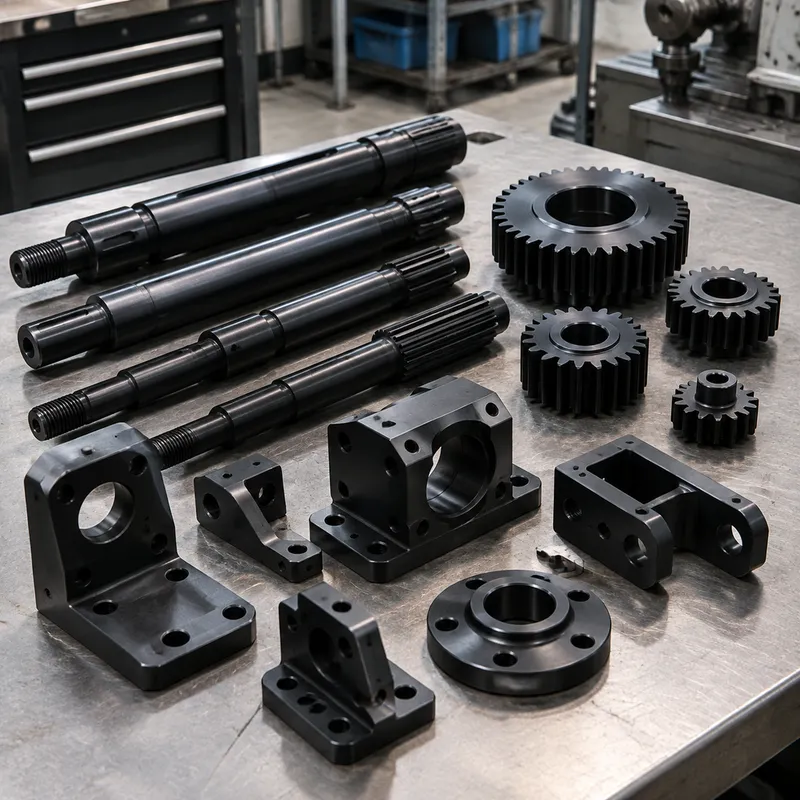
8620 exists for one signature job: parts that must be soft and tough in the core while carrying a hard, wear-resistant surface. The nickel-chromium-molybdenum chemistry is tuned for carburizing — a low core carbon content that stays ductile, and alloying elements that let the case build deep and harden predictably. Gears, camshafts, pins, bushings and powertrain hardware that live on that combination are specified in 8620 as a matter of course.
Machining 8620 is straightforward in the pre-carburizing condition, which is exactly when it gets cut: most of the geometry is machined soft, the part goes through carburizing and hardening, and only the precision features come back to the machine or grinder afterwards. The process split — what to finish before treatment and what to leave for after — is the engineering heart of an 8620 part, and the drawing that states it quotes faster and cleaner.
Specifications
| Property | Value | Condition |
|---|---|---|
| Tensile strength | 585–745 MPa | annealed |
| Yield strength (0.2% offset) | 350–515 MPa | annealed |
| Elongation | 15–20% | annealed |
| Hardness | 170–217 HB (annealed) | annealed, Brinell |
| Machinability rating | 60% | vs. AISI 1212 = 100% |
Values above are rendered from the collected model-evidence layer, each carrying the heat-treatment condition it was reported under; fields without collected evidence are stated as not established rather than estimated. Requirements outside the table are confirmed for the specific geometry and batch at quotation.
Applications & Selection Points
Carburized gears and gear blanks
Spur, helical and bevel gear blanks for automotive and industrial gearboxes are the canonical 8620 part. The blank is hobbed, shaped or fully machined soft, carburized to build the case on the flanks, hardened, and then finished — often by grinding the teeth — to final profile. The case gives wear life at the tooth surface while the tough core resists the bending fatigue and shock loads that crack through-hardened teeth.
Pins, bushings and wear-interface hardware
Clevis pins, cam followers, rocker-shaft pins and linkage bushings pair a hard outside with a non-brittle middle, which is precisely what carburized 8620 delivers. Machining the bore or shaft soft and leaving the wear surface for the case treatment is the efficient sequence; local grinding of bearing diameters after hardening brings the running clearances in.
Where 8620 is the wrong call
Parts that need uniform through-hardness — many die details, high-strength shafts without wear surfaces, or plates loaded in tension — belong on through-hardening grades like 4140 or 4340, where the whole section hardens rather than a thin case. And if no wear interface or surface fatigue exists at all, plain-carbon steel is usually the cheaper, weldable answer.
The machined-then-carburized sequence
Cutting 8620 before carburizing is the low-force, long-tool-life half of its life story; the discipline is planning what the furnace will do to the geometry. Case depth builds on every exposed surface, including threads and bores the drawing may not want hardened — masking, selective carburizing or leaving grinding stock on critical diameters are the countermeasures, and they all belong on the drawing.
Dimensional behavior through heat treatment
Carburizing and quenching move material — case growth, quench distortion and the occasional tempering shift all add up. Precision parts therefore rough-machine soft, heat treat, then finish the tight features. Thin and asymmetric sections distort most; symmetric stock removal and generous grinding stock on bearing diameters are the standard defenses.
Welding and repair considerations
8620 can be welded but its alloy content and case-hardening purpose make repair welding a qualified-procedure conversation, not a field convenience: the weld zone will not develop the case the base design relies on, and preheat-plus-post-weld treatment is needed to avoid cracking. Design welded assemblies around a different grade and reserve 8620 for machined-and-carburized parts.
Frequently Asked Questions
Why specify 8620 instead of through-hardened 4140 for a gear?
Because the failure modes differ. A carburized 8620 tooth carries a hard, wear-resistant surface over a tough, shock-tolerant core — the classic gear recipe. Through-hardened 4140 hardens the whole section, which raises the risk of brittle fracture under impact but simplifies processing where full-section hardness is genuinely needed. Gear and cam duty usually rewards the case; structural and torsional shaft duty often rewards through hardness.
What does carburizing do to my machined dimensions?
Every exposed surface grows slightly as the case forms, and the quench adds distortion on top. The practical response is a sequence: machine soft with grinding stock on the precision diameters, carburize and harden, then grind or hard-turn the tight features. Expect the shop to ask which surfaces are toleranced after treatment — that question is the mark of a shop that has run 8620 before.
Do all surfaces of an 8620 part get hard?
By default yes — carburizing sees every accessible surface, which is usually desired but not always. Threads, precision bores or assembly features that must stay soft need masking or selective treatment, and bores can be copper-plated or mechanically stopped to exclude carbon. State the surfaces to exclude on the drawing; the furnace shop converts them into a masking plan.
Is 8620 easy to machine before heat treatment?
Yes — in the annealed or normalized condition it cuts at a comfortable machinability level for an alloy steel, with predictable tool life and standard carbide practice. The hardness buyers associate with 8620 comes after the case treatment, not from the bar stock; machining plans should nevertheless account for the mixed lots a shop may see, since normalized stock cuts a little harder than annealed.
What should I send for an 8620 machining quote?
A STEP model, a 2D drawing with tolerances split into before-heat-treat and after-heat-treat groups, case depth and surface hardness requirements, quantity and inspection needs. The condition split and the case callout are the two inputs that most change both price and proposed sequence.
Ordering & Documentation
Documents
Send a STEP or IGES model with a 2D drawing that separates as-machined from post-treatment tolerances and carries the case depth and hardness callout. Name the grade and condition — 8620 without a case specification is an unfinished drawing.
Quotation
Pricing follows the model, drawing, stock condition, quantity, masking and grinding scope, and inspection plan. Case treatment is a priced process step with lead time of its own — parts that need it are quoted through the full sequence, not just the machining.
Sample & Supply
First articles on carburized parts verify case depth, surface hardness and post-treatment dimensions together — the three move as a set. Agree the inspection scope (certification, hardness survey, dimensional report) at quotation so the sample carries the evidence the production batch will be judged on.
Storage & Shipping
Finished 8620 parts ship with the surface state the process defines — bare case, ground or coated. Untreated surfaces of raw stock rust like any carbon steel and are normally oil-protected in transit. Store dry; case-hardened surfaces are not corrosion-proof.