2024 Aluminum CNC Machining
CNC machining of 2024 aluminum: the fatigue-critical aerospace alloy — strength and temper behavior, why corrosion protection is part of the specification, and what to send for a quotation.
Last updated: 2026-10-29
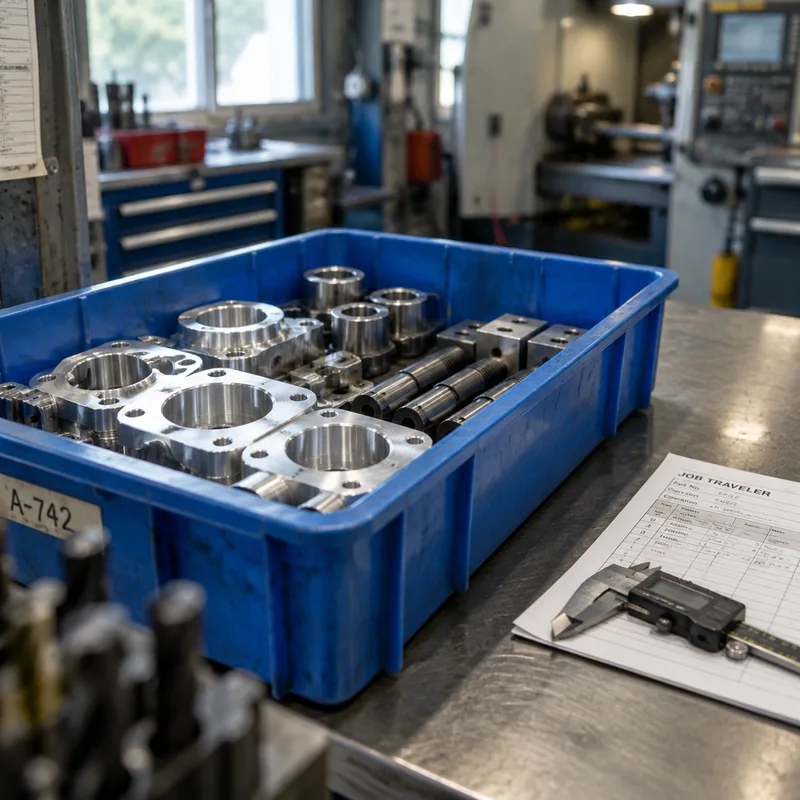
2024 is the classic aerospace structural aluminum: a copper-bearing alloy chosen for high strength and, above all, high fatigue resistance — the property that airframe skins, wing structures and fatigue-loaded fittings demand across decades of load cycles. In the shop it appears most often as T3-temper plate and bar, and it machines willingly at high metal-removal rates with standard carbide practice.
The copper that builds the strength is also the grade's defining limitation: 2024 sits at the poor end of the aluminum corrosion-resistance spectrum, and bare material in a damp or salted environment will corrode in ways the silicon-magnesium grades never would. Specifying 2024 therefore always includes a protection decision — cladding, anodizing, painting or a dry service environment — and that decision belongs in the RFQ, not as a surprise after first inspection.
Specifications
| Property | Value | Condition |
|---|---|---|
| Tensile strength | 68–70 ksi typical | 2024-T3 |
| Yield strength (0.2% offset) | 47–50 ksi typical (techsteel); 345 MPa (xometry) | 2024-T3 |
| Fatigue strength | 138 MPa | 2024-T3 (xometry generalized values) |
| Hardness | ≈120 HB (Brinell) | 2024-T3 |
| Elongation | 18 % | 2024-T3 (xometry generalized values) |
| Density | 2.78 g/cm³ | 2024-T3 (xometry generalized values) |
| Thermal conductivity | Not established in the collected evidence — confirm at quotation. | |
| Machined tolerance | Not established in the collected evidence — confirm at quotation. | |
Values above are rendered from the collected model-evidence layer, each carrying the heat-treatment condition it was reported under; fields without collected evidence are stated as not established rather than estimated. Requirements outside the table are confirmed for the specific geometry and batch at quotation.
Applications & Selection Points
Fatigue-critical and high-strength structural parts
Where the load cycles — aircraft structural fittings, brackets, aerospace and motorsport components — 2024 earns its specification through fatigue behavior that the general-purpose grades do not match at equal strength. If a drawing arrives from an aerospace pedigree with the grade already named, the fatigue requirement is usually the reason, and it is worth preserving through to material certification and traceability rather than treating as a substitutable aluminum.
Corrosion protection is part of the process plan
Machined 2024 parts that leave the shop bare carry the grade's weakness with them. Anodizing is the standard countermeasure — with the caveat that the copper-rich alloy anodizes to a yellower, less cosmetic finish than the architectural grades — and painting or cladding covers the rest. State the protection on the RFQ; a 2024 part quoted without a finish decision is an unfinished specification, and indoor-dry service should be stated explicitly to justify leaving it bare.
Where 2024 is the wrong call
Weldability is the practical exclusion: the alloy is notoriously crack-prone under welding, so machined-then-welded assemblies belong to different grades entirely. Corrosion-exposed service without a protection plan, and cosmetic anodized surfaces where color consistency matters, both push the selection toward the silicon-magnesium family. Strength alone is not the tiebreaker — 7075 offers higher static strength where fatigue is not the driver.
Machining-behavior selection points
Expect fast, free cutting in the common tempers with sharp carbide tooling and flood coolant; the alloy does not demand exotic practice. The watch-items are distortion on thin walls and long parts — stress relief between roughing and finishing is normal practice on aerospace geometry — and the fact that stress-temper state matters to final dimensions, so the temper on the purchase order should match the drawing, not just the alloy name.
Frequently Asked Questions
2024 or 7075 for a machined structural part?
Decide from the load character. 2024 wins where fatigue cycles dominate — that is its historical reason for existence in airframes. 7075 carries higher static strength for strength-limited designs. Corrosion exposure, welding and cosmetic anodizing all disfavor one or both. If the drawing is inherited from an aerospace context, treat the named grade as load-bearing information rather than a starting point for substitution.
Why does 2024 corrode when other aluminum alloys do not?
The copper that enables its strength and fatigue behavior leaves the alloy vulnerable: copper-rich regions form microstructures that break the protective oxide in damp or chloride environments. This is a metallurgy property, not a quality defect — which is why the standard answers are cladding (a pure-aluminum layer rolled onto sheet), anodizing or painting, and why bare 2024 should only ship to a service environment the RFQ has declared.
What should I send for a 2024 machining quote?
The standard package — STEP model, 2D drawing with tolerances, quantity and batch intent — plus the aerospace-specific inputs: the temper called out on the drawing (it is part of the specification), any material certification and traceability requirement, and the corrosion protection decision (anodize, paint, clad stock, or declared dry service). If the part is a welded assembly, say so — the grade conversation should reopen.
Ordering & Documentation
Documents
Send a STEP or IGES model with a 2D drawing carrying tolerances and the finish specification. Name the alloy and temper explicitly — the temper is a material specification for this family, not a label — and attach any governing standard or certification requirement rather than assuming the shop will infer aerospace practice from the grade alone.
Quotation
A quote is priced from the model and drawing, the named alloy and temper, quantity and batch intent, certification requirements, and the finishing plan. Stock form matters: plate versus bar versus rolled sheet changes grain direction, distortion behavior and price, so state the starting form where the drawing implies it.
Sample & Supply
Prototype quantities from one piece are normal for machined aluminum and are the cheapest way to validate distortion behavior and finish on the actual geometry before production. First-article inspection with material certification is available on request; for fatigue-critical parts, agree the traceability scope at quotation — it is a supply-chain commitment, not a machining step.
Storage & Shipping
Finished 2024 parts should not sit bare in damp storage; ship either finish-protected or wrapped dry with desiccant for long transit. Keep parts separated from dissimilar-metal contact in the box — galvanic pairs in a damp package are a classic source of the very corrosion the grade is prone to. Anodized or painted parts ship under the same care as their finish requires.