Titanium (Ti-6Al-4V) CNC Machining
Machining titanium Ti-6Al-4V: the collected strength-to-weight envelope, the stiffness caveat, the temperature and wear boundaries, and what to state on the RFQ.
Last updated: 2026-10-29
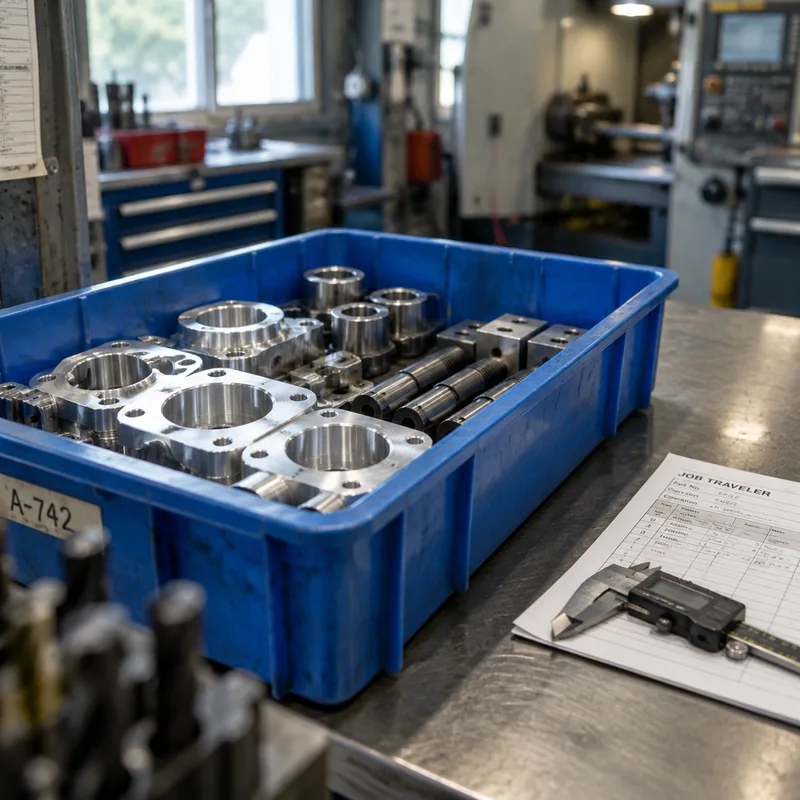
Ti-6Al-4V is the titanium alloy most machined parts are made of: roughly the tensile strength of medium alloy steels at a little over half the density, corrosion-resistant enough to skip coating in most service, and biocompatible enough for implants. Aerospace structures, medical hardware, marine components and high-end sporting goods are its natural territory — anywhere the weight budget is as real as the strength budget.
Its boundaries are as well-defined as its strengths. The modulus is only about half of steel’s, so stiffness-limited parts do not shrink weight the way strength-limited ones do; it cannot harden to wear-resistant levels the way tool steels do; and it wants respect at the cutter — low cutting speeds, rigid setups and flood coolant, because titanium punishes heat and chatter. Quoted honestly, it is a superb material with a machining cost to match.
Specifications
| Property | Value | Condition |
|---|---|---|
| Density | 4.43 g/cm³ | roughly 45% lighter than 304/316 stainless (7.93–7.99 g/cm³ per the same source table) |
| Tensile strength | 900–1100 MPa | Ti-6Al-4V band; ~896 MPa (130 ksi) typical condition, ~1103 MPa in the STA condition |
| Elastic modulus | 110 GPa | roughly 56% of steel’s modulus — stiffness-limited designs do not transfer from steel one-for-one |
| Hardness limit | ≈ 38 HRC (max for Ti-6Al-4V) | wear-critical applications where hardened steels reach 58–62 HRC favor steel |
| Service temp limit | ≈ 315 °C sustained | titanium keeps strength in the 300–600 °C band per one source; sustained service above ~600 °F (315 °C) favors appropriate alloy steels |
| Fatigue strength | 510–517 MPa | 10⁷ cycles, smooth unnotched specimens |
| Thermal conductivity | 6.7–7.5 W/m·K | Ti-6Al-4V, room temperature |
| Machinability rating | ≈22% | relative to AISI 1212 = 100% (Ti-6Al-4V Grade 5) |
Values above are rendered from the collected model-evidence layer, each carrying the heat-treatment condition it was reported under; fields without collected evidence are stated as not established rather than estimated. Requirements outside the table are confirmed for the specific geometry and batch at quotation.
Applications & Selection Points
Strength-limited, weight-critical structures
This is where titanium earns its premium: load paths that compare with alloy steel at a fraction of the weight. Airframe fittings, fastener-adjacent hardware, springs and high-cycle components use the strength-per-kilogram advantage directly. Where the design is stiffness-limited instead — long spans, thin panels — geometry, not material, carries the load, and the alloy advantage narrows.
Medical and dental hardware
The alloy osseointegrates and is the standard for implantable hardware — a property no steel offers. Machined implants and surgical instruments need clean process chains and full material traceability; state the documentation requirement on the RFQ, because it is part of the process plan, not an afterthought.
Corrosion service without coatings
Marine fittings and chemical-adjacent hardware in titanium stay bare by design: the passive oxide layer re-forms immediately and the part does not galvanically punish its neighbours the way carbon steel inserts in aluminium structures do. Where a coated steel part would need coating maintenance for its whole life, the premium buys that maintenance away.
Where another material wins
Above modest sustained temperatures, appropriate alloy steels hold properties further; where surfaces slide or wear, hardened steels reach hardness titanium cannot; and where neither weight nor environment is critical, the cost ratio makes titanium the wrong answer. The honest RFQ states the service — the grade proposal follows from it.
Cutting physics and parameter discipline
Titanium cuts the way it does because heat has nowhere to go: low thermal conductivity keeps the heat in the tool edge instead of carrying it away in the chip, and the strength at cutting temperature keeps the load high even at slow speeds. The parameter consequences are qualitative and strict — surface speeds well below steel practice, feeds that keep the edge under the work-hardened skin it creates, constant-engagement toolpaths, high-pressure flood or through-tool coolant, and scheduled tool changes before edge wear degrades the surface. Dwell and spring passes are more expensive here than on any common alloy: rubbing on titanium glazes the surface and chews the edge simultaneously.
Tolerance and surface finish on a springy, heat-sensitive alloy
The alloy's half-of-steel stiffness is a tolerance problem before it is a deflection-claim problem: thin walls and long bores spring away from the cutter and spring back where the tool is not, so the achievable tolerance on such features is set by the fixturing and pass strategy, not the machine. Fine surface finishes are reachable — titanium polishes well — but the cutting pass that produces them must be genuinely cutting, because burned or glazed titanium surfaces are both cosmetically and metallurgically wrong. Fire risk with fine titanium chips is a finishing-house discipline: swarf management belongs in the plan on any part with heavy chip generation.
Failure and rejection modes on titanium parts
The characteristic rejects: edge burnout visible as torn, work-hardened surfaces where a dull tool rubbed; spring-pass dimensional drift on thin features measured acceptable at roughing; notching wear at the depth-of-cut line on interrupted passes, which leaves a tapered profile late in the tool life; galling and seizure in threaded or sliding titanium-on-titanium contact, which is a design callout (coatings, dissimilar interfaces or lubrication spec) rather than a machining defect; and contamination embrittlement where oxygen pickup at elevated temperature went unmanaged in a prior process step. Most trace back to process-plan assumptions the RFQ never stated.
Positioning against its usual alternatives
The honest comparison set: aluminum alloys win on machinability and cost whenever the strength case is soft; alloy steels win on stiffness, wear and temperature; stainless wins on raw-material cost where weight is free; and engineering polymers take the corrosion-and-weight case when loads are low. Titanium's territory is the intersection — strength, weight and environment all matters at once — and printed titanium extends it to lattices and consolidated parts that billet machining would waste. Comparing on one axis alone is how titanium gets specified into parts that did not need it.
Frequently Asked Questions
Is titanium always the lightweight choice?
Only when the design is strength-limited. Titanium delivers steel-class strength at roughly half the density, but its stiffness is also about half of steel’s — so a part governed by bending or buckling needs the geometry rethought, not just the material swapped, before the weight saving appears. State which limit governs the design and the quotation can compare honestly.
Why does titanium machining cost more?
The metal is expensive to melt and form into stock, and the cutting is slow: heat does not leave through the chip the way it does in steel, so speeds drop, tools wear faster and rigid fixturing matters more. The process plan is the price driver as much as the raw bar. Designing generous tolerances on non-critical features keeps the premium where it buys something.
What should I send for a titanium machining quote?
The STEP model and drawing with tolerances, the alloy and condition, the service environment and temperature, quantity, and any traceability or certification requirement. Weight-critical and medical parts should say so explicitly — the condition of supply and the documentation scope both change the plan.
Are titanium threads and sliding interfaces a problem?
They can be, and it is a design-level property of the alloy pair: titanium against itself galls under load — the surfaces microweld and tear — which ruins threads and seizing-prone interfaces. The standard answers are process-side and design-side together: well-formed threads cut with sharp tooling and good finish, lubrication or anti-seize on assembly, dissimilar mating materials where the design allows, and coatings where they do not. Flagging threaded and sliding features on the RFQ gets the countermeasure priced in rather than discovered at assembly.
Why is my titanium part dimensionally drifting between operations?
Most often it is the stiffness problem expressing itself: features that measured in spec in a clamped state relax once the part is unfixtured, and the drift shows up at a later operation or incoming inspection. Thin sections, long bores and aggressive roughing sequences amplify it. The fixes are fixturing that supports rather than clamps distortion into the part, rough-then-finish passes with intermediate relaxation, and tolerance callouts that distinguish clamped-measured from free-state dimensions. If free-state tolerance matters to your assembly, say which features — it changes how the part is inspected, not just how it is cut.
Ordering & Documentation
Documents
Send a STEP model with a 2D drawing carrying tolerances and finish notes. Name the alloy — Ti-6Al-4V by default — and the condition of supply, because strength varies with heat-treat condition and the drawing’s numbers assume one.
Quotation
A quote is priced from the model and drawing, alloy and condition, quantity, tolerance class, finish and documentation needs. Titanium stock is a visible cost line: flag features that allow smaller starting stock or near-net forms where the geometry permits.
Process plan
Expect rigid setups, low cutting speeds, flood coolant and scheduled tool changes. Deep bores, thin walls and interrupted cuts are where the process plan earns its keep — flag them on the RFQ rather than discovering them in first-article scrap.
Certification & Supply
Material certification with lot traceability is standard practice on titanium and mandatory in aerospace and medical scope — agree the certification level at quotation. Finished parts ship deburred and passivated by default; coating is usually unnecessary in corrosive service.