Aerospace CNC Machining
Aerospace and defense CNC machining: simultaneous 5-axis milling and turning for turbine blades, impellers and structural parts in titanium, Inconel 718, 17-4PH and aluminium — ±0.025 mm class tolerances.
Last updated: 2026-10-26
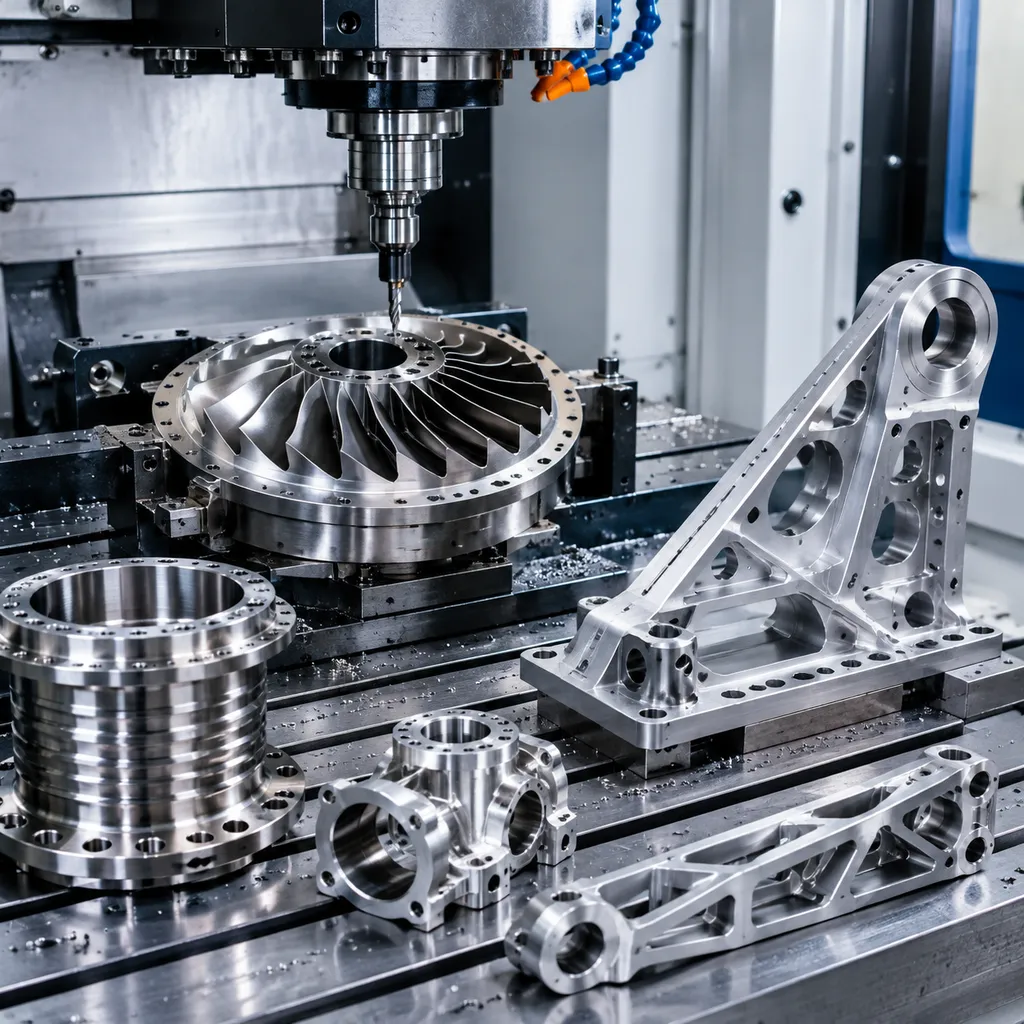
Aerospace CNC machining produces flight-critical and defense hardware — turbine blades, impellers, structural fittings, actuation components — on simultaneous 5-axis milling and turning centers that hold tight tolerances and fine finishes on compound curves and undercuts. The process discipline differs from general machining in one word: evidence. Every dimension, material lot and process step traces to a requirement.
The catalog envelope covers diameter tolerances of ±0.025 mm and length ±0.050 mm typical, 5–10 business days for prototype defense components, and an alloy list that reads like an airframe bill of materials: 4340 and 300M alloy steels, 17-4PH and 15-5PH stainless, titanium 6Al-4V, Inconel 718, 7075-T6 and 7050-T7451 aluminium, and 95% tungsten alloy.
Specifications
| Specification | Aerospace CNC Machining |
|---|---|
| Tolerance | diameter tolerances ±0.025 mm; length ±0.050 mm typical. |
| Axes | 5-axis simultaneous |
| Lead Time | 5–10 business days for prototype defense components. |
Materials
CNC machining service for aerospace and defense components using simultaneous 5-axis milling and turning centers to produce complex geometries such as turbine blades, impellers, and structural parts. Holds tight tolerances with superior surface finish on compound curves and undercuts.
Values above are the collected catalog specification envelope for this product family. Tolerances and lead times at the demanding end of a range are confirmed for the specific geometry, material and batch at quotation.
Applications & Selection Points
Complex rotating and airfoil geometry
Blades, impellers and blisks need simultaneous 5-axis tool paths to keep tool approach normal to curved surfaces — the geometry class where 3-axis approximation leaves scalloping and fatigue-relevant surface conditions. Thin airfoil sections also make workholding and cut strategy a deflection-management exercise, planned before the first cut.
Hard-metal structural parts
Titanium 6Al-4V and Inconel 718 are the structural workhorses of the hot and loaded sections of an aircraft — and notoriously demanding to machine: low cutting speeds, rigid setups, disciplined coolant strategy. The alloy list exists because material selection is fixed by the engineering requirement; the machining plan must follow it, not substitute it.
Tolerance placement on flight hardware
The ±0.025 mm diameter / ±0.050 mm length typicals cover precision bearing and fit interfaces on this class of work. Inspection evidence — dimensional reports, first-article inspection — is part of the deliverable, specified at order and executed against the drawing revision.
Defense and export-controlled work
Defense components carry the same machining discipline plus documentation and handling expectations (the cited 5–10 business day prototype lead time is for this class). Export control and eligibility are confirmed at quotation — they are order-level properties, not machining properties.
Surface treatment and part identity
Aerospace drawings specify surface treatment as strictly as geometry: anodizing, chem film, passivation, plating and paint each carry process specs, and treatments on flight hardware are executed against those specs with traceability of their own. Part marking — the identifiers etched or stamped into the hardware — is the thread that ties each physical part to its inspection record and material lot. Both belong on the drawing from the start: a part that arrives finished but unmarked, or treated off-spec, is documentation-incomplete regardless of how well it measures.
Frequently Asked Questions
What does AS9100D certification actually change for a buyer?
AS9100D wraps ISO 9001 with aerospace-sector requirements: configuration management, risk management, first-article processes, traceability and counterfeit-part prevention. For a buyer, the practical differences appear as evidence — FAI reports, full material traceability, controlled revisions. Certification is a process claim, not a dimensional guarantee; the drawing and the inspection plan remain the contract.
Which aerospace alloy for my part, and what does it change in machining?
Alloy selection follows the load, temperature and weight budget of the design — 7075-T6 for high-strength airframe fittings, titanium 6Al-4V where weight and corrosion ride together, Inconel 718 for heat, 17-4PH/15-5PH for corrosion-resistant strength. Each choice moves machining cost: titanium and Inconel cut far slower than aluminium. Confirm the material callout with the drawing rather than substituting on availability.
What does an aerospace machining RFQ need?
Drawing with revisions and tolerances, material spec and traceability requirement, quantity and delivery schedule, inspection requirements (FAI scope, reports), finish/surface treatment callouts, and any certification or export-control context. The documentation package is part of the quote scope — quoting hardware without its evidence requirements prices the wrong job.
Ordering & Documentation
Documents
Controlled drawing package, material specification, inspection requirements (first-article scope, dimensional reports) and any process specifications. Revision control is strict: orders execute against a named revision, and changes route through a documented update.
Quotation
Pricing inputs: geometry and material (titanium/Inconel quote very differently from aluminium), tolerance class, inspection and documentation scope, quantity, schedule and destination. Prototype defense components quote at the 5–10 business day band; production schedules are agreed per lot.
Sample & Supply
First-article inspection precedes production lots, per aerospace practice. Batch continuity — same material lot class, same process chain — is preserved across production orders, and any deviation routes through documented approval rather than silent substitution.
Storage & Shipping
Flight hardware ships individually protected with identity preserved (part marking, traceability documentation with the shipment). Steel alloys in bare-machined state ship oiled or wrapped; titanium and aluminium are more forgiving. Store with traceability documentation attached — hardware without its paper trail is not flight hardware.