High Volume CNC Machining
High volume CNC machining from 1,000 to 1,000,000+ parts: ±0.0005 in across full runs, ±0.0001 in on critical features, machinability-first material sets and lights-out automation economics.
Last updated: 2026-10-29
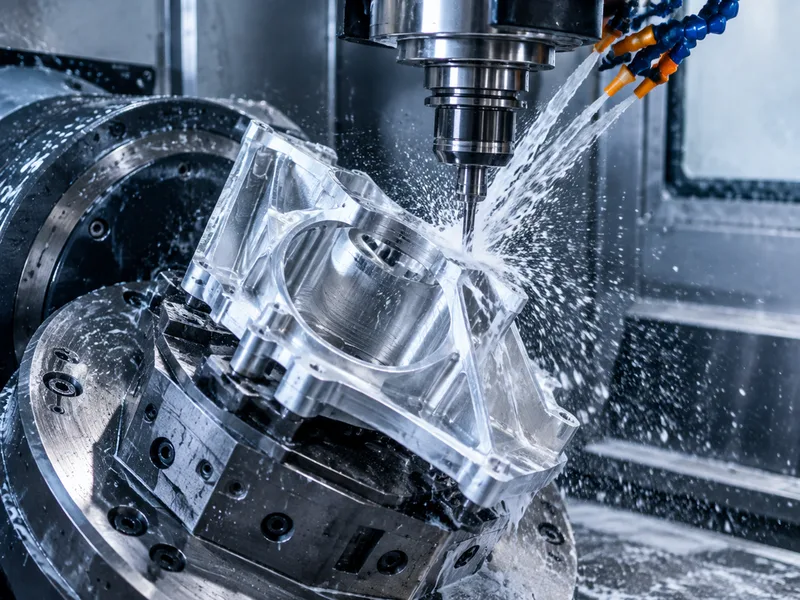
High volume CNC machining is a different discipline from prototype work: machines are dedicated to a part family, fixtures are hardened and palletized, and the goal shifts from flexibility to repeatable output. Production runs start around 1,000 units and scale past 1,000,000, and well-controlled processes hold ±0.0005 in (±12.7 µm) across full runs with critical features at ±0.0001 in (±2.5 µm).
The economics decide the process: setup and programming costs amortize toward insignificance at scale, and automation multiplies the effect — multi-spindle equipment can trade a 30% higher machine cost for a 500% throughput increase, and lights-out cells run overnight unattended. Material choice is machinability-first, because a 5–10% machinability edge compounds across every cycle, every tool and every scrapped part.
Specifications
| Specification | High Volume CNC Machining |
|---|---|
| Tolerance | ±0.0005 in (±12.7 µm) routine across full runs; ±0.0001 in (±2.5 µm) on critical features |
| Axes | multi-axis machining, integrated with automation, is utilized to enhance productivity and flexibility in high-volume production |
| Lead Time | Standard lead times scale with order volume: 50-500 parts (mid-volume) typically 21-28 days, expedited 14-21 days; 500+ parts (production) 28-42 days, expedited 21-28 days |
Materials
Surface Finishes
High volume CNC machining covers production runs from 1,000 into the hundreds of thousands of parts, on dedicated or semi-dedicated equipment: horizontal machining centers, multi-spindle and Swiss-type lathes with bar feeders, and pallet-loaded 5-axis cells running lights-out. Well-controlled processes hold ±0.0005 in (±12.7 µm) across full runs, with critical features at ±0.0001 in (±2.5 µm). Material choice is driven by machinability at scale: 6061-T6 dominates milling, free-machining C360 brass and 303 stainless cut cycle time in turning.
Values above are the collected catalog specification envelope for this product family. Tolerances and lead times at the demanding end of a range are confirmed for the specific geometry, material and batch at quotation.
Applications & Selection Points
Runs from 1,000 parts upward
The threshold where dedicated fixturing, proven tool life management and SPC pay for themselves. Below it, small-batch machining keeps its flexibility advantage; above it, per-part cost falls sharply as setup amortizes — with unit costs typically 50–80% under low-volume pricing once automation lands.
Free-machining material strategies
At volume, machinability outranks raw strength: 6061-T6 stays the milling workhorse, while C360 brass and 303 stainless cut cycle time in turning work. Over-specified alloys are a real cost — stepping a design from 7075 to 6061 or 4140 to 1045 can save significantly without functional compromise.
Automotive, medical, aerospace, electronics
Each industry carries its own material set: 6061, 6082, 1045 and 4140 for automotive; 7075, 2024, 17-4 PH and Ti-6Al-4V for aerospace; 316L, 17-4 PH and PEEK for medical; C360 brass, 6061 and C110 copper for electronics. State the industry at quotation so the supplier proposes from the right starting set.
Lights-out production cells
Bar feeders, robotic loading and pallet changers let turning and milling cells run unattended for hours or days. Tool wear is managed on planned replacement — cycle counts, spindle-load monitoring, sister tooling — so dimensional consistency survives the shifts nobody watches.
Frequently Asked Questions
What quantities count as high volume CNC machining?
Collected market practice starts high volume at 1,000 parts, scaling into the hundreds of thousands or millions, with medium volume running 100–1,000. The real boundary is economic: where dedicated fixtures and programs amortize faster than they are paid for. Quote the annual volume and per-lot size openly — they decide the process route.
Which tolerances survive at production scale?
Well-controlled CNC processes hold ±0.0005 in (±12.7 µm) across full production runs, with critical features reaching ±0.0001 in (±2.5 µm). The discipline is statistical, not heroic: SPC, planned tool life and stable fixturing keep the band. Reserve the tightest callouts for features that need them — every over-tight tolerance multiplies cycle time and scrap risk across the whole run.
What does a high volume machining quote need?
A production-stable 3D model and drawing with tolerances and finish callouts, the annual volume and per-lot quantity, material grade with acceptable substitutes, and quality documentation requirements. Ask explicitly whether the price assumes dedicated fixturing or a standard-workholding route — it moves both the tooling cost and the per-part price.
Ordering & Documentation
Documents
A 3D model plus dimensioned drawing with tolerance bands separated into general and critical features. Note acceptable material substitutes — at volume, a machinability-equivalent grade can be the single largest cost lever.
Quotation
Pricing inputs: annual and per-lot volume, material grade, tolerance and finish callouts, and quality documentation (SPC records, first-article reports, certifications). Ask for per-part price at the target annual volume, not just the first-lot price.
Sample & Supply
First articles validate the fixture and program before the run commits; process capability is then held by SPC rather than per-part inspection. Agree the replenishment cadence — blanket orders with call-offs are the normal shape once the process is qualified.
Storage & Shipping
Finished batches need packaging that survives the whole campaign, not one shipment: returnable trays or dunnage sized to the part, corrosion protection for bare steel and copper alloys, and lot traceability preserved on every container.