PA66 (Nylon 66) CNC Machining
CNC machining of PA66 nylon: moisture, conditioning and tolerance behavior, where the higher heat and stiffness of the polymer earn its specification over PA6, and what to send for a quotation.
Last updated: 2026-10-29
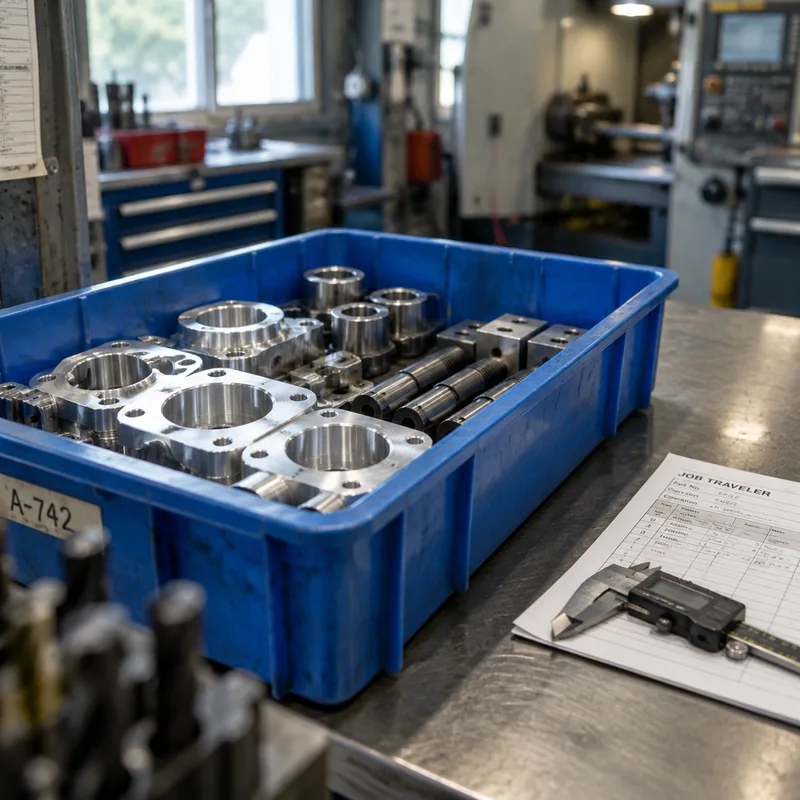
PA66 — nylon 66 — is the stiffer, hotter-running half of the workhorse nylon pair. Against its sibling PA6 it trades some toughness for higher rigidity, a higher melting point and better resistance to creep at temperature, which is why gears, rollers, insulators and under-hood hardware specify it where PA6 would soften or flex. Like every polyamide it is tough, wear-resistant and quietly self-lubricating, and it machines on ordinary equipment with sharp tooling.
The property that governs machined PA66 more than any other is water. The polymer absorbs moisture from the air, and that absorption changes both its dimensions and its mechanical state — a part measured dry in the morning is not the part bolted into a humid machine in August. Production practice therefore revolves around drying before machining, conditioning or dry-service declarations, and reserving tight tolerances for the features whose function genuinely survives the moisture swing.
Specifications
| Property | Value | Condition |
|---|---|---|
| Tensile strength | 82 MPa (11.9 ksi) | PA66, dry, referenced supplier table |
| Yield strength (0.2% offset) | 69 MPa (10 ksi) | PA66, dry, referenced supplier table |
| Hardness | Rockwell R120 | PA66 |
| Density | 1.14 g/cm³ | PA66 |
| Melting point | 262 °C (chixin supplier table); ~260 °C (davantech supplier table) | PA66 |
| Moisture absorption | ≈2.0 % at room conditions (vs up to 2.5 % for PA6) | PA66, room conditions |
| Flexural modulus | ≈3.0 GPa | PA66 (vs ~2.7 GPa PA6) |
| Machined tolerance | ±0.05 mm typical with dried/annealed stock; ±0.02 mm possible with controlled environment; anneal 90–100 °C 2–4 h; dry 80–90 °C 8–12 h to <0.2 % moisture | unfilled PA6/PA66, prepared stock |
| Flexural strength | Not established in the collected evidence — confirm at quotation. | |
| Compressive strength | Not established in the collected evidence — confirm at quotation. | |
Values above are rendered from the collected model-evidence layer, each carrying the heat-treatment condition it was reported under; fields without collected evidence are stated as not established rather than estimated. Requirements outside the table are confirmed for the specific geometry and batch at quotation.
Applications & Selection Points
Gears, rollers and wear components
Machined PA66 serves wherever quiet, lubrication-free sliding and impact tolerance matter: timing gears and sprockets, roller and guide wheels, wear pads, bushings in equipment that cannot tolerate grease. The polymer's damping and self-lubrication are the point — metal predecessors ran louder and needed maintenance. Where sustained load or elevated temperature rides along, the glass-filled grades carry the same roles further.
Electrical and mechanical insulators
PA66 is a proven electrical insulator with good mechanical strength, which makes machined standoffs, insulating spacers and connector hardware standard fare — much of the world's wiring hardware is molded PA66 for exactly this pairing. Machined parts inherit the role where geometry is custom or volume does not justify molding, with heat stabilization variants available for service near the polymer's thermal limits.
Moisture-aware tolerance planning
The honest engineering on machined nylon happens before the cut: decide whether the part lives dry (sealed enclosure, indoor steady climate) or wet (humid service, washdown, immersion), because the answer sets both the tolerance the drawing may carry and the conditioning the shop must apply. Parts are often machined dry and dimensioned in their dry state — then the service environment moves them. State the service humidity on the RFQ; it is the single input that most changes a nylon quote.
Where PA66 is the wrong call
Metal-level tight tolerances in wet or cycling-humidity service are the classic mismatch — no shop trick holds what the polymer itself will move. Sustained heavy load at elevated temperature belongs to filled or higher-performance polymers, and dimensional stability across wide temperature swings favors acetals. If a drawing inherited nylon from a metal part without revisiting tolerances, that conversation should precede the quote.
Frequently Asked Questions
PA66 or PA6 for a machined part?
Decide from service temperature, stiffness and load: PA66 is stiffer, handles higher temperature and resists creep better, making it the choice for gears, under-hood parts and loaded insulators. PA6 is tougher and more impact-resistant, better for parts that take blows. Both absorb moisture with the same dimensional consequences. When a drawing says just "nylon", this pairing is the first clarification to request.
Why do nylon tolerances change after machining?
Two mechanisms: the polymer absorbs ambient moisture and swells, and it stress-relieves from machining heat. Both movements are predictable enough to plan for — dry the stock before cutting, keep cutting cool and light, condition the finished part toward its service state before final measurement, and inspect in the state the drawing's tolerance is meant to describe. A tolerance without a measurement-condition declaration is ambiguous on this material.
What should I send for a PA66 machining quote?
The standard package — STEP model, 2D drawing with tolerances, quantity and batch intent — plus the nylon-specific inputs: the exact grade (unfilled, heat-stabilized, glass-filled), the service humidity and temperature, and which features genuinely need tight tolerance. If the part was converted from a metal drawing, say so; retargeting the tolerance bands before quoting is cheaper than remaking parts after inspection.
Ordering & Documentation
Documents
Send a STEP or IGES model with a 2D drawing carrying tolerances and the service environment. Name the grade precisely — unfilled, heat-stabilized and glass-filled PA66 behave differently in every way that matters — rather than writing "nylon", and declare the humidity the part will live in; on this material the environment is part of the specification.
Quotation
A quote is priced from the model and drawing, the named grade, quantity and batch intent, and the tolerance class on critical features. Stock form (rod, sheet, tube) affects both price and how the cut part moves afterward, so state the starting form where fixed. Conditioning and drying requirements are quoted into the process plan, not improvised.
Sample & Supply
Prototype quantities from one piece are normal for machined plastics and are the cheapest way to settle the moisture-and-tolerance question on real geometry — including which measurement state the acceptance inspection should use. First-article inspection is available on request; agree the conditioning protocol at quotation so inspection measures what the drawing means.
Storage & Shipping
Finished PA66 parts move dimensionally with ambient humidity, so parts ship sealed in poly bagging to stabilize moisture uptake in transit and storage. Keep them away from heat sources that relax machining stresses, and note that very dry storage followed by humid service will move the part — the conditioning decision from the quotation should carry through to how the parts are packed.