PEEK CNC Machining
Machining PEEK: the collected grade-property envelope (unfilled through carbon-filled), why annealing decides tolerance, and what to state on the RFQ.
Last updated: 2026-10-29
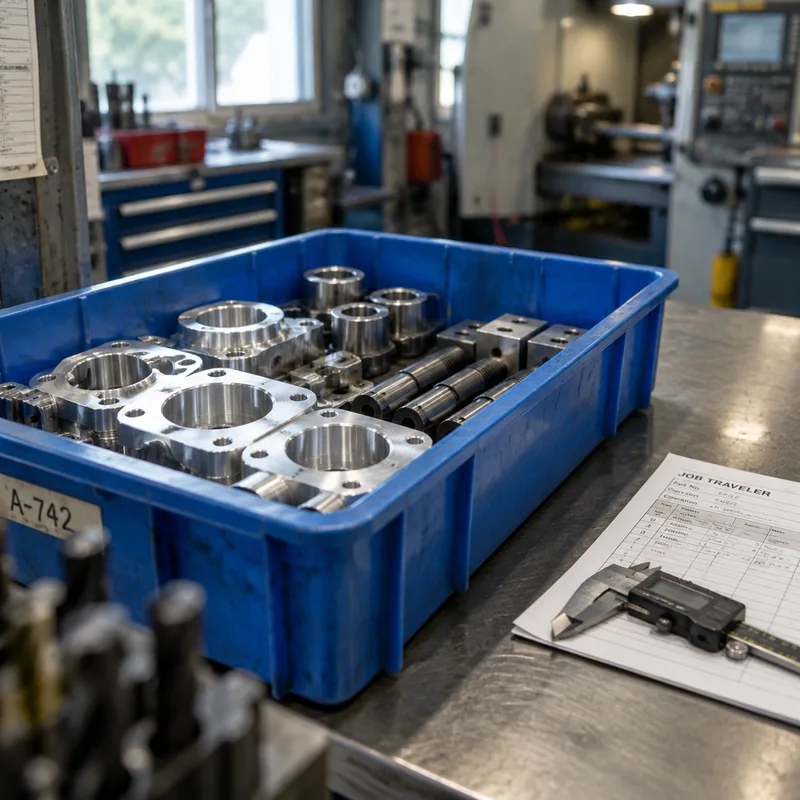
PEEK sits at the top of the machined-plastics ladder: it keeps its mechanical properties at temperatures where other engineering plastics soften, resists nearly every process chemical, and carries the biocompatibility record that implantable devices require. Those properties are why spinal implants, semiconductor wet-bench components, aerospace brackets and downhole seals specify it — and why its raw stock costs more than most metals it replaces.
The machining story has one non-negotiable step: stress relief. PEEK stock carries residual stresses from extrusion, and removing material lets those stresses move the part — often after it has already measured in tolerance. A controlled pre-machining anneal, then a rough-anneal-finish sequence on tight features, is what separates a stable PEEK part from a revisiting one.
Specifications
| Property | Value | Condition |
|---|---|---|
| Density | 1.32 g/cm³ | unfilled PEEK; source comparison points: titanium 4.5 g/cm³, stainless steel 7.9 g/cm³ |
| Tensile strength unfilled | 100 MPa | unfilled grade; stronger than most general-purpose engineering plastics, weaker than 6061-T6 aluminium (276 MPa per the same source) |
| Tensile strength filled | 90–200 MPa by grade | GF30 (30% glass) 170 MPa; CF30 (30% carbon) 200 MPa; bearing grade PEEK-HPV 90 MPa |
| Continuous service temp | 260 °C | continuous service; source contrast: austenitic stainless 870 °C, titanium Grade 5 315 °C |
| Melting point | ≈ 343 °C | per Victrex, as cited by the source |
| Annealing | 200–250 °C soak for 3–4 h | pre-machining stress relief; slow ramp and controlled cool; rough machine → anneal → finish for tight-tolerance parts |
| Hardness | ≈R126 (Rockwell M) | Rockwell M |
| Compressive strength | Not established in the collected evidence — confirm at quotation. | |
| Max stock dimensions | Not established in the collected evidence — confirm at quotation. | |
Values above are rendered from the collected model-evidence layer, each carrying the heat-treatment condition it was reported under; fields without collected evidence are stated as not established rather than estimated. Requirements outside the table are confirmed for the specific geometry and batch at quotation.
Applications & Selection Points
Medical and implantable components
PEEK is radiolucent — it stays invisible on X-ray and MRI the way metal implants do not — so surgeons can track fusion progress without artefact interference. Medical grades for long-term implantation carry the biocompatibility documentation regulators expect, and the material withstands repeated autoclaving. Machined medical PEEK needs a clean process chain, and the grade should be named on the RFQ, not assumed.
Weight-critical aerospace structures
At roughly a third of the weight of an equivalent metal bracket, unfilled PEEK competes with structural aluminium on strength per unit weight, and its carbon-filled variant approaches metals on stiffness per unit weight. For weight-budgeted airframes and satellite components, that trade — plus a service temperature most plastics never reach — is the whole argument.
Chemical process equipment
PEEK shrugs off solvents, dilute acids and alkalis that eat austenitic stainless, which is why wet-bench and pharmaceutical process parts specified in metal get replaced on a schedule while PEEK equivalents run for years. Where the environment, not the load, defines the part, the material decision usually makes itself.
Choosing the grade before quoting
Unfilled stock machines easily with standard carbide; glass-filled grades are harder on cutters and generally want coated or diamond tooling; carbon-filled stock is abrasive enough that diamond tooling is the realistic choice. Filled grades buy stiffness and strength at the cost of tooling budget — state the grade, or the environment and loads that decide it, on the RFQ.
Frequently Asked Questions
Why did my machined PEEK part move after it left the machine?
Almost always residual stress. Extruded PEEK stock carries internal stresses that release as material is removed, so the part can distort after it has measured in tolerance in the fixture. The countermeasure is a stress-relief anneal before machining — and for tight features, a second anneal between roughing and finishing. Skipping it is the most commonly reported cause of dimensional failure on this material.
Is PEEK stronger than aluminium?
Per unit of weight, unfilled PEEK competes with structural aluminium even though its absolute strength is lower — the density difference does the work. Filled grades close the absolute-strength gap further. The right comparison is the property combination the part needs: where temperature, chemical exposure or imaging compatibility are in play, the metals comparison misses the point.
What should an RFQ for machined PEEK include?
The named grade (unfilled, glass-filled, carbon-filled or a medical grade), the service environment and temperature, the tight tolerances with their features, and any documentation requirement such as biocompatibility or material certification. Tolerance-critical parts should also state whether the drawing applies dimensions in the dry-as-machined or moisture-equilibrated state — plastics move less than nylon, but the convention still matters.
Ordering & Documentation
Documents
Send a STEP model with a 2D drawing carrying tolerances, thread callouts and finish notes. Name the exact PEEK grade and stock form — bar, sheet or plate — because grade and form decide both the property envelope and the annealing response.
Quotation
A quote is priced from the model and drawing, the named grade and stock form, quantity, tolerance class on critical features, and documentation requirements. Material cost is a visible share of the total on PEEK parts, so stock size and nesting matter — flag any feature that lets the part be cut from smaller stock.
Process plan
Expect the process plan to include stress-relief annealing: before machining as standard, and between roughing and finishing where tolerances are tight. Confirm who performs the anneal and to what documented cycle — it is a process step with a specification, not a shop-floor judgment call.
Sample & Supply
Prototype quantities validate the annealing cycle and fixturing on the real geometry before production. First-article inspection with material certification is available on request; for medical components, agree the documentation scope — material lot traceability, cleanroom handling, certificates — at quotation.