PEI (Ultem) CNC Machining
CNC machining of PEI (Ultem): an amorphous high-temperature plastic with a collected property envelope covering thermal headroom, strength and moisture behavior, plus selection and quotation guidance.
Last updated: 2026-10-31
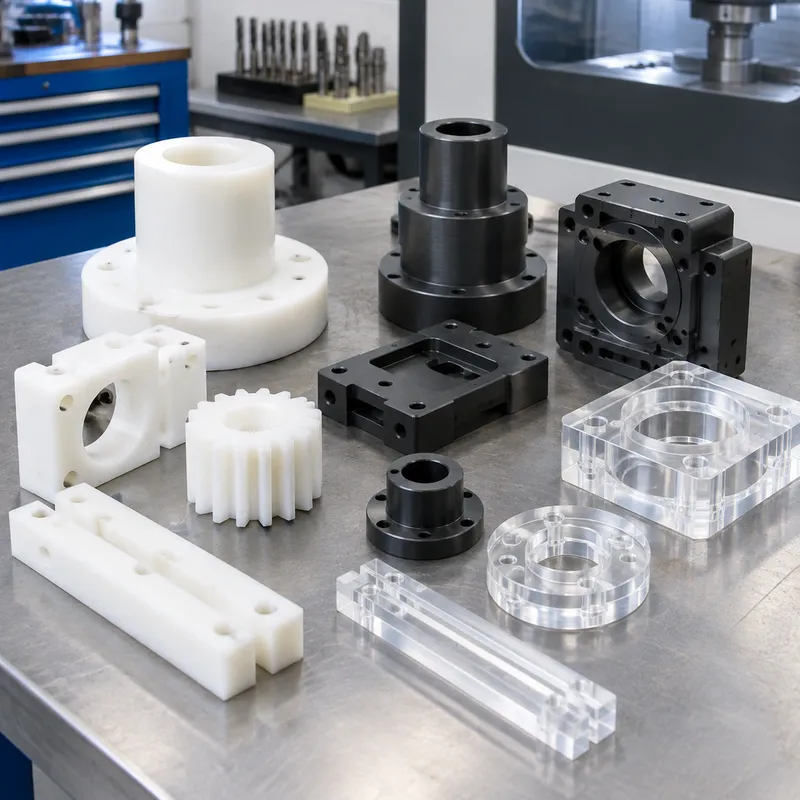
PEI — sold under the trade name Ultem — is an amorphous high-performance thermoplastic that occupies the space between engineering plastics like PPS and the far more expensive PEEK. It combines a high glass transition temperature with useful strength, inherent flame resistance and good dimensional stability, which is why it appears in aerospace interior components, electrical insulation parts, medical instrument housings and semiconductor fixtures.
Machining PEI is friendlier than machining most high-temperature plastics: it cuts with clean, continuous chips, holds tolerance well for an unfilled amorphous material, and anneals predictably. The main planning inputs are its sensitivity to notches and sharp internal corners relative to metals, moisture management before machining, and stress-relief practice on parts with heavy material removal.
Specifications
| Property | Value | Condition |
|---|---|---|
| Density | 1.27 g/cm³ | amorphous, 25 °C |
| Tensile strength | 115 MPa | unfilled |
| Elongation | 60–80 % | at break |
| Heat deflection temperature | 210 °C | at 0.46 MPa (66 psi) |
| Glass transition temperature | 215–217 °C | |
| Water absorption | 0.25 % | over 24 hours |
Values above are rendered from the collected model-evidence layer, each carrying the heat-treatment condition it was reported under; fields without collected evidence are stated as not established rather than estimated. Requirements outside the table are confirmed for the specific geometry and batch at quotation.
Applications & Selection Points
High-temperature electrical and electronic components
PEI is a natural fit for electrical insulators, connector bodies, coil bobbins and terminal blocks that see continuous heat. Its amorphous structure gives stable electrical properties across a wide temperature range, and the grade is inherently flame resistant without halogen additives — a compliance advantage in aerospace and transit interiors. Machined PEI parts serve well where molded volumes are too small to justify tooling.
Aerospace and transportation interior parts
Seat components, ducting clips, interior brackets and trim features are classic PEI territory because the grade meets flame, smoke and toxicity expectations in its base form. Machining from plate or billet suits development articles, retrofit kits and low-volume fleets; production volumes usually migrate to injection molding once the design freezes.
Medical and food-contact adjacent hardware
PEI withstands repeated autoclave cycles better than most amorphous engineering plastics, so instrument trays, surgical fixture components and sterilization baskets are common machined parts. Confirm the specific sterilization method and cycle count with the supplier at quotation — resin grade and any coloring additives affect the claim.
Where PEI is the wrong call
If the part never sees elevated temperature, acetal, nylon or ABS deliver the function at a lower material cost. If the service environment exceeds what PEI tolerates continuously, or demands the chemical inertness of fluoropolymers, PEEK or PTFE belong in the comparison instead. PEI also absorbs more moisture than PPS — for wet or humid service with tight tolerances, factor dimensional change into the selection.
Machining behavior and process planning
PEI machines dry or with light coolant mist and produces manageable chips at conventional speeds. Sharp, positively raked tooling keeps cutting forces low; dull tools smear amorphous plastics and leave stresses behind. Parts with heavy stock removal benefit from a stress-relief anneal between roughing and finishing, because amorphous grades hold the memory of aggressive cuts as residual stress that can move thin walls later.
Tolerance, surface finish and secondary operations
Unfilled PEI holds tolerances tighter than most semi-crystalline plastics because it does not shrink and warp the same way, but it still cannot match metal behavior — thermal expansion is an order of magnitude higher, so gauge parts at room temperature and expect movement in hot service. Tapping, thread milling and reaming all work with sharp tooling; tolerances comparable to machined aluminum are realistic on small features with stress relief in the sequence.
Ordering notes that change the quote
State the resin grade explicitly — unfilled, glass-filled and other variants machine and cost differently. Declare the operating temperature and any sterilization or flame-smoke-toxicity requirement, because those drive both material selection confirmation and finishing choices. For parts machined from plate, thickness availability and grain direction matter to flatness; large thin parts should carry a flatness callout the machining route can actually inspect.
Frequently Asked Questions
Is Ultem the same thing as PEI?
Ultem is the best-known trade name for polyetherimide resin. Procurement documents should name the polymer and the specific resin grade, because filled and unfilled variants differ in strength, thermal behavior and cost. Machining suppliers quote from the named grade and stock form, so a drawing that only says "Ultem" invites an assumption where a specification belongs.
Should my part be PEI or PEEK?
Decide from the service envelope, not the brand hierarchy. PEI covers most high-temperature electrical, interior and sterilization applications at a materially lower price. PEEK earns its premium where continuous service temperature, chemical inertness or bearing-grade wear behavior exceed what PEI delivers. If the environment is ambiguous, state it on the RFQ and let the quoting side confirm the selection — downgrading late is far cheaper than discovering a failure in service.
How does machined PEI compare with molded PEI?
Mechanically, a machined part from compression- or extruded-stock PEI avoids the orientation and sink effects of molded thin sections, and it is the only economic route below meaningful production volumes. Injection molding wins once volumes justify tooling, especially for high volumes of small parts. Many programs prototype machined, validate, then transition to molding — designing with that transition in mind avoids features only one route can make.
Does PEI need to be dried before machining?
PEI absorbs modest moisture, but enough to matter on surface-critical or tolerance-critical work: machining wet material can leave straining or porosity at the surface and affects chip behavior. Stock that has been stored open in humid conditions should be dried per the resin datasheet before finish passes. The shop handles this as a process step — what the buyer supplies is the tolerance and surface expectation that makes drying non-negotiable.
What should I send for a PEI machining quote?
The standard package: a STEP model, a 2D drawing with tolerances and finish callouts, the named resin grade and stock form, quantity, and the service environment including maximum temperature and any sterilization or flammability requirement. For thin or flat parts, include the flatness expectation. PEI quotes are sensitive to stock size — non-standard thicknesses can dominate the material line.
Ordering & Documentation
Documents
Send a STEP or IGES model with a 2D drawing carrying tolerances, threads and finish specifications. Name the polymer, the resin variant and the stock form — plate, rod or billet — because PEI families differ enough that "Ultem" alone is not a specification.
Quotation
Quotes are priced from the model and drawing, the named grade and stock form, quantity, tolerance class on critical features, and the service environment. Sterilization, flammability or electrical requirements belong in the RFQ because they can change the resin confirmation and the inspection plan.
Sample & Supply
Prototype quantities from one piece are normal for machined plastics, and a first article validates the stress-relief sequence on the specific geometry. Material certification for the resin grade is available on request — agree its scope at quotation.
Storage & Shipping
Machined PEI ships clean and dry; the grade is not corrosion-prone, but surface-critical faces should be protected from abrasion in transit. Store finished parts away from sustained heat sources and, for humidity-sensitive assemblies, bag them until installation.