Silicone & Elastomer 3D Printing (PolyJet)
Silicone and digital-elastomer 3D printing: Shore A elastomer grades plus rigid, high-resolution layers, multi-hardness overmolding prototypes in a single build.
Last updated: 2026-10-29
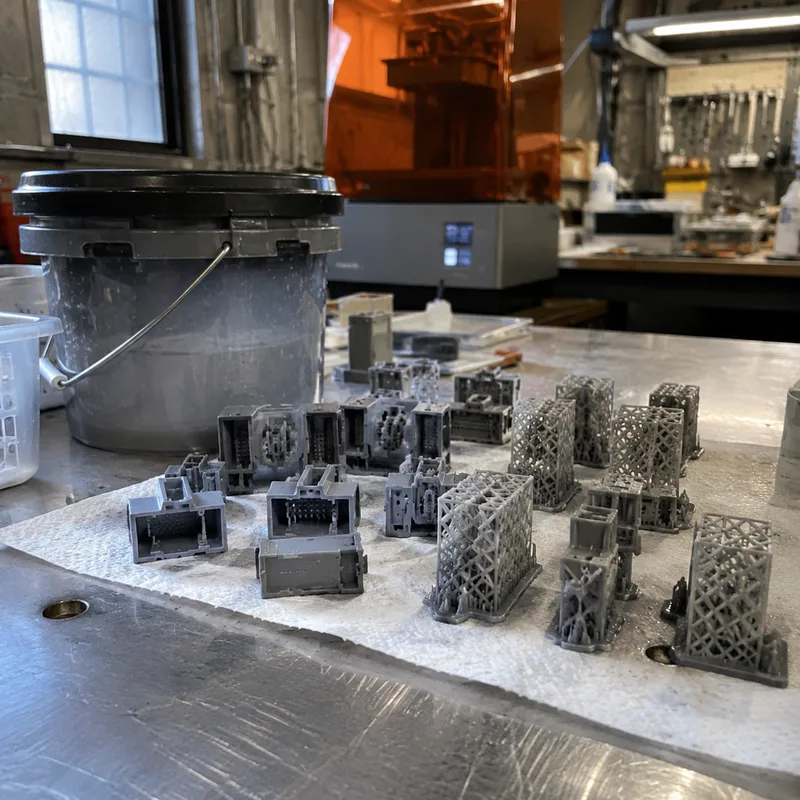
PolyJet silicone and digital-elastomer printing builds soft, rubber-like parts by jetting and UV-curing droplets of photopolymer voxel by voxel — which is what makes it the only quick route to a chosen Shore A hardness, or several hardnesses in one part. Digital grades span Shore A 30A through 95A plus rigid, and true 3D-printed silicone covers the softer end of that window.
The trade is envelope and material class: this is a prototyping and low-volume process for seals, gaskets, grips, flexible hinges and overmolding simulation, printed at a high-resolution layer height on a build platform far smaller than fused-filament machines. Parts needing production elastomer chemistry move to molded silicone; parts needing the geometry decided first start here.
Specifications
| Property | Value | Condition |
|---|---|---|
| Max size | PolyJet 490×390×200 mm; 3D-printed silicone 297×210×200 mm | two envelopes: the PolyJet resin platform and the smaller silicone print window inside it |
| Layer height | 30 µm | the resolution layer height of the process (about a quarter of a sheet of printer paper) |
| Min feature | 0.80 mm freestanding wall or feature; holes/channels below 0.80 mm not produced; max aspect 4:1 | functional or load-bearing features should keep at least 1.0 mm diameter |
| Tolerance | ±0.1 mm + ±0.001 mm/mm (with good part design) | geometry-dependent; stated for normal resolution |
| Shore hardness | Shore A 30A–95A plus rigid digital materials | hardness grades selectable, and combinable within a single build for overmolding prototypes |
| Materials | digital elastomers 30A–95A and rigid (tensile 2.4–3.1 MPa at 30A up to 50–65 MPa rigid); 3DP silicone 35A (0.5–0.8 MPa, 160% elongation) and 65A (2.0–2.5 MPa, 160% elongation) | per the source material-comparison table |
| Lead time | Not established in the collected evidence — confirm at quotation. | |
| Temperature resistance | Not established in the collected evidence — confirm at quotation. | |
| Color options detail | Not established in the collected evidence — confirm at quotation. | |
Values above are rendered from the collected model-evidence layer, each carrying the heat-treatment condition it was reported under; fields without collected evidence are stated as not established rather than estimated. Requirements outside the table are confirmed for the specific geometry and batch at quotation.
Applications & Selection Points
Overmolding and two-hardness prototypes
Rigid and flexible photopolymers combine within a single build, which simulates an overmolded or insert-molded part before any tooling exists. Prototype the grip, seal or living hinge with the real hardness gradient, then commit the design to production molding.
Seals, gaskets and soft-touch components
Shore A grade selection is the design lever: softer grades for compression and sealing, firmer grades for buttons and flexible couplings. Compressive behavior tracks the grade table, so a hardness choice made here carries into the molded production part.
Form, fit and ergonomic studies
The high-resolution layer height produces smooth surfaces that read as production parts, which makes the process useful for ergonomic and consumer-facing studies where layer lines would mislead the evaluation.
When molded silicone is the right answer instead
Production chemistry, food or medical grades, large envelopes and high volumes all point to compression or liquid silicone molding. PolyJet photopolymers simulate elastomers — they are not the same material family — so treat printed parts as design-validation hardware, not certified end-use elastomer.
Frequently Asked Questions
How hard can a printed silicone-like part be?
Digital elastomer grades run from Shore A 30A to 95A, plus rigid materials, selectable per region of the part and combinable in one build. True 3D-printed silicone covers soft grades around 35A and a firmer 65A. State the target hardness and whether regions differ — that is the input the process is built around.
How accurate and how fine is the detail?
Layers print at high resolution with tolerances around a tenth of a millimeter plus a proportional length term for well-designed parts. Freestanding walls and features resolve to well under a millimeter, holes and slots below that floor do not resolve, and slender features respect an aspect-ratio limit — design to those floors.
What do I send for a quote?
The model, the Shore A hardness (or hardness map) per region, color, and quantity. Because the process is toolless, prototype quantities turn around quickly — the quote turns on size, material grade and build packing rather than tooling.
Ordering & Documentation
Documents
A model with hardness grades and color assigned per region, and the functional intent called out — sealing, grip, flexure or overmolding simulation. The grade choice is a drawing input here, not a shop decision.
Quotation
Pricing follows build volume, material grade and quantity. Multi-hardness and multi-color builds pack differently from single-grade runs — say so up front so the quote reflects the real build.
Process plan
Parts print fully surrounded by support material, removed afterward by water jet and chemical bath, with no post-cure required. Expect that cleanup to set minimum feature spacing in the design.
Sample & Supply
First articles verify hardness grade and geometry; dimensional checks concentrate on the features that mate with the rigid assembly. Repeat orders reproduce from the same build recipe — agree what the acceptance check covers.
Request a quote for Silicone & Elastomer 3D Printing (PolyJet) →