PTFE (Teflon) CNC Machining
CNC machining of PTFE (Teflon): chemical inertness and temperature envelope, why the material moves under load and with temperature, and how to specify tolerances that the polymer can actually hold.
Last updated: 2026-10-29
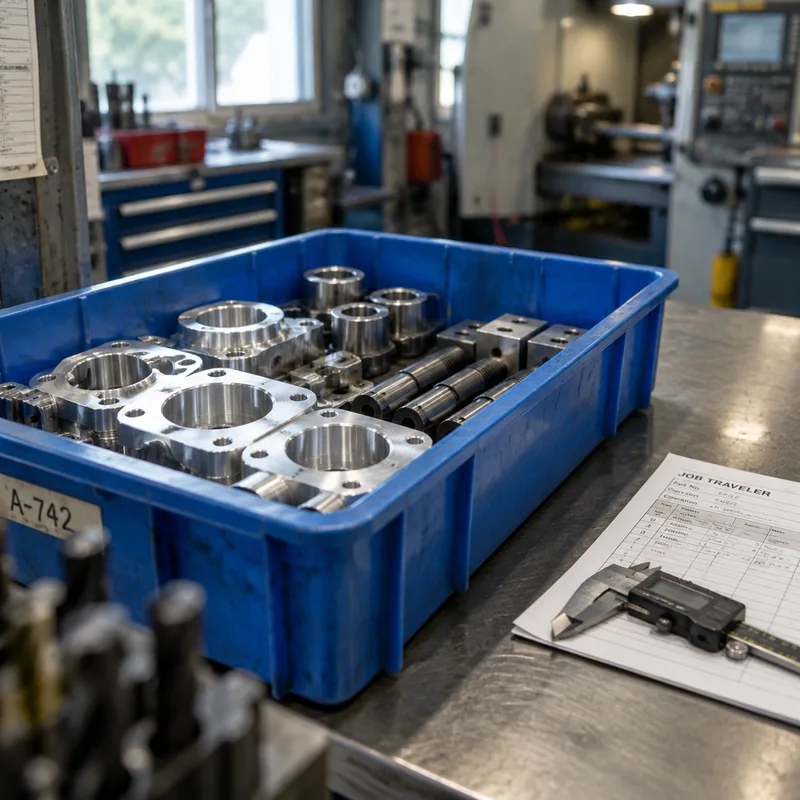
PTFE is the fluoropolymer at the extreme end of engineering plastics: almost nothing chemically attacks it, it slides with a lower friction coefficient than nearly any other solid, and it serves across a wider temperature band than most thermoplastics. Those three properties — inertness, lubricity, thermal breadth — are exactly why seals, insulators, liners and lab or food-contact hardware get specified in it despite its awkward machining behavior.
The awkwardness is real and it is dimensional. PTFE is soft, it creeps under sustained load, and it expands and contracts with temperature far more than metals or even most plastics, so a dimension measured in a cold shop will not be the same dimension on a hot line. Machining it successfully is less about aggressive cutting and more about sharp tooling, light clamping, and a tolerance conversation that starts from what the polymer can honestly hold in service — not what the drawing inherited from a metal part.
Specifications
| Property | Value | Condition |
|---|---|---|
| Melting point | ≈327 °C | virgin PTFE |
| Continuous service temperature | ≈260 °C continuous; useful from about −200 °C to 260 °C | virgin PTFE, continuous duty |
| Thermal expansion | ≈120×10⁻⁶/°C (120 ppm/°C) | virgin PTFE |
| Sintering temperature | ≈370 °C (compression-molded billet sintering) | compression-molded / sintered stock |
| Machined tolerance | ±0.05 mm typical best for pure PTFE; ≈±0.02 mm for glass-filled; ~0.13 mm quoted as generally achievable | pure vs glass-filled PTFE, machined |
| Density | 2200 kg/m³ | room temperature |
| Hardness | ≈R58 (Shore D) | Shore D |
| Tensile strength | Not established in the collected evidence — confirm at quotation. | |
Values above are rendered from the collected model-evidence layer, each carrying the heat-treatment condition it was reported under; fields without collected evidence are stated as not established rather than estimated. Requirements outside the table are confirmed for the specific geometry and batch at quotation.
Applications & Selection Points
Chemical, food and laboratory contact parts
Where the medium would attack metals and most plastics — aggressive chemicals, repeated sterilization, analytical equipment — PTFE is often the last material standing. Machined spacers, valve seats, gaskets and liner components take advantage of the inert surface without coatings or plating. Food and pharma contact is a natural fit, with the caveat that filler-free virgin material is usually the contact-grade choice and filled variants must be cleared for the application.
Electrical and thermal insulation hardware
PTFE is an excellent electrical insulator that keeps its properties across the service temperature band, which makes it a standard for machined insulators, standoff bushings and high-frequency component supports where signal loss matters. Thermal hardware uses the same stability in the other direction: parts that must survive repeated thermal cycling without embrittling or outgassing problematically.
Low-friction and non-stick components
Wear pads, slide surfaces, seal energizers and anti-stick contact faces exploit the lowest friction of any common solid. The honest boundary is wear life under load: unfilled PTFE creeps and wears relatively fast, which is why loaded slide parts often move to glass- or bronze-filled grades. If the part carries sustained compression, say so on the RFQ — the filler question is a load question first.
Where PTFE is the wrong call
Structural load paths, precision fits held across wide temperature swings, and abrasive wear are where PTFE disappoints. Creep means a bolted PTFE part relaxes over time; thermal movement means a metal-level press fit is not a stable press fit. When a drawing shows PTFE in a load-bearing or tight-tolerance role inherited from a metal predecessor, the substitution conversation should happen before the RFQ, not after first-article inspection.
Frequently Asked Questions
Virgin PTFE or filled PTFE for a machined part?
Decide from load and wear, not from cost. Virgin material keeps the full chemical inertness and the cleanest surface for contact applications; glass, bronze or carbon fillers trade some of that for dramatically better creep resistance and wear life. Filled grades also machine to a firmer edge and hold dimension better. If the part slides under load or carries sustained compression, a filled grade is usually the right question to raise at quotation.
Why are PTFE tolerances looser than metal tolerances?
Because the material moves: thermal expansion is high, creep under load is permanent, and the polymer continues to stress-relieve after machining. A tolerance the polymer cannot hold in service is not a tighter part, it is a scrap-rate agreement. The practical approach is to reserve tight callouts for the features that carry function, condition the part before final measurement, and accept that ambient measurement conditions must be stated on the drawing for the numbers to mean anything.
What should I send for a PTFE machining quote?
The standard package — a STEP model with a 2D drawing carrying tolerances — plus the inputs that change a PTFE quote specifically: the grade (virgin or filler type), the service temperature range, any chemical or food-contact requirement, and which features genuinely need tight tolerance. State the working environment; for PTFE more than most materials, environment decides both grade and achievable tolerance.
Ordering & Documentation
Documents
Send a STEP or IGES model with a 2D drawing carrying tolerances and the service environment. Name the grade explicitly — virgin versus a specific filler changes strength, wear and contact compliance — rather than writing "Teflon", and call out any governing standard for food, pharma or electrical service.
Quotation
A quote is priced from the model and drawing, the named grade, quantity and batch intent, and the tolerance class on critical features. Stock form matters more than usual: machining from rod, sheet or tube changes both cost and how the material moves after cutting, so state the starting form if it is fixed.
Sample & Supply
Prototype quantities from one piece are normal for machined PTFE and are the cheapest way to validate the tolerance conversation on real geometry — particularly which dimensions move between the machine and the service environment. First-article inspection is available on request; agree the measurement conditions at quotation, because ambient state is part of the specification for this material.
Storage & Shipping
Machined PTFE is dimensionally stable at ordinary warehouse conditions but soft — finished surfaces score and dent easily, so parts ship separated and protected rather than bulk-packed. Keep finished parts away from abrasive handling contact and from sustained point loads in storage, which will imprint the surface over time.