Aluminum Die Casting
Aluminum die casting: the collected alloy and property envelope (A380/A360), what the process buys over machining, and how to prepare a casting RFQ.
Last updated: 2026-10-29
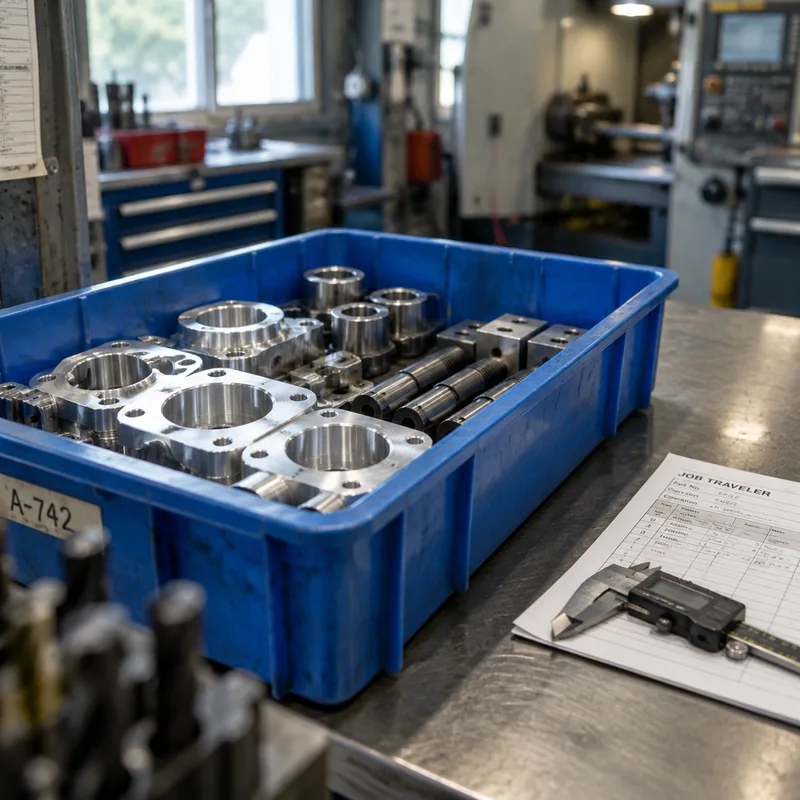
Aluminum die casting is the volume route for metal parts with complex shapes: molten aluminum injected under pressure into a steel die, producing net-shape parts in seconds per shot. The workhorse alloy balances castability and mechanical properties, with a corrosion-and-finish-oriented sibling for parts that get anodized. Enclosures, housings, brackets and heat-dissipating components by the thousands are its territory.
The economics are tooling-driven: a die is a real investment, and per-part cost falls as volume rises — which is why the honest first question in any casting conversation is the annual quantity. Machined-from-billet prototypes prove the design; the casting proves the economics. The usual path runs through both.
Specifications
| Property | Value | Condition |
|---|---|---|
| Common alloys | A380 (most common); A360 where corrosion resistance or finishing such as anodizing matters | per source: A380 balances castability and mechanical properties |
| Density | ≈ 2.7 g/cm³ | moderate vs zinc (~6.6 g/cm³ per the same source) |
| Melting point | ≈ 600 °C | higher casting temperature than zinc (~380 °C) — more thermal load on the die |
| Min wall thickness | 1.0–1.5 mm | die casting (A380/ADC12), thin-wall |
| Dimensional tolerance | ±0.1–0.5 mm | as-cast (die casting) |
| Tensile strength | Not established in the collected evidence — confirm at quotation. | |
| Max part size | Not established in the collected evidence — confirm at quotation. | |
Values above are rendered from the collected model-evidence layer, each carrying the heat-treatment condition it was reported under; fields without collected evidence are stated as not established rather than estimated. Requirements outside the table are confirmed for the specific geometry and batch at quotation.
Applications & Selection Points
Enclosures and housings at volume
Motor housings, gearbox cases, electronics enclosures and pump bodies are the classic castings: complex outside geometry, cored internal features, and wall thicknesses machining cannot afford at volume. The die amortizes across the batch and every part after the first few thousand gets cheaper.
Finishing-critical and outdoor parts
Parts that get anodized or live outdoors are where the corrosion-oriented alloy earns its place: better finishing behaviour and corrosion performance than the general-purpose alloy. Name the finish on the RFQ — it can decide the alloy, and the alloy cannot be swapped after tooling is cut.
When casting beats machining — and when it does not
Above modest volumes, complex geometry, or cored features, casting wins on cost per part. Below them, machining from billet avoids tooling entirely. Tight tolerances on individual machined features are handled by casting near-net and machining the critical surfaces — the hybrid plan is standard, not a compromise.
Designing for the process
Uniform wall, generous draft, filleted corners and ejection-friendly geometry are the design grammar of die casting. Parts designed for machining and handed to a caster come back with questions; parts designed with draft and uniform wall quote faster and cast sounder. Share the drawing early and let the DFM pass shape the details.
Frequently Asked Questions
Which aluminum casting alloy should my part use?
The general-purpose workhorse alloy suits most enclosures and structural housings; where the part gets anodized or faces corrosive service, the corrosion-and-finish-oriented alternative is usually proposed. Both are industry-standard casting alloys with decades of service history — the finish and environment decide, and the RFQ should name one or describe the other.
How many parts justify a die casting tool?
The crossover against machining moves with geometry, but the shape of the answer is constant: tooling is a fixed cost and machining is a per-part cost, so volume is the decider. Prototype quantities machine from billet; production quantities in the thousands amortize a die quickly. Quote both routes at the expected annual quantity and the comparison is arithmetic.
What should I send for an aluminum die casting quote?
A STEP model with a 2D drawing calling out critical machined surfaces and tolerances separately from as-cast surfaces, the finish, the alloy preference or its deciding environment, and the annual quantity. The quantity is not paperwork — it decides whether casting or machining is the honest recommendation.
Ordering & Documentation
Documents
Send a STEP model with a 2D drawing that separates as-cast surfaces from post-machined ones, with tolerances on each. Name the finish — anodizing, powder coat, plating — because finish can steer the alloy choice.
Quotation
A casting quote is priced from the part mass, the die complexity, the cavity count, the annual quantity and the finish. Ask for the machining-after-casting scope to be explicit — which faces are machined, to what tolerance — so the quote is comparable across suppliers.
Tooling & Samples
Tooling lead time dominates the schedule; first samples validate fill, porosity and dimensions before the die is accepted. Plan a design-freeze before tooling starts — geometry changes after cut steel are a different conversation.
Production & Supply
Production runs hold dimensions within the as-cast standard, with critical features machined as specified. Agree inspection — Leak testing, porosity criteria, first-article and in-process checks — at quotation; packaging for cast parts protects machined faces in transit.