M2 Tool Steel CNC Machining
CNC machining of M2 tool steel: the general-purpose high-speed steel — machining it in the annealed state, heat treatment, grinding practice, and what to put on the RFQ.
Last updated: 2026-10-31
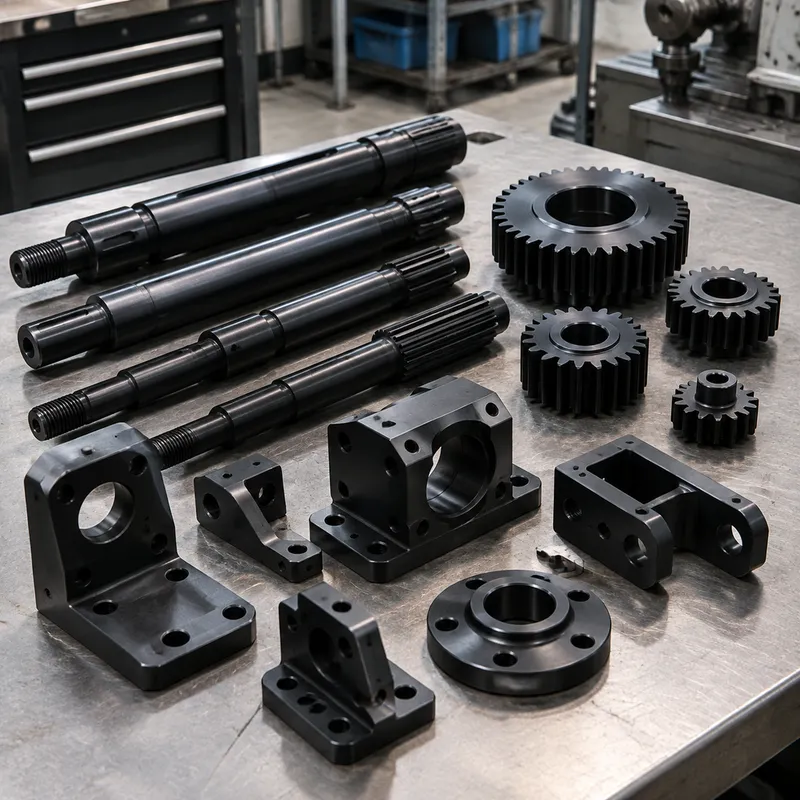
M2 is the general-purpose high-speed steel: the tungsten-molybdenum balance that replaced the older T-series grades in drills, taps, reamers, broaches and shear blades. Its tungsten and molybdenum carbides give it red hardness — the ability to keep a working edge at cutting temperatures that soften carbon steels — while its vanadium carbides add abrasion resistance. It remains the default answer when a cutting or forming tool needs more than alloy steel delivers but powder-metallurgy grades are more than the duty requires.
The machining question for M2 is really two questions. In the annealed condition it machines like a respectable alloy steel, and almost all M2 cutting happens there — the part is roughed, then heat-treated, then finished by grinding. In the hardened state it is a grinding and EDM material, not a cutting-tool material. Quotes that do not separate those two phases are the source of most M2 schedule surprises.
Specifications
| Property | Value | Condition |
|---|---|---|
| Composition | C 0.78–1.05 %, Mo 4.50–5.50 %, W 5.50–6.75 %, V 1.75–2.20 % | weight % |
| Hardness | 62–65 HRC | 62 tempered at 1150 °F (quenched 2200 °F); 65 as hardened |
| Density | 8.16 g/cm³ | |
| Elastic modulus | 190–210 GPa | |
| Machinability | ≈50 % | of the W (water-hardening) group, annealed |
Values above are rendered from the collected model-evidence layer, each carrying the heat-treatment condition it was reported under; fields without collected evidence are stated as not established rather than estimated. Requirements outside the table are confirmed for the specific geometry and batch at quotation.
Applications & Selection Points
Cutting tools: drills, taps, reamers, end mills
M2 is the workhorse substrate for general-purpose cutting tools in both ground and forged-flute forms. Machined-from-billet M2 usually appears in custom tools, special-form cutters and repair parts where a standard catalog tool does not exist. The route is consistent: machine everything possible in the annealed state leaving grinding stock, heat treat, then finish the working geometry by grinding. Tool geometries that skip the grind phase rarely hold edge quality or dimension.
Shear, slitting and forming blades
Paper and plastic converting knives, shear blades and forming rolls use M2 where abrasion and heat arrive together but the shock loading of a stamping die is absent. Machined blade blanks are finished by grinding to final edge geometry after hardening. Blade buyers should state the cut material and line speed — those determine the exact heat-treatment target within the grade window.
Wear components and gauge elements
Bushings, wear rails, gauge pins and fixture elements that see sliding abrasion use M2 where case-hardened steel would wear through or dimensionally drift. Its advantage over D2 here is toughness — M2 takes impact and edge-loading that would chip the higher-carbon die steels. Machining is conventional in the annealed state, and the ground-after-hardening route delivers the dimensional stability gauges need.
Where M2 is the wrong call
If the tool sees heavy impact, S7 or a shock-resisting grade is the honest answer. If the duty is pure abrasive wear without heat — some cold-work dies — D2 holds an edge longer. If production volumes justify it, powder-metallurgy high-speed steels deliver finer carbide distribution and better grindability. And if the part never gets hot, M2 is paying for red hardness it will never use; 4140 or A2 solves it cheaper.
Machining behavior in the annealed state
Annealed M2 machines acceptably — its machinability runs around half of a water-hardening grade, so expect shorter tool life and plan feeds accordingly. The carbides that make the steel valuable are the same particles that abrade cutting edges, and the molybdenum-rich structure tends toward tough chips rather than clean breaks. Sharp tooling, steady feed under the work-hardening threshold and flood coolant are the standard answers; interrupted cuts and thin drill webs are where the difficulty concentrates.
Heat treatment and distortion control
M2 hardens through a high-temperature austenitizing quench followed by multiple tempering cycles, and this is the step that decides the tool. Salt-bath or vacuum hardening is the norm; open-furnace work risks decarburization that ruins the surface the grind was counting on. Distortion is real and directional — long, thin parts need fixturing or straightening plans agreed before heat treatment, not after. The grinding stock left in the annealed machining phase exists to absorb exactly this movement.
Grinding and finishing practice
After hardening, M2 is a grinding proposition: fluting, point work and edge finishing all happen on abrasive or wheel-EDM equipment. Its vanadium carbides resist grinding more than the tungsten grades, so wheel selection and dress frequency matter — burned edges from aggressive grinding are a classic latent failure in M2 tools, cracking later in service. Buyers ordering finished M2 tools are entitled to ask how the grind sequence protects edge integrity.
Frequently Asked Questions
Can M2 be machined after heat treatment?
Only by grinding, EDM or abrasive processes — at full hardness it is beyond conventional cutting tools. Every M2 route is therefore planned in two phases: everything geometric happens in the annealed state with grinding stock added, and hardening comes between. A drawing that requires a machined feature the grind cannot reach should be questioned at quotation, because it forces the expensive compromise of hardening, tempering, then sub-critical machining.
Is M2 or D2 the right steel for my blade?
Follow the heat. D2 is the better cold-work wear steel — it holds an edge against abrasion at room temperature and is more dimensionally stable in heat treatment. M2 wins wherever the edge gets hot: high-speed slitting, frictional cutting, anything with sustained line speed. If the blade runs cool and slow, D2 usually costs less and lasts longer; if the edge heats, M2 keeps hardness D2 loses.
What does heat treatment add to lead time on M2 parts?
A full quench-and-multi-temper cycle plus any straightening, freezing and post-temper inspection typically adds days, and outside heat-treat capacity queues add more at busy periods. Quotes that promise annealed-state lead times on hardened parts are assuming something. State the required hardness and condition explicitly — the difference between as-quenched, single-tempered and properly cycled M2 is both performance and schedule.
Why did my M2 tool chip rather than wear out?
Chipping is usually process history, not grade failure: grinding burn that left micro-cracks, too little tempering, a geometry with stress concentration at the edge, or duty beyond the grade. Among these, grinding burn is the most common and the least visible — it looks like a finished tool. Buying from shops that control wheel grade and dress frequency, and that stress-relieve between heavy roughing and hardening, removes most of the risk.
What should I send for an M2 machining quote?
A STEP model and 2D drawing with the required hardness and heat-treatment specification named, critical dimensions flagged with which phase finishes them, and the duty — what the tool will cut, at what speed and temperature. If the part is long or thin, say so; distortion management is priced, not improvised. Certification is rarely needed for tooling, but hardness verification after heat treatment should be assumed.
Ordering & Documentation
Documents
Send a STEP or IGES model with a 2D drawing that names the heat-treatment specification and required hardness, and marks which dimensions are finished after hardening. Ambiguity between annealed and hardened dimensions is the classic M2 quoting error.
Quotation
Quotes price annealed machining, heat treatment and grinding as separate lines. Geometries needing EDM rather than grinding after hardening, or distortion-prone thin sections, should be identified at RFQ — both change the route and the price more than any other input.
Sample & Supply
Prototype quantities from one piece are normal for tooling. A first article should be verified for hardness and, on cutting edges, for grind integrity. Batch supply benefits from fixing the heat-treat source early — tool performance tracks that step more than any other.
Storage & Shipping
Hardened M2 ships well but is brittle: pack tools so edges cannot contact hard surfaces or each other. Light oil film protects the ground surfaces. Store away from humidity — pit marks on a gauge or edge are rework the grade did not deserve.