D2 Tool Steel CNC Machining
CNC machining of D2 air-hardening cold-work tool steel: the wear-resistance recipe, what annealed-state machining buys before hardening, and the grinding-dependent finish reality after heat treatment.
Last updated: 2026-10-31
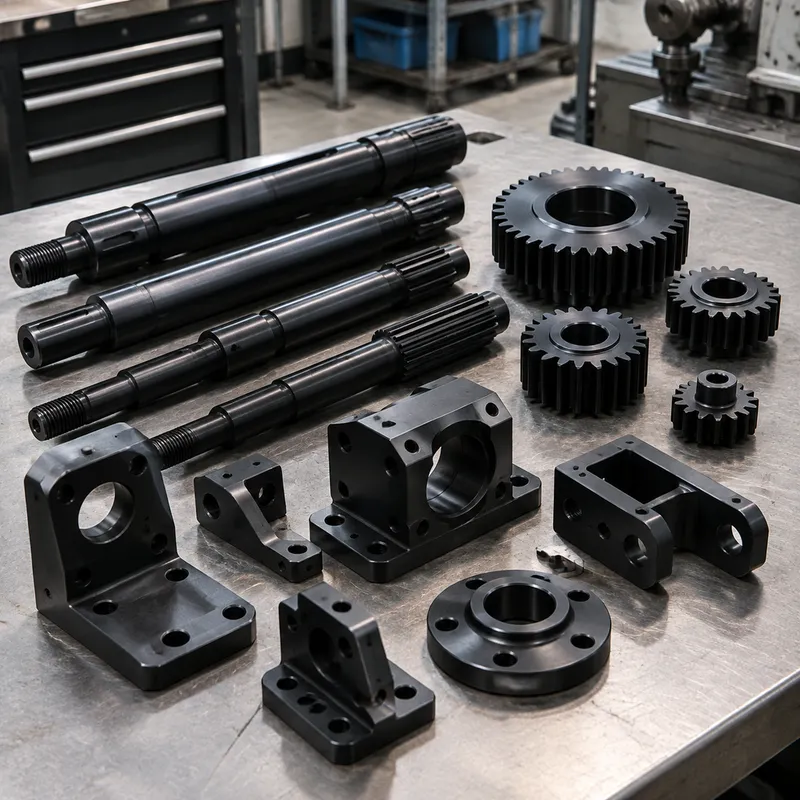
D2 is the high-carbon, high-chromium cold-work tool steel that wears slowly no matter what runs against it. Punches, dies, forming rolls, shear blades and blanking tools specify it because abrasion — not impact — is their failure mode, and the carbide-rich microstructure of hardened D2 resists abrasion far longer than lower-alloy steels can. Its air-hardening behavior adds dimensional discipline: the quench is gentle enough that distortion stays manageable on precision tooling.
Machining D2 is a two-phase conversation. In the annealed condition it cuts like a hard, abrasive ordinary steel — slowly, but with conventional tooling. After hardening to its working hardness it is effectively beyond chip-forming machining and lives in grinding and EDM territory. The process plan therefore front-loads every possible feature into the soft state, and the drawing that understands this sequences itself correctly.
Specifications
| Property | Value | Condition |
|---|---|---|
| Tensile strength | 700–900 MPa | |
| Yield strength (0.2% offset) | 450–700 MPa | |
| Hardness | 55–62 HRC | after heat treatment |
| Elongation | 8–12% | |
| Machinability rating | ~40–50% |
Values above are rendered from the collected model-evidence layer, each carrying the heat-treatment condition it was reported under; fields without collected evidence are stated as not established rather than estimated. Requirements outside the table are confirmed for the specific geometry and batch at quotation.
Applications & Selection Points
Cold-work dies, punches and shear blades
Blanking and forming dies, punch-and-die sets, trim tools and shear blades are D2 heartland: high production counts running abrasive sheet and strip against a cutting edge. The grade holds its edge for tens of thousands more cycles than plain tool steels, and its deep air-hardening means even relatively large sections harden through without the quench cracks oil-hardening grades risk.
Forming rolls, wear rails and long-wear tooling details
Roll-forming rolls, cam rails, gauges and fixture details that rub against hard or abrasive stock specify D2 for the same reason: sliding abrasion is the wear mechanism and the grade is built for exactly that. Its moderate toughness is the trade — details loaded by impact step down to the shock-resistant tool steels instead.
Where D2 is the wrong call
Impact-loaded tooling — heavy forging, cold-heading punches that hammer rather than shear — finds D2 too brittle and belongs on shock-resisting grades. Hot-work dies above its temperature comfort zone belong on the hot-work family. And for parts where the wear duty is modest, paying the machining and grinding cost of D2 buys nothing; the decision is about the wear mechanism, not the word tool steel.
Machining in the annealed state
Everything about a D2 part that a cutter can reach should happen before heat treatment: pockets, holes, threads, most geometry. Annealed D2 machines slowly — its carbide content is abrasive even soft — so rigid setups, sharp coated carbide and conservative feeds are the practice. The payoff is that only the precision surfaces remain for post-hardening grinding, which is where the cost of the grade concentrates.
Hardened-state finishing and the grinding reality
After hardening, D2 finishes by surface and cylindrical grinding, wire or sinker EDM for details a wheel cannot reach, and hard turning only where the shop has the tooling and the discipline for it. Grinding burn is the classic defect: the same wear resistance that makes the grade valuable makes it punish aggressive wheels. A hardened D2 part without a grinding plan is an unfinished plan.
Distortion and size-change through hardening
Air hardening keeps D2 distortion low by tool-steel standards, which is why precision dies use it — but low is not zero. Size change from carbide transformation and stress relief still moves precision features, so critical surfaces carry grinding stock and the sequence finishes them post-hardening. Stress-relief pauses during heavy soft-state machining reduce the surprise.
Frequently Asked Questions
Why is my shop quoting so much grinding on my D2 part?
Because hardened D2 sits in the hardness band where chip-forming machining stops being practical, and the precision features have to be finished by abrasive or electrical processes. The quote is honest: most of the value of a D2 part is created in the grinding and EDM hours after hardening. More geometry finished in the annealed state is the main lever for reducing that cost.
Should my tool be D2 or A2 tool steel?
Follow the wear mechanism. D2 carries a much higher volume of hard carbides and wins on sliding abrasion — long-run blanking, forming against abrasive stock. A2 trades some wear resistance for noticeably better toughness, and wins where chipping risk from interrupted or impact loading outranks abrasive wear. Shops default to D2 for edge-holding dies and to A2 when dies have broken in service.
Can D2 be machined after heat treatment?
Not conventionally in any useful sense — at working hardness it defeats carbide tooling rapidly. Grinding, EDM and, with specialist tooling, hard turning are the finishing options. This is why the soft-state sequence matters so much: every feature that can be machined soft, should be.
What should I send for a D2 machining quote?
A STEP model plus a 2D drawing that separates soft-state machining from post-hardening finishing, the hardness requirement, grinding tolerances on the critical surfaces, quantity and inspection needs. A drawing that marks which surfaces must finish hard and to what tolerance lets the shop sequence the job correctly on the first pass.
Ordering & Documentation
Documents
Send a STEP or IGES model with a 2D drawing carrying tolerances, the hardness callout, and the split between pre-hardening and post-hardening features. Name the grade and product form — D2 bar, plate and pre-hardened stock machine differently.
Quotation
Pricing follows the model, drawing, soft-state machining scope, hardened-state grinding and EDM scope, quantity and inspection. On tool steel the finishing hours dominate; a quote that only prices machining and ignores the grinding plan is not a complete quote.
Sample & Supply
First articles on hardened D2 verify hardness, post-treatment dimensions and the absence of grinding burn together — the three move as a set. Agree the inspection scope at quotation; tooling parts usually carry a higher verification standard than general machined work.
Storage & Shipping
Finished D2 ships with the surface system the process defines — ground surfaces are bare precision steel and should be protected from contact corrosion in transit. Raw stock is normally supplied annealed and lightly coated; store dry.