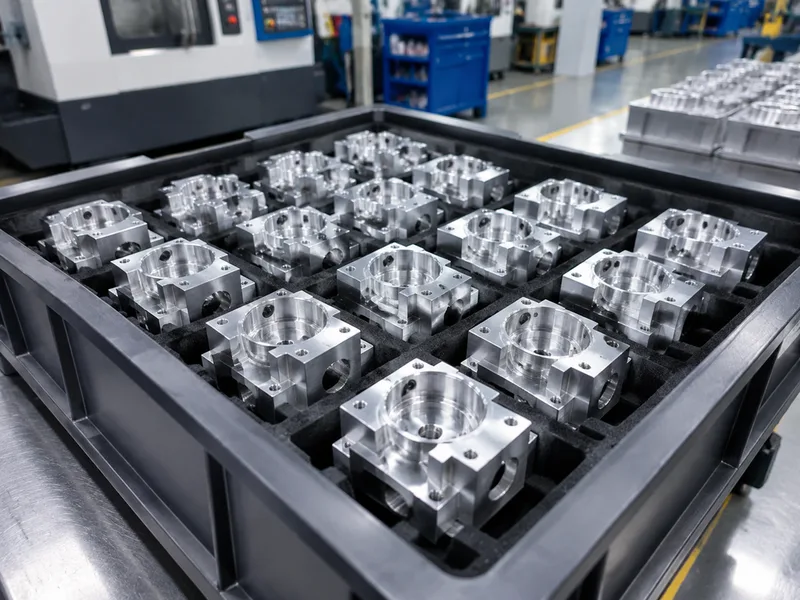
Low-volume CNC production covers pilot series, market-testing batches, spare parts and equipment manufacturing — typically from ten to several thousand pieces. Because parts are machined, there is no mold or tooling investment, and design changes between runs cost nothing.
We keep each order series on the same line and setup, and document first-article results, so part ten thousand matches part one. Volume price breaks are quoted upfront so you can plan product economics honestly.
Capabilities
- Typical volumes from 10 to 1,000+ parts
- No tooling or mold investment
- Same line and documented settings per order series
- First-article and final inspection on every run
- Volume price breaks quoted upfront
Typical materials
Aluminum alloys, stainless steel, carbon steel, brass, copper and engineering plastics — the same grades used for prototypes, so validation carries over.
| Material / grade | Typical condition | Machinability | Where it fits |
|---|---|---|---|
| Aluminium 6061 | T6 (solution treated and aged) | Easy: free-cutting, good chip control | Brackets, housings, fixtures, prototypes into production |
| Aluminium 7075 | T6 / T651 | Harder: more tool wear, needs rigid setups | High-strength, weight-critical parts; not for welding |
| Stainless 304 / 304L | Annealed | Work-hardens: slower speeds, positive feed | General corrosion resistance, food and process equipment |
| Stainless 316 / 316L | Annealed | Tougher than 304: more tool wear | Chloride, marine, medical and pharmaceutical exposure |
| Carbon steel 1018 / 1045 | As-rolled / normalised | Easy to moderate; needs protection against rust | Shafts, plates, weldments, tooling bodies |
| Brass C360 | H02 half hard | Excellent: high speeds, clean finish | Fittings, bushings, connectors, decorative parts |
| Copper C110 | Annealed / H02 | Gummy: sharp tools and high rake angles | Conductivity, busbars, thermal management |
| Titanium Grade 5 (Ti-6Al-4V) | Mill annealed | Difficult: low speeds, heat control, tool wear | Aerospace, medical and lightweight high-strength parts |
| Engineering plastics (POM, PEEK, PA) | Extruded / annealed | Easy to gummy: soft jaws, sharp tooling | Insulation, low friction, chemical and wear parts |
Finishes
Full finishing range: anodizing, plating, powder coating, passivation, polishing and marking, applied consistently across runs.
| Finish | What it does | Specify it when |
|---|---|---|
| As machined | Tool marks left visible; Ra typically 1.6-3.2 µm | The part only has to function |
| Bead blast | Uniform matte surface, hides tool marks | Cosmetic parts before anodising |
| Anodising Type II | Builds an oxide layer; colour options | Aluminium appearance plus mild corrosion and wear resistance |
| Hard anodising Type III | Thicker, harder oxide layer | Sliding or wearing aluminium surfaces |
| Chromate conversion | Thin protective film that stays conductive | Electrical bonding or grounding on aluminium |
| Electroless nickel | Uniform, hard, corrosion-resistant layer | Wear plus corrosion, including inside bores |
| Zinc plating | Economical sacrificial corrosion protection | Steel parts in indoor or sheltered service |
| Powder coat | Thick, durable, decorative layer | Appearance is the requirement |
| Passivation | Removes free iron and restores the oxide film | Stainless parts after machining |
| Stress relief / heat treatment | Relieves residual stress before or after cutting | Thin walls and tight tolerances that must survive machining |
Tolerances
Standard ISO 2768-m; repeat orders hold the tolerances validated on the first article.
| Callout | What it needs | Effect on cost and lead time |
|---|---|---|
| General: ±0.25 mm / ±0.010 in | Standard tooling, dimensional check | Baseline: no adder |
| Standard: ±0.13 mm / ±0.005 in | Machine in good condition, first-article check | Small adder; the usual quoting default |
| Tight: ±0.025 mm / ±0.001 in | Ground or diamond tooling, temperature control, CMM | Step change: slower cuts plus full inspection |
| Precision: ±0.013 mm / ±0.0005 in | Finish passes, gauging, controlled environment | Machining dominates the price; often a separate operation |
| Position / angularity (GD&T) | Datum control, one setup where features are related | Depends on how many setups the datum spans |
| Surface finish Ra 0.8 µm or finer | Finer stepovers, polishing or a finishing pass | Adds a process step, not just machining time |
Process Options
- CNC machining is a subtractive manufacturing process.
- Finishing Options: Black Oxide, Electropolishing, ENP, Media Blasting, Nickel Plating, Passivation, Powder Coating, Tumble Polishing, Zinc Plating, Vibratory Tumbling
- EPX 82 is processed using Carbon DLS
- MUD is a type of mold that uses a standard injection molding frame.
- Different taper turning methods suit different jobs. Compound slides often handle short tapers, while CNC interpolation and taper attachments improve repeatability on longer parts
- G92 is used by programming one or more G92's right after the G76 threading cycle
- Estimates are provided through an auto-quoted method.
- EDM relies on a voltage and a thin wire
- Advanced machining processes like micro-machining and EDM are used to create small, precise mold cavities and cores
Surface Finish Reference
- The finish of MoldTech MT11010 is a fine matte texture.
- The finish of MoldTech MT11020 is a medium matte texture.
- The finish of MoldTech MT11030 is a coarse matte texture.
- SPI A-1 has a surface roughness of 0.012–0.025 µm.
- SPI B-2 has a finish of Medium semi-gloss.
- SPI B-2 has a surface roughness of 0.10–0.15 µm.
- SPI C-3 has a surface roughness of 0.63–0.70 µm.
- Super high gloss, polished with a Grade #3 (6000-grit) diamond buff to Ra 0.012–0.025 µm.
- Medium semi-gloss, finished with 400-grit paper to Ra 0.10–0.15 µm.
- Normal matte, polished with 320-grit stone to Ra 0.63–0.70 µm.
Tolerance Reference
- The tolerance with drawing for CNC Milling is as low as +/- 0.005 mm.
- FDM 3D printing offers a low-cost component with average accuracy and uses thermoplastics for 3D printing.
- Wire Cut EDM is highly accurate.
- The U6 H.E.A.T machine achieves tight tolerances.
- Die sinker EDM is capable of maintaining tight tolerances
- The shop needs to have CNC machines that can achieve a specific tolerance.
Industries We Serve
- antennas
- automotive
- CNC machined parts
- custom parts
- electronics
- medical diagnostic
- optical displays
- optical_systems
Material Reference
- ABS
- Austenitic Stainless Steel
- Carbon steel
- ceramic
- composites
- Copper - T2
- copper or graphite
- Hardened Materials
- High Impact Polystyrene
- Low-density polyethylene
- MDF
- metal
- Polybutylene Terephthalate
- SUS304
- thermoplastics
- thick metal sheets
- tungsten carbide
Ordering, Lead Times & MOQ
Custom CNC parts carry no forced MOQ; ordering from a single prototype piece is standard industry practice.
Instant-quote platforms publicly advertise prototype lead times of 1-3 business days.
Online RFQ is the industry-standard flow: upload a 3D model (STEP/STP/DWG/DXF), receive an instant quote or engineer review, then production, inspection, and delivery.
Frequently asked questions
How do you keep quality consistent across repeat orders?
Each order series stays on the same line and setup. The first article is inspected and documented, in-process settings are recorded, and final inspection repeats on every run. Repeat orders are checked against the original approved sample.
When is low-volume CNC better than injection molding?
Below roughly a few thousand parts, CNC wins: no mold investment, no lead time for tooling, and full design freedom between runs. Injection molding only pays off at volumes where the mold cost amortizes — and only for plastics. We will tell you honestly where the crossover sits for your part.
Can I scale from low-volume to larger runs later?
Yes. Scaling means more machine time, not a new process. Your validated design, production setup and QC documentation carry over, and we re-quote with volume price breaks as quantities grow.
What does a repeat order cost?
Repeat orders are typically faster and cheaper than the first run because engineering review and first-article setup are already done. Send the order quantity and we re-quote against your documented production record.
What is the minimum order quantity (MOQ)?
Prototypes from 1 pc. Low-volume production typical 50-500 pcs. No forced MOQ on custom parts; unit price drops with volume.
What is the typical lead time?
Industry benchmark: instant-quote platforms deliver prototypes in 1-3 business days. Our own production: prototypes 5-10 working days, including in-house QC and shipping. Production: 2-4 weeks depending on quantity/finishing. Express options exist; finishing adds days.
What tolerance should I specify?
Specify tight tolerances only on critical features. Standard ±0.1 mm covers most features. Tighter tolerance = cost multiplier; apply selectively via drawing GD&T.
How is quality controlled?
First-article inspection in our own shop before the first production order. In-process checks. Final inspection report (dimensions) with shipment. Material certs (mill test reports) on request.
Is my design protected?
NDA before file exchange. Files used only for your production. No resale of custom designs.
Which material should I choose?
Function first: strength, weight, corrosion, cost. Common pairings: 6061 general, 304/316 corrosive env., PEEK medical. See materials guide pages.
Which surface finish do I need?
Anodizing for aluminum corrosion/wear/color. Passivation for stainless. Plating for conductivity/steel protection. Cosmetic vs functional distinction.
How do you ship and what terms?
DHL/FedEx/UPS express for samples and small batches. Air/sea freight for production volumes. Incoterms: EXW/FOB/DAP/DDP options.
Sources · 2
- rapiddirect.comIndustry peer technical page
- jlccnc.comIndustry peer technical page
Technical references cited for verifiability — not supplier recommendations. Browse the research library.
Related Knowledge
Capability commitments on this page are owner-confirmed (2026-09-21).