2205 Duplex Stainless Steel CNC Machining
CNC machining of 2205 duplex stainless: roughly double the yield of 316 with serious chloride resistance — collected property envelope, machining behavior, RFQ guidance.
Last updated: 2026-10-31
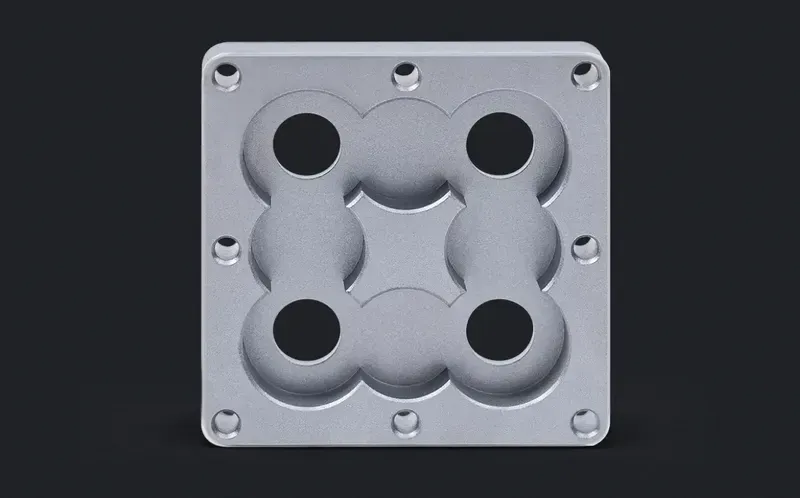
2205 is the most widely used duplex stainless steel: an austenite-ferrite microstructure balanced at roughly half and half, standardized in EN 10088-3 for bar and forged products among others. The two-phase structure is the point — the ferrite brings roughly double the yield strength of an austenitic grade, and the chromium-molybdenum-nitrogen chemistry brings chloride pitting resistance well beyond 316. The result is a structural stainless that lets designers cut section thickness and weight without giving up corrosion performance.
Machining 2205 is genuinely harder than machining 316: the high ferrite content gives it stiffness and abrasiveness that eats cutting edges, and its high strength means real cutting forces. It machines at austenitic-like speeds with heavier tooling budgets, and the process discipline that matters most is thermal — because the corrosion and toughness properties of a duplex part depend on never over-heating it, in the cut or in the weld.
Specifications
| Property | Value | Condition |
|---|---|---|
| Density | 7.805 g/cm³ | |
| Tensile strength | 650–880 MPa | bar, EN 10088-3 |
| Yield strength (0.2% offset) | ≥450 MPa | proof stress, min |
| Elongation | ≥25 % | A50 mm, min |
| Hardness | ≤270 HB | Brinell, max |
| Elastic modulus | 200 GPa | |
| Composition | Cr 21.00–23.00 %, Ni 4.50–6.50 %, Mo 2.50–3.50 % | weight % |
Values above are rendered from the collected model-evidence layer, each carrying the heat-treatment condition it was reported under; fields without collected evidence are stated as not established rather than estimated. Requirements outside the table are confirmed for the specific geometry and batch at quotation.
Applications & Selection Points
Structural components in chloride environments
Bridges and structures in coastal atmospheres, offshore hardware, chemical plant structural fittings and load-bearing components exposed to salt spray use 2205 where 316 would pit and ordinary steel would die young. The strength argument is the quiet seller: parts sized for stiffness in duplex are lighter than their austenitic equivalents. Machined parts cluster in fittings, connectors, and machined-from-bar components between fabricated sections.
Oil, gas and desalination hardware
Piping systems, valve bodies, heat-exchanger components and seawater intake hardware use the grade where chloride brines and moderate temperatures arrive with pressure duty. Its chloride resistance covers most seawater duties up to the temperature band where the super duplex tiers begin. Sour-service variants exist; where H2S service is in play, the specific service standard belongs on the RFQ.
Pulp and paper, chemical processing
Digesters, bleaching-wash equipment and process vessels handling chloride-bearing process streams have used 2205 since its earliest days. Machined parts are shafts, agitator components, valve trim and wear fittings. The economics mirror the structural case: duplex delivers 316-plus corrosion behavior with less alloy weight and less material cost per part — which is exactly why it displaced austenitic grades in these duties.
Where 2205 is the wrong call
If the duty is acid chemistry rather than chloride exposure, the copper-bearing austenitic 904L or the nickel alloys solve it better. If service temperature runs high for long periods, the ferrite phase embrittles and the duplex structure loses its argument — austenitic grades take over. And if the corrosion problem is mild enough that 304 or 316 genuinely suffices, duplex pays for metallurgy the duty never exercises.
Machining behavior and process planning
The duplex cutting signature is abrasive, high-force chips with little of the austenitic gumminess but a lot of edge wear: positive-rake coated carbide, rigid setups and disciplined feed rates keep the process honest. The material-specific rule is thermal control — cutting zones that overheat the surface can alter the phase balance locally, and the properties that justified the grade live in that balance. Steady cuts, generous coolant and no dwell cover both the tooling and the metallurgy.
Welding — the discipline buyers should know exists
Duplex welding is a controlled process: heat input and cooling rate must keep the weld and heat-affected zone in the right phase balance, with filler matched or over-alloyed in nickel. This is why welded 2205 assemblies belong with fabricators who run duplex routinely — a weld done with austenitic habits can quietly deliver the corrosion resistance of a much cheaper steel. Machined components that weld into assemblies should have their critical faces finish-machined after the thermal cycle.
Tolerance, inspection and surface finish
The grade is dimensionally stable and its high strength helps thin, stiff parts hold geometry under cut. Batch drift tracks tool wear rather than part movement — edge wear on abrasive duplex chips is fast, so tool-change intervals belong in the process plan. Certification traceable to the heat and the product standard, with phase-balance evidence on critical service parts, is the supply expectation worth stating at quotation.
Frequently Asked Questions
Is 2205 stronger than 316L, and does that save money?
Yes on strength — roughly double the yield — and the saving is real where the design uses it: thinner sections, lighter parts, smaller fasteners. The saving disappears where geometry is set by stiffness, corrosion margins or standard dimensions rather than strength. Machined fittings and bar components often cannot exploit the strength; pressure vessels and structural sections can. Ask the design question at quotation rather than assuming the alloy premium pays for itself.
Can 2205 replace 316L everywhere in seawater service?
In most immersed and splash duties, yes — its pitting resistance exceeds 316L with room to spare. The exceptions are metallurgical, not chemical: long service above the embrittling temperature band, and heavy welded construction where the fabricator lacks duplex discipline. If the part welds into a larger assembly, the weld process control matters more than the alloy choice on the drawing.
Why does 2205 consume more tooling than 316L?
The ferrite phase is hard and abrasive, the material is strong, and chips are stiff — every one of those moves wear onto the cutting edge. Expect cutting speeds near austenitic practice but tool life meaningfully shorter, and plan tool-change intervals accordingly. Shops experienced in duplex quote this honestly; quotes identical to 316L pricing usually assume 316L tooling reality, which shows up later as dimensional drift late in the batch.
Does 2205 need heat treatment after machining?
No — the solution-annealed condition is the delivery and service condition, and re-annealing after machining is a recovery step for welded or badly cold-worked parts, not a routine. What matters post-machining is cleaning: heat tint and free-iron removal on corrosion-critical faces, same discipline as the austenitic grades. State critical faces on the drawing so the cleaning scope is priced rather than assumed.
What should I send for a 2205 machining quote?
A STEP model and 2D drawing with tolerances, corrosion-critical faces marked, the material specification and product form, quantity, and the service environment — chloride exposure, temperature range, and any pressure or sour-service requirement. If the part welds into an assembly, say so: duplex weld discipline is a supplier capability question that belongs in sourcing, not in an after-the-fact discovery.
Ordering & Documentation
Documents
Send a STEP or IGES model with a 2D drawing carrying tolerances and marked corrosion-critical surfaces. Name the specification and product form, and declare any welding the part will see — duplex weld discipline is part of the quoting decision.
Quotation
Quotes price from model, drawing, stock form, quantity and service environment, plus cleaning and certification scope. Deep bores, heavy threading and thin walls should be flagged — tool wear on this alloy makes them the schedule risk.
Sample & Supply
Prototype quantities from one piece are normal. A first article verifies surface finish and cleaning practice on critical faces. Heat certification is standard; phase-balance or corrosion-test evidence can be requested for critical service parts — agree scope at quotation.
Storage & Shipping
Finished parts resist transit corrosion but should never contact carbon steel; embedded free iron is the classic self-inflicted pitting site. Pack with separation, store dry, and deliver the passivated, tint-free surface condition the specification expects.
Request a quote for 2205 Duplex Stainless Steel CNC Machining →