904L Stainless Steel CNC Machining
CNC machining of 904L: the super austenitic stainless behind sulfuric acid service and premium seawater hardware — collected property envelope, machining behavior, RFQ guidance.
Last updated: 2026-10-31
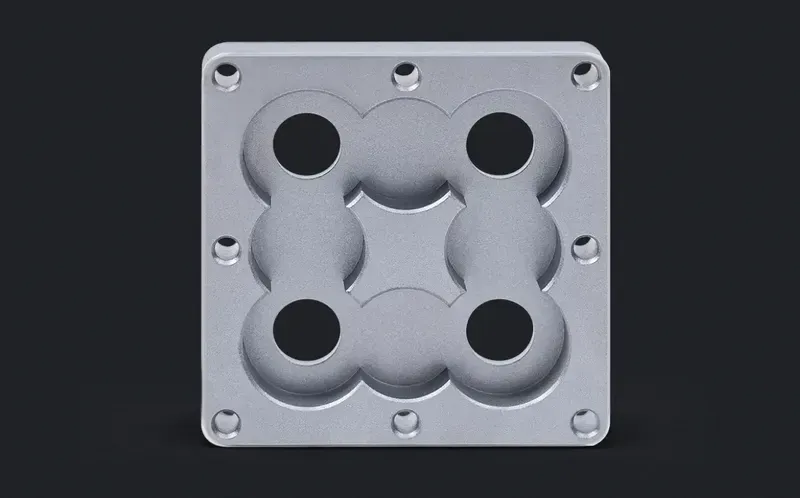
904L is the super austenitic stainless steel with a deliberately unusual balance: high nickel, added molybdenum and copper, and low carbon. That chemistry is aimed at sulfuric acid across a broad concentration range — the environment that defeats ordinary austenitic grades — and at seawater service without the pitting that 316 eventually shows. Watch buyers will recognize it as the alloy of certain premium dive watches; process buyers know it from acid plant hardware, and it is standardized in ASTM B625 for plate, sheet and strip products.
For machining it behaves like a tougher, gummier cousin of 316L: fully austenitic, work-hardening, and slow-chipping, with the copper addition adding adhesive tendency at the cutting edge. It machines conventionally with the standard austenitic discipline — sharp tools, steady heavier cuts, no dwell — but tooling budgets should be set closer to the nickel alloys than to carbon steel.
Specifications
| Property | Value | Condition |
|---|---|---|
| Tensile strength | ≥490 MPa | min, ASTM B625 flat rolled products |
| Yield strength (0.2% offset) | ≥220 MPa | 0.2% proof, min, ASTM B625 flat rolled products |
| Elongation | ≥36 % | in 50 mm, min |
| Hardness | 150 HB | 70–90 HRB typical |
| Density | 7900 kg/m³ | |
| Composition | Ni 23–28 %, Mo 4–5 % | weight % |
Values above are rendered from the collected model-evidence layer, each carrying the heat-treatment condition it was reported under; fields without collected evidence are stated as not established rather than estimated. Requirements outside the table are confirmed for the specific geometry and batch at quotation.
Applications & Selection Points
Sulfuric acid process hardware
Acid plant heat exchangers, pumps, valve internals and pipework components in dilute-to-mid sulfuric service are the classic 904L portfolio — the copper-bearing austenite holds where 316 thins out. Machined parts cluster at the interfaces: fittings, spray system components, instrumentation bodies. Quotes should carry the acid concentration and temperature, because the alloy advantage is concentration-dependent and the honest comparison with higher-nickel alloys depends on it.
Seawater and marine-critical components
Seawater cooling circuits, offshore instrument housings, rudder and stern-gear fittings use 904L where chloride pitting and crevice attack over long service lives rule out 316. It is not a duplex-grade substitute in every duty, but where weldability in the field matters, its fully austenitic structure avoids the duplex welding discipline. State the service — immersion, splash or atmospheric — since that determines whether 904L or a cheaper stop fits.
Pharmaceutical and food-grade equipment
The low carbon content and clean corrosion behavior made 904L common in pharmaceutical reactors, fermentation hardware and aggressive cleaning-service components before duplex and higher alloys took part of the market. Machined parts are mostly fittings, valve bodies and sensor hardware. Surface finish expectations dominate quotes here — the polish and Ra requirements are the process, not the alloy.
Where 904L is the wrong call
If the chloride duty is severe with high mechanical strength in the same part, the duplex family — 2205 and up — delivers more strength and comparable corrosion behavior at lower alloy cost. If the acid is hot and concentrated, nickel alloys earn their premium instead. And if 316 genuinely survives the service — which it does in many atmospheric and mild-immersion duties — 904L is paying an alloy premium for margin the part never uses.
Machining behavior and process planning
904L work-hardens quickly and its chips are tough and continuous, so the austenitic playbook applies with emphasis: sharp positive-rake tooling, cuts deep enough to get under the previously hardened layer, rigid setups, and coolant that manages both heat and chip evacuation. Dwell, light spring passes and rubbing are the specific errors that harden the surface and destroy the next tool. Threading works better with thread milling than with small taps; drilling wants through-coolant tooling.
Welding and post-processing
The low carbon content means sensitization is essentially absent — 904L welds and services as-welded where 316 would need the L-grade discipline anyway. Post-weld, heat tint removal on corrosion-critical faces is standard practice, and pickling or mechanical cleaning on welds in acid or seawater service is a specified step. Machined components welded into assemblies should sequence final finishing after the thermal cycle.
Tolerance, inspection and surface finish
The austenitic structure brings the usual non-magnetic behavior and no hardening transformation; dimensional control is a matter of heat and fixturing management. Its lower thermal conductivity versus carbon steel means cutting heat concentrates at the tool — another reason tool wear, not part movement, is the drift risk in batches. Certification traceable to the heat, and often to ASTM B625 product forms, is the normal supply expectation.
Frequently Asked Questions
Is 904L worth the premium over 316L?
Only where the duty genuinely involves sustained acid contact or long-life seawater immersion. The alloy premium is structural — high nickel plus molybdenum plus copper — and it repeats on every size in the BOM. For atmospheric marine service, splash zones and intermittent exposure, 316L usually delivers the service life at a fraction of the cost. The honest test is the failure mode you are buying against: if the answer is pitting over decades, 904L is real; if it is vague corrosion worry, 316L is probably the answer.
Should my part be 904L or duplex 2205?
Compare on three axes: strength (2205 is roughly double the yield, so thinner sections work), corrosion duty (904L leads in sulfuric acid; duplex leads in high-chloride brines with strength needs), and fabrication (904L welds with plain austenitic practice; duplex needs controlled heat input and follow-up). If the part is thick and pressurized, duplex usually wins the economics; if it is machined fittings in acid service, 904L usually does.
Why does 904L machine harder than 316L?
Same austenitic work-hardening physics, plus two aggravators: higher alloy content means more abrasive carbide and intermetallic potential at the edge, and the copper addition increases adhesive tendency — chips weld to the rake face more readily. The result is shorter tool life and lower feeds rather than a different technique. Shops already cutting 316L or the nickel alloys adapt quickly; tooling budget should simply be set higher.
Does 904L need passivation after machining?
The alloy self-passivates strongly, but machined surfaces carry free iron from tooling contact and shop contamination like any stainless. A pickling or citric passivation step restores the clean surface, and in acid or seawater service it is a specification step rather than an optional polish. What the buyer controls is stating which faces are corrosion-critical, so the cleaning scope is priced in rather than assumed.
What should I send for a 904L machining quote?
A STEP model and 2D drawing with tolerances and corrosion-critical faces marked, the material specification and product form, quantity, and the service environment in real terms — medium, concentration, temperature, immersion versus splash. Surface finish and cleaning requirements on critical faces should be explicit. Certification scope, typically traceable to the heat and the B625 product form, belongs at quotation.
Ordering & Documentation
Documents
Send a STEP or IGES model with a 2D drawing carrying tolerances, finish callouts and marked corrosion-critical surfaces. Name the specification and product form — plate, bar or forging — because certification expectations track the form.
Quotation
Quotes price from model, drawing, stock form, quantity and the service environment, plus cleaning and certification scope. Tooling-consumption reality on this alloy is part of a realistic price; quotes far below the 316L baseline usually assume something the drawing does not say.
Sample & Supply
Prototype quantities from one piece are normal. A first article verifies surface finish and cleaning practice on the critical faces. Material certification traceable to the melt is standard supply in this service tier — agree it before production.
Storage & Shipping
Finished parts resist transit corrosion but should not contact carbon steel — embedded free iron becomes a pitting site in exactly the service the alloy was chosen for. Pack with separation, store dry, and preserve the passivated surface condition the specification requires.