HDPE CNC Machining
CNC machining of HDPE: the chemically inert commodity plastic for tanks, liners and wear parts — collected property envelope, cutting behavior, and RFQ guidance.
Last updated: 2026-10-31
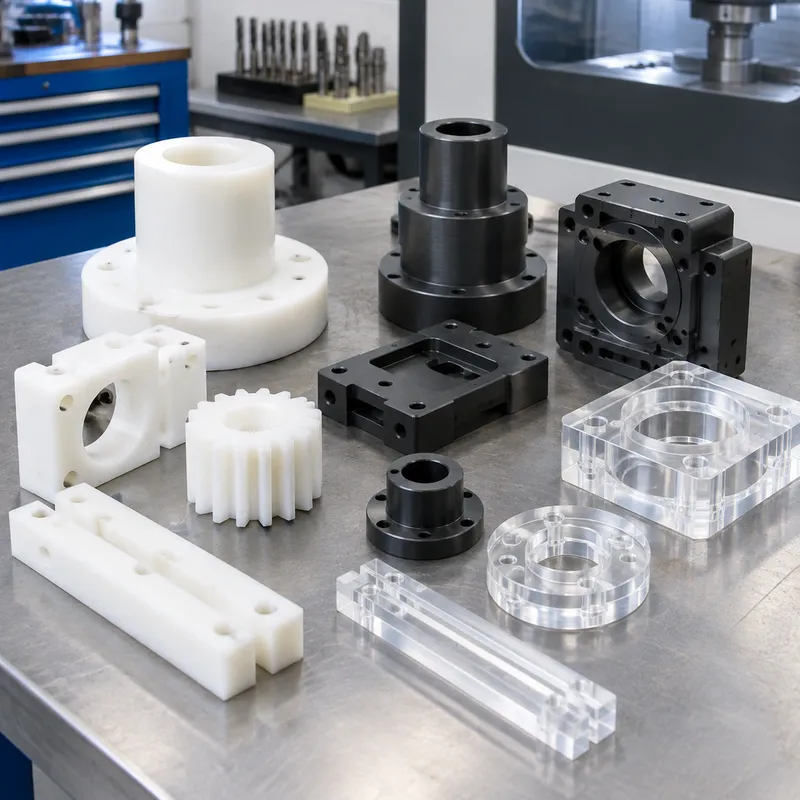
HDPE — high-density polyethylene — is the toughest of the commodity plastics: chemically near-inert, slippery, water-absorption-free, and inexpensive enough that it appears everywhere from cutting boards to tank liners to laboratory benchtops. Its density sits low and its tensile strength is modest compared with engineering plastics, but its chemical resistance envelope is enormous, which is why chemical tanks, ducting and food-handling surfaces are its machining territory.
For a machine shop, HDPE is one of the friendliest plastics to cut: soft, predictable and forgiving. The difficulty is not cutting forces but dimensional discipline — thermal expansion and low stiffness mean thin walls flex, heat moves geometry, and holding tight tolerances is a planning question rather than a machine question. Buyers who quote HDPE like metal get the price wrong in both directions.
Specifications
| Property | Value | Condition |
|---|---|---|
| Density | 930–970 kg/m³ | |
| Tensile strength | 38 MPa | versus 21 MPa for LDPE |
| Max service temperature | 120 °C | short periods |
Values above are rendered from the collected model-evidence layer, each carrying the heat-treatment condition it was reported under; fields without collected evidence are stated as not established rather than estimated. Requirements outside the table are confirmed for the specific geometry and batch at quotation.
Applications & Selection Points
Chemical tanks, liners and ducting components
Tank fittings, manway components, baffles, ducting parts and containment hardware use HDPE where the chemical environment would attack nearly any metal — acids, alkalis and salts at moderate temperature roll off it. Machined-from-plate suits retrofit fittings and low-volume tank hardware; welded fabrication covers the tank body. State the chemical, concentration and sustained temperature — the envelope is broad but not unconditional.
Food handling and cutting surfaces
Cutting boards, food-contact guides, scrapers and handling fixtures are classic HDPE work: non-absorbent, cleanable, non-marking and gentle on blades. Machined custom fixtures and guides supplement standard sheet. Food-contact work should declare the contact class and cleaning chemistry at quotation — sanitizers and hot cleaning cycles are within the envelope but belong in the spec, not in an assumption.
Wear strips, guides and low-load sliding parts
Conveyor wear strips, guide rails, bushings and sliding pads use HDPE where loads are light and lubricant-free running matters. Its low friction and non-marking behavior suit packaging and material-handling equipment. Under concentrated load or elevated temperature it creeps — UHMW-PE or acetal take the heavier duties — so state the load, speed and temperature triangle and let the material follow it.
Where HDPE is the wrong call
If the part needs stiffness or dimensional precision under load, acetal, nylon or PPS outclass it at moderate cost. If it needs wear life under real load, UHMW-PE is the same family done better. If it needs continuous heat, the engineering plastics take over well below where metals begin. And where UV exposure is sustained, unmodified HDPE degrades — stabilized variants exist but must be specified. HDPE is the cheap answer to a surprisingly specific set of duties.
Machining behavior and process planning
HDPE cuts easily and tolerates a wide range of tooling, but the process discipline is thermal and mechanical: sharp tools with positive geometry, light depths on thin sections, and clamping that holds without distorting — the material is stiff enough to cut and soft enough to bend. Chips are clean and continuous. Coolant is usually unnecessary; air blast keeps chips clear without thermal shock. Sharp edges matter — dull tools smear polyethylene and leave a poor surface.
Tolerance, flatness and thermal reality
The tolerance conversation on HDPE is honest expectation-setting: thermal expansion far above metal, modest stiffness, and creep under sustained load mean tight tolerances are achievable at room temperature on supported geometry but should not be asked to survive hot service or heavy load. Flatness on large thin sheet parts needs relaxed callouts or mechanical constraint in service. The shop can hold precise dimensions — the question is what the part does after it leaves the fixture.
Joining, welding and secondary operations
HDPE welds readily by extrusion or hot-air methods, which is why machined fittings integrate into fabricated tanks so well. It also taps and screws acceptably at low loads, though thread-forming in a creeping plastic is a design decision, not a detail. Adhesives bond it poorly — its chemical inertness is surface inertness too — so mechanical fastening and welding are the real assembly routes, worth naming in the RFQ.
Frequently Asked Questions
Is HDPE or UHMW-PE the right polyethylene for my part?
Follow the load and the wear. UHMW-PE carries far higher impact and abrasion duty — it is the wear-strip and chute-liner material. HDPE is stiffer, easier to machine accurately, cheaper, and better where the part is a structure or fitting rather than a wear element. Both share the chemical envelope. If the part is a tank fitting or a fixture, HDPE; if it is a sliding contact element under real load, UHMW-PE.
What tolerances are realistic on machined HDPE?
Moderate tolerances on supported geometry at room temperature are routine; precision tolerances are achievable in the fixture but should be questioned against the service. The material moves with temperature far more than any metal and creeps under load, so a tight dimension that matters in hot or loaded service needs either a different material or a design that tolerates movement. State which dimensions are truly critical and the service temperature — the shop will quote what the material can honestly deliver.
Does HDPE need to be dried or stress-relieved before machining?
No drying — it absorbs essentially no water, one of its genuine advantages over nylon. Stress relief is occasionally worthwhile on heavily machined plate parts to stabilize flatness, and it is a low-cost step compared with rework. The main process care is avoiding heat buildup in the cut: sharp tools and modest depths keep the surface clean and the geometry where it was cut.
Can HDPE parts be glued?
Poorly — the same chemical inertness that makes HDPE a tank material makes its surface resist adhesion. Special surface treatments and polyolefin-specific adhesives exist but are process-heavy. The reliable routes are welding and mechanical fastening, both of which the fabrication world around HDPE already uses. If the design assumes bonded assembly, raise it at quotation — it may change the material choice to one that bonds.
What should I send for an HDPE machining quote?
A model or drawing with tolerances, the stock form — sheet thickness matters on flat parts — quantity, and the service: chemical, concentration and temperature if it is containment duty; load, speed and counterpart if it is sliding duty. Food-contact or UV-exposure requirements should be declared. On commodity plastics the material is cheap; the price lives in tolerances, finishing and stock selection.
Ordering & Documentation
Documents
Send a model or 2D drawing with tolerances and the service description. Name the stock form — extruded versus pressed sheet differ in flatness and stress state — and mark any food-contact or UV-stabilization requirement.
Quotation
Quotes price from geometry, tolerance class and stock selection. Tight flatness on large thin parts and heavy machining on thick plate are the two cost movers — both are worth a conversation at quotation rather than a surprise after.
Sample & Supply
Prototype quantities from one piece are normal, and a first article checks fit and flatness before a batch commits. Material certification is rarely required on commodity plastics but resin-grade confirmation is available — agree it when the duty depends on it.
Storage & Shipping
Finished HDPE ships and stores easily: no corrosion, no moisture sensitivity. The care points are mechanical — thin walls and delicate features pack with support — and thermal: keep finished parts away from sustained heat sources that could relax machined-in flatness.