UHMW-PE CNC Machining
CNC machining of UHMW-PE: the highest-impact, lowest-friction polyethylene for wear strips, chute liners and guides — machining behavior, tolerance reality, RFQ guidance.
Last updated: 2026-10-31
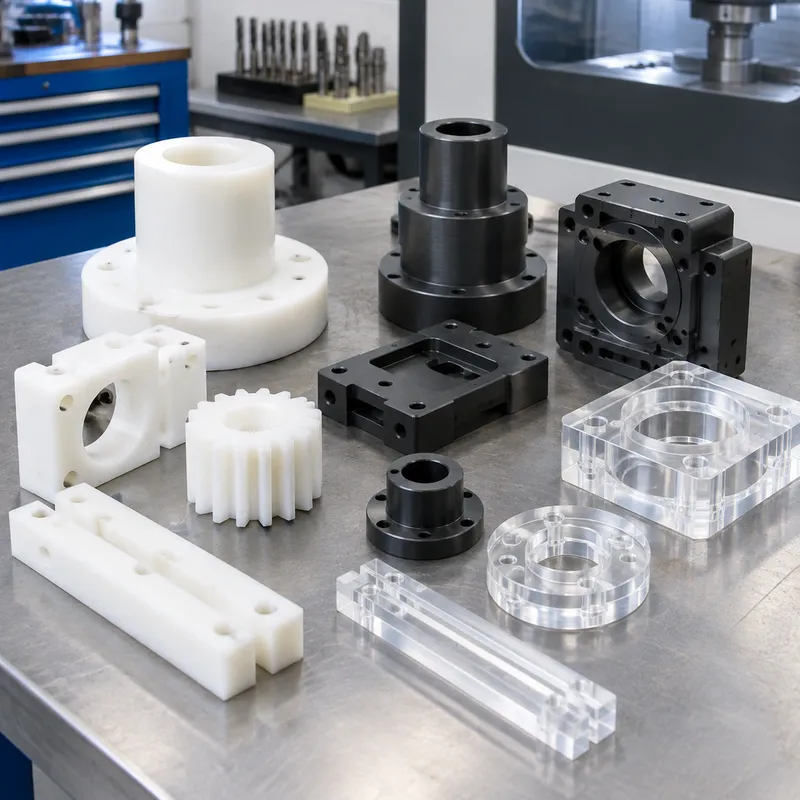
UHMW-PE — ultra-high-molecular-weight polyethylene — is the toughness champion of the plastics: notched Izod specimens frequently refuse to break, its friction coefficient sits near PTFE territory without any lubricant, and its abrasion resistance leads the entire thermoplastic field. Chute liners, wear strips, guide rails, dock fenders and chain guides are its native habitat — anywhere material slides against it for years and the plastic wins.
That same molecular structure is what makes it interesting to machine: UHMW-PE cuts soft and slick, holds almost no rigidity, and treats precision tolerances as a negotiation. Machining it successfully is a clamping and planning exercise — the cutting is easy, the geometry holding is not. Buyers who quote it with metal habits or even engineering-plastic habits get surprise quotes; the honest approach starts from what the material is.
Specifications
| Property | Value | Condition |
|---|---|---|
| Tensile yield strength | 19.3–23 MPa | typical |
| Shore hardness | 60–65 Shore D | approximately |
| Elongation | 250–450 % | at break |
| Density | 0.93–0.94 g/cm³ | |
| Impact strength | >1,070 J/m | notched Izod, specimens often do not break |
Values above are rendered from the collected model-evidence layer, each carrying the heat-treatment condition it was reported under; fields without collected evidence are stated as not established rather than estimated. Requirements outside the table are confirmed for the specific geometry and batch at quotation.
Applications & Selection Points
Wear strips, guide rails and chain guides
Conveyor wear strips, chain guide profiles, guide rails and slide liners are the volume application — low friction without lubrication, quiet running, and wear life that embarrasses metals in dusty, gritty environments. Standard profiles come extruded; machined UHMW-PE covers custom guides, transition pieces, and repair fittings. State the load, speed and counterpart material — the wear solution follows that triangle.
Chute, hopper and bulk-material liners
Chute liners, hopper linings, belt scraper blades and dump-truck bed liners use the material where bulk material must slide rather than hang up — its low friction and non-sticking behavior release sticky products that bind on steel. Machined liner segments, wear pads and scraper edges supplement formed sheet. Abrasive wear is where the material leads all thermoplastics; impact-heavy duties are where its toughness shows.
Impact pads, bumpers and protective elements
Dock bumpers, machine impact pads, cushion blocks and protective spacer hardware use its extreme impact toughness — it deforms and recovers where other plastics crack. Machined custom pads and spacers are common in packaging machinery and material handling. Where the pad must also carry sustained load, creep is the design limit to check — toughness and creep resistance are different properties and UHMW-PE has only the first.
Where UHMW-PE is the wrong call
If the part needs stiffness, precision or threaded features under load, it will disappoint: acetal and nylon deliver rigidity at modest cost. If it needs heat resistance, the polyethylenes sit at the bottom of the temperature ladder. If it needs bonding into assemblies, polyolefin surface inertness rules out adhesive joints. And if the duty is truly mild, HDPE delivers the same family behavior cheaper. UHMW-PE earns its slot on wear, impact and friction.
Machining behavior and process planning
The cutting itself is easy — sharp tools, low forces, clean chips at conventional speeds. The process problem is the material: it flexes under clamping and cutting, sheds precision as heat builds, and its low friction works against every fixture. Successful routes clamp with broad, padded contact, support thin sections continuously, use sharp tooling throughout, and machine final passes lightly. Thin-wall and long-part geometry is where quotes differentiate — a shop that has machined it before prices the fixturing honestly.
Tolerance, flatness and dimensional honesty
Precision on UHMW-PE is a negotiation: thermal expansion far above metal, stress relaxation in the stock, and creep under load mean tight tolerances are fixture-bound rather than part-bound. Useful tolerances on supported geometry at room temperature are achievable; precision callouts should be reserved for dimensions that are genuinely functional, and even then checked against service temperature and load. Flatness on large sheet parts relaxes with size — this is material physics, not shop skill.
Fastening and assembly
Adhesives do not bond it — polyolefin surfaces resist everything, so assembly is mechanical. Bolted joints work with oversized or slotted holes to absorb movement, and steel or nylon inserts carry threaded features under load. Welding to HDPE and PP fabrications is possible with polyethylene welding practice, which matters when machined liner segments integrate into tank or chute fabrications.
Frequently Asked Questions
Is UHMW-PE or acetal the right material for my wear part?
Compare the triangle: load, temperature, precision. UHMW-PE wins impact, abrasion and friction — and loses stiffness, heat and dimensional control. Acetal is the precise, stiff, load-capable wear material for gears, cams and bushings with real tolerances. Chain guides and chute liners are UHMW territory; bushings and precision slides are acetal territory. State the load, the counterpart and the tolerance — the answer follows.
What tolerances can I actually hold on machined UHMW-PE?
Useful tolerances on supported, room-temperature geometry are routine. Tight tolerances can be held in the fixture and should be expected to move with temperature, load and time — this is the most creep-prone material in common machining stock. The right buying move is separating function-critical dimensions from cosmetic ones and stating the service temperature; the shop quotes what the material can honestly deliver instead of a number that will not survive service.
Can UHMW-PE parts be glued or bolted?
Glued, no — the same inertness that makes it chemically tough makes its surface refuse adhesives, including epoxies and cyanoacrylates. Bolted, yes, with design allowances: oversized or slotted holes for movement, broad washers to spread load, and inserts where threads carry real force. Welding to other polyolefin fabrications is a genuine option for liner work. If the design assumes bonded assembly, that is a material-selection conversation, not a machining detail.
Why is my machined UHMW-PE part not flat after machining?
Sheet stock carries internal stress from its extrusion, and machining releases it asymmetrically — the part moves. The mitigations are stress-relieving before machining, balanced material removal from both faces, and accepting that large thin parts relax. This is material physics rather than shop error, and experienced shops plan for it. Specifying unrelaxed flatness on a large thin UHMW-PE part guarantees either a surprise price or a surprise movement.
What should I send for a UHMW-PE machining quote?
A model or drawing with tolerances, quantity, and the duty: load, speed and counterpart for wear parts; impact energy for pads; bulk material and geometry for liners. Name the stock form — sheet thickness and extruded profiles shape price. Say which dimensions are function-critical; on this material, honest tolerance selection is the difference between a smooth quote and a rework story.
Ordering & Documentation
Documents
Send a model or 2D drawing with tolerances and the duty description. Name the stock form — extruded sheet versus pressed sheet differ in stress state and flatness behavior — and mark function-critical dimensions explicitly.
Quotation
Quotes price from geometry, tolerance class and stock selection, with fixturing as a real line — thin, flexible parts cost real fixture engineering. Large thin flat parts and precision callouts are the two cost movers worth discussing at RFQ rather than after.
Sample & Supply
Prototype quantities from one piece are normal, and on this material a first article is genuinely informative — check fit under service conditions, not just in the fixture. Resin-grade and food-contact-grade confirmations are available where the duty requires them.
Storage & Shipping
UHMW-PE ships and stores without corrosion or moisture concerns, but parts must be stored flat and cool — stacked weight and heat relax machined flatness. Thin, flexible parts pack with support so transit compression does not become a permanent set.