Rigid PVC CNC Machining
CNC machining of rigid PVC: the chemically resistant, self-extinguishing commodity plastic for tanks, valves and ducting — collected property envelope, cutting behavior, RFQ guidance.
Last updated: 2026-10-31
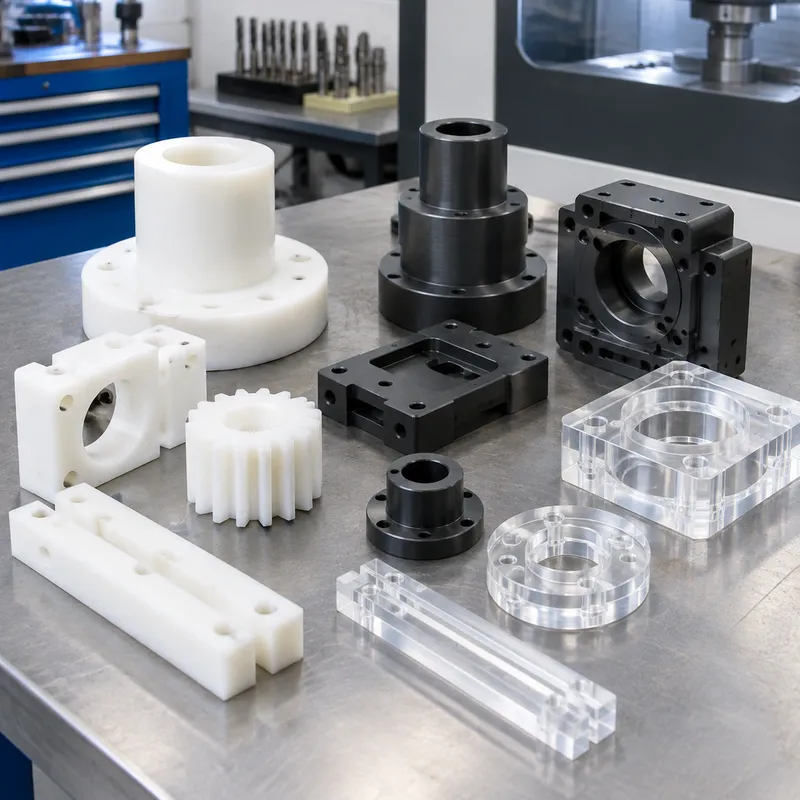
Rigid PVC — unplasticized, sometimes written uPVC — is the chemically resistant commodity plastic of tanks, piping, valves, ducting and electrical housings. It is stiffer than the polyolefins, resists acids, alkalis and salt solutions across a wide band, and is inherently self-extinguishing, which is why electrical and construction codes have trusted it for decades. Its machining stock is sheet, rod and tube at commodity prices, and machined PVC parts usually exist where fabrication cannot hold the geometry.
In the shop it is one of the easiest plastics to machine: rigid, dimensionally cooperative, and clean-chipping. The watch items are heat and impact — PVC softens well below the engineering plastics and is notch- and impact-sensitive in cold conditions, so thin fragile features and aggressive heat-generating cuts are where parts fail. Buyers get the best results quoting PVC as what it is: a cheap, rigid, chemically tough material with modest mechanical ambition.
Specifications
| Property | Value | Condition |
|---|---|---|
| Density | 1.3–1.45 g/cm³ | rigid (unplasticized); plasticized 1.1–1.35 |
| Thermal conductivity | 0.14–0.28 W/(m·K) | rigid; plasticized 0.14–0.17 |
| Yield strength (0.2% offset) | 31–60 MPa | rigid; plasticized 10.0–24.8 |
| Youngs modulus | 3.4 GPa | rigid |
Values above are rendered from the collected model-evidence layer, each carrying the heat-treatment condition it was reported under; fields without collected evidence are stated as not established rather than estimated. Requirements outside the table are confirmed for the specific geometry and batch at quotation.
Applications & Selection Points
Tank fittings, valve bodies and process components
Machined PVC fittings, manway components, sight glasses, valve seats and spool-piece hardware serve chemical tanks and plating lines where the medium defeats metals and the temperature stays modest. Machined-from-rod suits small valve and instrument bodies; sheet stock covers baffles and covers. Declare the chemical, concentration and sustained temperature — PVC handles a wide acid-and-alkali band but has a real thermal ceiling.
Ducting, fume handling and scrubber components
Fume duct fittings, damper components, scrubber internals and fan housings in corrosive exhaust service are staple PVC territory — the combination of acid resistance and self-extinguishing behavior is exactly what fume handling codes ask for. Machined parts supplement welded duct fabrication at the interfaces: sensor bosses, damper shafts, instrument fittings. Flame and smoke requirements belong on the RFQ as explicit callouts.
Electrical insulation and housing components
Insulator blocks, terminal housings, junction components and enclosures use PVC for its dielectric behavior plus inherent flame resistance without additives. Machined-from-sheet covers prototype housings, fixture insulators and custom terminal hardware. Where parts see sustained heat near the material ceiling or cold-impact duty, the comparison with polycarbonate or PPS is worth running before committing.
Where rigid PVC is the wrong call
If the part sees sustained temperatures well above ambient, PVC creeps and softens — CPVC, polypropylene or an engineering plastic extends the range at moderate cost. If it sees impact, especially cold, PVC is brittle where HDPE and ABS bend. If it needs precision under load, the engineering plastics win. And in food or potable contexts, the plasticizer and stabilizer chemistry makes PVC a specification question rather than a default.
Machining behavior and process planning
Rigid PVC machines cleanly with sharp tools: chips break rather than smear, surfaces come off the cutter finished, and tolerances hold well for a commodity plastic. The discipline is thermal — PVC softens earlier than most machining plastics, so heat-generating cuts, dull edges and aggressive feeds risk burning or gumming the surface. Sharp tooling, moderate speeds with real feed, and air or light coolant manage it comfortably. Thin features machine fine but stay fragile; chamfers on brittle edges are cheap insurance.
Bonding, welding and assembly
Unlike the polyolefins, PVC bonds genuinely well — solvent cementing is the classic joining method of the PVC world, and adhesive assembly of machined parts is routine. It also welds with hot-air and extrusion methods for tank and duct work. This makes PVC the easy choice where machined parts must integrate into fabricated assemblies. Threaded metal inserts bond into it well for screwed assemblies under load.
Tolerance, inspection and surface finish
Rigidity gives PVC the best dimensional manners of the commodity plastics: flat sheet stays flat, bores hold size, and finishes carry over from the cutter. Thermal expansion still exceeds metal by an order of magnitude, so gauge at room temperature and specify service-relevant tolerances rather than metal habits. Inspection on process parts usually focuses on fit and sealing surfaces rather than precision callouts.
Frequently Asked Questions
Should my part be rigid PVC or polypropylene?
Compare on heat, impact and joining. PVC is stiffer, easier to bond with solvent cement, and self-extinguishing — the duct and housing favorite. Polypropylene tolerates higher sustained temperatures, bends instead of breaking under impact, and handles some chemicals PVC does not — but it is harder to bond and flammable without modification. If the duty is room-temperature chemistry and assembly-by-bonding, PVC; if heat or impact is in the picture, polypropylene usually wins.
What temperatures can a machined PVC part actually see?
Treat rigid PVC as an ambient-to-warm material: its mechanical properties fall off well before the engineering plastics enter the conversation, and sustained heat plus load means creep. Hot chemical duties migrate to CPVC or polypropylene. The right way to buy is stating the sustained and peak temperatures on the RFQ and letting the material be confirmed against them — this is the single most common PVC mis-specification.
Is PVC suitable for food or potable water contact?
It can be, but it is a specification, not an assumption: resin formulations differ in stabilizers and residuals, and certified grades exist for potable and food contexts. Standard industrial stock may not carry the certification the duty requires. If the part touches consumables, name the certification requirement at quotation so the correct stock form is sourced — this is a procurement question, not a machining one.
Why did my PVC part crack at a corner or hole?
Most likely impact or stress concentration: rigid PVC is notch-sensitive, especially cold, and sharp internal corners, unchamfered holes and press-fits create the initiation points. The fixes are design-side — radiused corners, clearance fits, inserts instead of self-tapping screws under load — and machining-side, where sharp tools and clean cuts leave better edges than smearing cutters. Cracking under sustained load points to creep instead; that is a material-choice conversation.
What should I send for a PVC machining quote?
A model or drawing with tolerances, quantity, and the service environment: chemical and temperature if it is process duty, flame-smoke requirements if it is ducting or electrical, certification class if it is food or potable contact. Name the stock form where geometry depends on it — sheet thickness and rod diameter availability shape both price and lead time on commodity plastics.
Ordering & Documentation
Documents
Send a model or 2D drawing with tolerances and the service description. Name the stock form and any certification requirement — potable, food-contact, flame class — because stock sourcing follows the certification, not the geometry.
Quotation
Quotes price from geometry, tolerance class and stock selection. Thin fragile features, deep bores and large flat parts are the cost movers on commodity plastics; all three are worth declaring at RFQ rather than discovering mid-batch.
Sample & Supply
Prototype quantities from one piece are normal. A first article checks fit and edge quality before batch. Resin-grade or certification confirmation is available on request — agree it when the duty or a code requirement depends on it.
Storage & Shipping
Finished PVC ships and stores easily — no corrosion, no moisture uptake — but it is impact-sensitive: delicate features and corners pack with support and no hard contact. Store away from sustained heat, and in cold climates avoid rough handling that snaps thin edges.