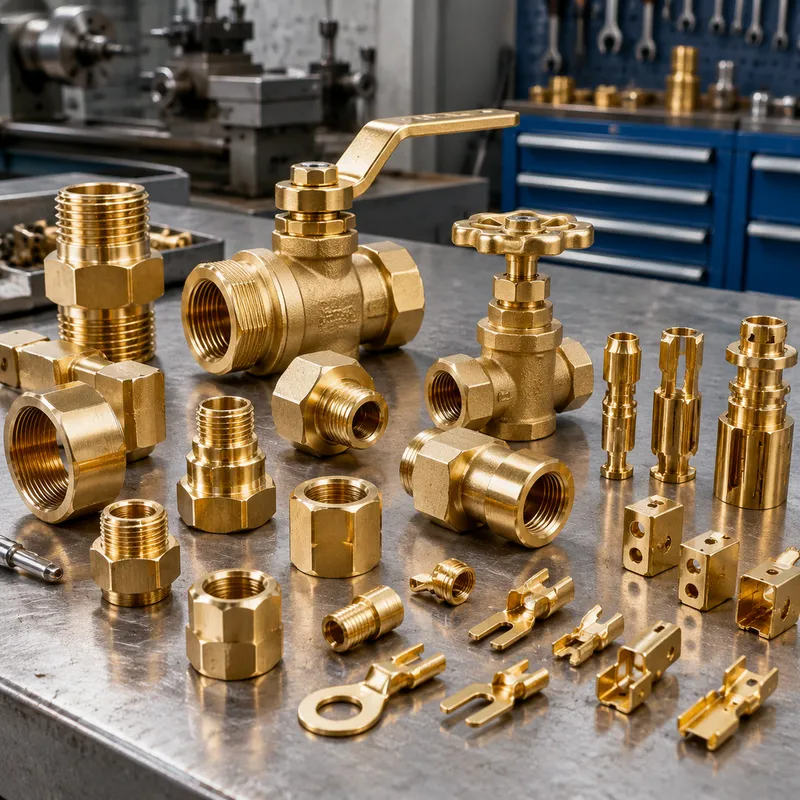
De messingdele, vi bearbejder, dækker VVS-fittings, ventilhuse, koblinger, elektriske terminaler og dekorative komponenter: C36000 letbearbejdeligt messing til store serier af drejede dele, C260 patronmessing når formbarhed og koldbearbejdelighed betyder noget, C693 blyfrit messing til drikkevandskrav.
Messing er et af de mest bearbejdelige metaller — det kører ved høje spindelhastigheder med fremragende spånstyring. Vi påpeger bly- og belegningsangivelser under DFM-gennemgangen, så de færdige dele opfylder drikkevands- og RoHS-krav, hvor de er specificeret.
Material Grades & Properties
Brass Grades We Machine
| Grade | Standard | Characteristics |
|---|---|---|
| C36000 (free-cutting) | ASTM B16 | Best machinability of common metals; standard for turned parts. |
| C26000 (cartridge) | ASTM B36 | Good cold workability; used for deep-drawn and formed parts. |
Key Properties of Machined Brass
- ✓Excellent machinability
- ✓Natural corrosion resistance
- ✓Attractive appearance
- ✓Good electrical conductivity
Typical tolerances:±0.05 mm standard; excellent surface finish as-machined
Applications for Brass Parts
- Plumbing fittings and valves
- Electrical connectors and terminals
- Musical instrument parts
- Decorative hardware
- Instrument components
Machining Notes for Brass
Reference standard for 100% machinability rating; very high cutting speeds; watch for lead-free variants (C360 is leaded) in potable-water applications.
Finishes for Brass Parts
- Polishing
- Lacquer coating
- Nickel plating
- Antique/aged finish
Kapacitet
- Bearbejdning af C36000/C260/C693 efter tegning
- Gevind- og fittinggeometri i én opspænding
- Koordinering af chromatering, fornikling og fortinning
- Gratfri finish på pakningsflader
Typiske materialer
Messing C36000, C260, C34500, blyfrit C693 (Eco Brass) på anmodning.
| Materiale / kvalitet | Typisk tilstand | Bearbejdelighed | Typisk anvendelse |
|---|---|---|---|
| Aluminium 6061 | T6 (opløsningshærdet og udhærdet) | Let: letbearbejdelig, god spånstyring | Beslag, huse, fiksturer, prototyper og opskalering til serie |
| Aluminium 7075 | T6 / T651 | Sværere: mere værktøjsslid, kræver stive opspændinger | Højfaste, vægtkritiske dele; ikke egnet til svejsning |
| Rustfrit stål 304 / 304L | Udhærdet (annealed) | Kalthærder: lavere skærhastigheder, positiv føring | Generel korrosionsbestandighed, fødevarer og procesudstyr |
| Rustfrit stål 316 / 316L | Udhærdet (annealed) | Sværere end 304: mere værktøjsslid | Klorid, marine, medicinske og farmaceutiske miljøer |
| Kulstofstål 1018 / 1045 | Varmvalset / normaliseret | Let til middel; kræver rustbeskyttelse | Aksler, plader, svejsede konstruktioner, værktøjskroppe |
| Messing C360 | H02 halvhård | Fremragende: høje hastigheder, ren overflade | Fittings, bøsninger, stik, dekorative dele |
| Kobber C110 | Udhærdet (annealed) / H02 | Klistret: skarpe værktøjer og store spånvinkler | Ledningsevne, strømskinne (busbar), termisk styring |
| Titanium Grade 5 (Ti-6Al-4V) | Valseudhærdet (mill annealed) | Svær: lave hastigheder, varmestyring, værktøjsslid | Luftfart, medicoteknik og letvægts højfaste dele |
| Tekniske plastmaterialer (POM, PEEK, PA) | Ekstruderet / udhærdet | Let til klistret: bløde kæber, skarpe værktøjer | Isolering, lav friktion, kemiske og sliddele |
Overfladebehandlinger
Klar/gul chromatering, fornikling, fortinning, polering, glasperleblæsning.
| Overfladebehandling | Hvad den gør | Angiv den når |
|---|---|---|
| Som bearbejdet | Værktøjsspor efterlades synlige; Ra typisk 1,6-3,2 µm | Delen kun skal fungere |
| Glasperleblæsning | Ensartet mat overflade, skjuler værktøjsspor | Designdele før eloxering |
| Eloxering Type II | Opbygger et oxidlag; farvemuligheder | Aluminiumsudseende plus moderat korrosions- og slidesikkerhed |
| Hårdeloxering Type III | Tykkere, hårdere oxidlag | Glidende eller slidte aluminiumsflader |
| Chromatering (conversion coat) | Tynd beskyttelsesfilm, der forbliver ledende | Elektrisk binding eller jordforbindelse på aluminium |
| Kemisk nikkelforinkning | Ensartet, hårdt, korrosionsbestandigt lag | Slid plus korrosion, også inde i boringer |
| Forsinking (zink) | Økonomisk offerbeskyttelse mod korrosion | Ståldele indendørs eller i beskyttet miljø |
| Pulverlakering | Tykt, holdbart, dekorativt lag | Udseendet er kravet |
| Passivering | Fjerner frit jern og genskaber oxidfilmen | Rustfrit stål efter bearbejdning |
| Spændingsudligning / varmebehandling | Aflaster indre spændinger før eller efter skæring | Tynde vægge og snævre tolerancer, der skal overleve bearbejdningen |
Tolerancer
ISO 2768-m standard; ±0,01 mm på kritiske detaljer.
| Tegningsangivelse | Hvad den kræver | Effekt på pris og leveringstid |
|---|---|---|
| Generel: ±0,25 mm / ±0,010 in | Standardværktøj, målingskontrol | Basisniveau: intet tillæg |
| Standard: ±0,13 mm / ±0,005 in | Maskine i god stand, førstestykkekontrol | Lille tillæg; det sædvanlige tilbudsgrundlag |
| Snæver: ±0,025 mm / ±0,001 in | Slebet eller diamantværktøj, temperaturstyring, CMM | Trinskift: langsommere skær plus fuld kontrol |
| Præcision: ±0,013 mm / ±0,0005 in | Finskær, grænsemål, kontrolleret miljø | Bearbejdningen dominerer prisen; ofte en separat operation |
| Position / vinklighed (GD&T) | Datumstyring, én opspænding hvor detaljer hænger sammen | Afhænger af, hvor mange opspændinger datumet spænder over |
| Overfladeruhed Ra 0,8 µm eller finere | Finere toothed fremføring, polering eller finskæring | Tilføjer et processtrin, ikke blot bearbejdningstid |
Materials We Machine
- Alloy 260
- Brass
- Copper
- Zinc
Common Applications
- Antimicrobial Surfaces
- Appliance Parts
- Architectural Applications
- Architectural Finishes
- Compression Fittings
- Conductive Parts
- Connector pins & sockets
- Decorative Components
- Decorative hardware
- Decorative pieces
- Electrical Hardware
- Electrical Parts
- Electrical Terminals
- Fishing Applications
- General Hardware
- Grounding Hardware
- Industrial Fittings
- Industrial and Appliance Clips
- Marine hardware
- Medical and telecom components
- Meter Bodies
- Ornamental Work
- Pins and Terminal Blocks
- Plumbing Parts
Procesmuligheder
- CNC machining is a subtractive manufacturing process.
- Finishing Options: Black Oxide, Electropolishing, ENP, Media Blasting, Nickel Plating, Passivation, Powder Coating, Tumble Polishing, Zinc Plating, Vibratory Tumbling
- EPX 82 is processed using Carbon DLS
- MUD is a type of mold that uses a standard injection molding frame.
- Different taper turning methods suit different jobs. Compound slides often handle short tapers, while CNC interpolation and taper attachments improve repeatability on longer parts
- G92 is used by programming one or more G92's right after the G76 threading cycle
- Estimates are provided through an auto-quoted method.
- EDM relies on a voltage and a thin wire
- Advanced machining processes like micro-machining and EDM are used to create small, precise mold cavities and cores
Surface Finish Reference
- The finish of MoldTech MT11010 is a fine matte texture.
- The finish of MoldTech MT11020 is a medium matte texture.
- The finish of MoldTech MT11030 is a coarse matte texture.
- SPI A-1 has a surface roughness of 0.012–0.025 µm.
- SPI B-2 has a finish of Medium semi-gloss.
- SPI B-2 has a surface roughness of 0.10–0.15 µm.
- SPI C-3 has a surface roughness of 0.63–0.70 µm.
- Super high gloss, polished with a Grade #3 (6000-grit) diamond buff to Ra 0.012–0.025 µm.
- Medium semi-gloss, finished with 400-grit paper to Ra 0.10–0.15 µm.
- Normal matte, polished with 320-grit stone to Ra 0.63–0.70 µm.
Tolerance Reference
- The tolerance with drawing for CNC Milling is as low as +/- 0.005 mm.
- FDM 3D printing offers a low-cost component with average accuracy and uses thermoplastics for 3D printing.
- Wire Cut EDM is highly accurate.
- The U6 H.E.A.T machine achieves tight tolerances.
- Die sinker EDM is capable of maintaining tight tolerances
- The shop needs to have CNC machines that can achieve a specific tolerance.
Industries We Serve
- antennas
- automotive
- CNC machined parts
- custom parts
- electronics
- medical diagnostic
- optical displays
- optical_systems
Material Reference
- ABS
- Austenitic Stainless Steel
- Carbon steel
- ceramic
- composites
- Copper - T2
- copper or graphite
- Hardened Materials
- High Impact Polystyrene
- Low-density polyethylene
- MDF
- metal
- Polybutylene Terephthalate
- SUS304
- thermoplastics
- thick metal sheets
- tungsten carbide
Ofte stillede spørgsmål
Hvilket messing til drikkevandsfittings?
Blyfrit C693 (Eco Brass) er standardvalget, hvor drikkevandsregler gælder; bekræft dit regionale krav om lavt blyindhold på tegningen, så bearbejder vi derefter.
Sætter messinggevind sig fast?
Messing bearbejdes rent, men fine gevind kan sætte sig fast under belastning. Vi styrer skærgeometrien og overfladen og anbefaler antisejzemiddel eller belegning, hvor samlingerne er permanente.
Kan I overholde krav til belegningstykkelse?
Ja. Angiv belegningstype og -tykkelse på tegningen — vi bearbejder kritiske mål med belegningstillæg, så belagte gevind og passingarer forbliver i tolerance.
What is the minimum order quantity (MOQ)?
Prototypes from 1 pc. Low-volume production typical 50-500 pcs. No forced MOQ on custom parts; unit price drops with volume.
What is the typical lead time?
Industry benchmark: instant-quote platforms deliver prototypes in 1-3 business days. Our own production: prototypes 5-10 working days, including in-house QC and shipping. Production: 2-4 weeks depending on quantity/finishing. Express options exist; finishing adds days.
How do I get a quote and what information do you need?
3D files (STEP/IGS) + 2D drawing with tolerances. Material, quantity, finish, destination country. Quote turnaround: 24-48h typical.
What tolerance should I specify?
Specify tight tolerances only on critical features. Standard ±0.1 mm covers most features. Tighter tolerance = cost multiplier; apply selectively via drawing GD&T.
How is quality controlled?
First-article inspection in our own shop before the first production order. In-process checks. Final inspection report (dimensions) with shipment. Material certs (mill test reports) on request.
Is my design protected?
NDA before file exchange. Files used only for your production. No resale of custom designs.
Which material should I choose?
Function first: strength, weight, corrosion, cost. Common pairings: 6061 general, 304/316 corrosive env., PEEK medical. See materials guide pages.
Which surface finish do I need?
Anodizing for aluminum corrosion/wear/color. Passivation for stainless. Plating for conductivity/steel protection. Cosmetic vs functional distinction.
How do you ship and what terms?
DHL/FedEx/UPS express for samples and small batches. Air/sea freight for production volumes. Incoterms: EXW/FOB/DAP/DDP options.
Sources · 4
- manufyn.comUnclassified source
- alnafie-steel.comUnclassified source
- clarwe.comUnclassified source
- rapiddirect.comIndustry peer technical page
Technical references cited for verifiability — not supplier recommendations. Browse the research library.
Relaterede ydelser
Related Knowledge
Capability commitments on this page are owner-confirmed (2026-09-21).